What an Immersive Experience Company Actually Does
A full-service immersive experience company handles strategy, spatial design, content production, software development, hardware integration and post-launch operations under one contract. The work falls into four areas:
- Permanent installations: experience centres, museum galleries and corporate visitor centres built for daily public use
- Simulation-based learning: VR training modules that replace dangerous or expensive physical practice
- Event and brand activations: expo pavilions, product launches and sensor-driven brand moments
- Digital experiences: 3D websites, interactive platforms and holographic displays
Our own offerings map to these four areas, and we evaluate vendors against all four.
The stakes are documented. PwC research found that 73% of consumers rank experience as an important factor in their purchasing decisions.
A Market Growing at 27.9% Attracts Every Kind of Vendor
Grand View Research values the global immersive technology market at USD 40.88 billion in 2024 and projects it to reach USD 169.88 billion by 2030, growing 27.9% a year.
Growth like that attracts entrants. Event agencies, AV resellers and app developers add the word immersive to an existing service list. We operate in one of the fastest growing regions for it and review such proposals monthly. An immersive technology company in India now competes directly with firms that have never shipped a single interactive installation.
The label on a proposal tells you little about an immersive experience company. The structure of the vendor behind it tells you almost everything.
Four Vendors That Sound Identical on a Sales Call
Every immersive experience agency pitch uses the same vocabulary: engagement, storytelling, innovation. The table shows what sits behind it.
| Vendor type | Builds well | Where projects stall |
| Event and AV vendor | Staging, LED walls, equipment rental | Custom software, analytics, anything after the event ends |
| Software development shop | Applications and code | Spatial design, fabrication, on-site installation |
| Immersive design studio | Concepts, visuals, visitor journeys | Engineering depth, hardware integration, maintenance |
| Full-stack immersive experience company | End-to-end delivery and operations | Higher upfront cost than a single-discipline vendor |
If your brief combines physical space, custom software and ongoing content, a single-discipline vendor, including a pure immersive design studio, will subcontract the gaps. Accountability weakens with every subcontract.
The 10 Point Checklist Every Immersive Experience Company Should Pass
We built this checklist from two kinds of experience: responding to briefs as an immersive experience company, and reviewing projects after another vendor failed. Score each point from 1 to 5. Weight the first four double.
- Relevant delivery scale: ask for one completed project that matches your footfall, environment and technical complexity, then verify it
- In-house engineering: a serious immersive technology company employs its own Unity, Unreal and hardware teams, ask to meet the people who will build yours
- Spatial and narrative design: check how the immersive design studio side of the team plans visitor journeys and story structure, because screens without a narrative hold attention for seconds
- Technology fit: a strong partner explains why your project needs AR, VR or MR, and states plainly when it does not
- Measurement plan: dwell time, interaction rates and footfall analytics belong in scope before production starts
- Content operations: confirm who updates content in year two and which tools they hand over
- Transparent costing: line items for design, development, hardware, installation and support, with exclusions stated
- Realistic timeline: discovery to handover with named milestones and client dependencies listed
- Maintenance and support: uptime commitments, spare part logistics and remote support hours in writing
- References you call yourself: two past clients, contacted without the vendor present
An immersive experience agency that scores below 3 on the first four points will struggle at delivery, whatever the demo looked like.
Seven Questions That Separate Builders From Brokers
Ask these in the second meeting:
- Who owns the source code and 3D assets after handover?
- Which parts of this proposal will you subcontract?
- What did your last project of this size cost against its original quote?
- How do you test experiences with real users before launch?
- What happens when a projector, sensor or server fails on a public day?
- Which KPIs did your last three installations report, and to whom?
- Can we run a paid pilot before committing to full scope?
A capable immersive experience company answers each with specifics. Vague answers here predict vague delivery. Our experience centre design playbook shows how we answer them on our own projects.
What It Costs and How Long It Really Takes
What Moves the Price
Vendors quote different scopes under the same label, which is why quotes for one brief vary by multiples. Three factors move the number: content volume, hardware grade and integration depth.
We publish a detailed experience centre cost breakdown drawn from our own delivered projects. Check every quote against it and ask the immersive experience company to map each line to the checklist.
How Long Each Phase Takes
Discovery and concept take 3 to 6 weeks. Design and development take 8 to 16 weeks. Installation and testing take 2 to 4 weeks. An immersive technology company promising a permanent centre in under two months is cutting the testing phase, and testing is where public-facing projects fail or survive.
Five Red Flags Buyers Notice Too Late
- Portfolio without process: finished visuals with no explanation of who designed and built what
- Hardware-first proposals: equipment lists arriving before a single question about your visitors
- No measurement line: an immersive experience agency that cannot state what it will report cannot prove what it delivered
- Silence on post-launch: no CMS, no staff training, no support plan anywhere in the quote
- One demo for every client: the same showreel pitched to a museum, a bank and a factory
One is a caution. Two or more together usually predict a failed project.
How ViitorX Measures Up on Its Own Checklist
We apply this scorecard to ourselves and publish the evidence. Our team built the Varanasi ropeway VR experience, a fully immersive simulation of planned public infrastructure, so government stakeholders could evaluate it before construction began.
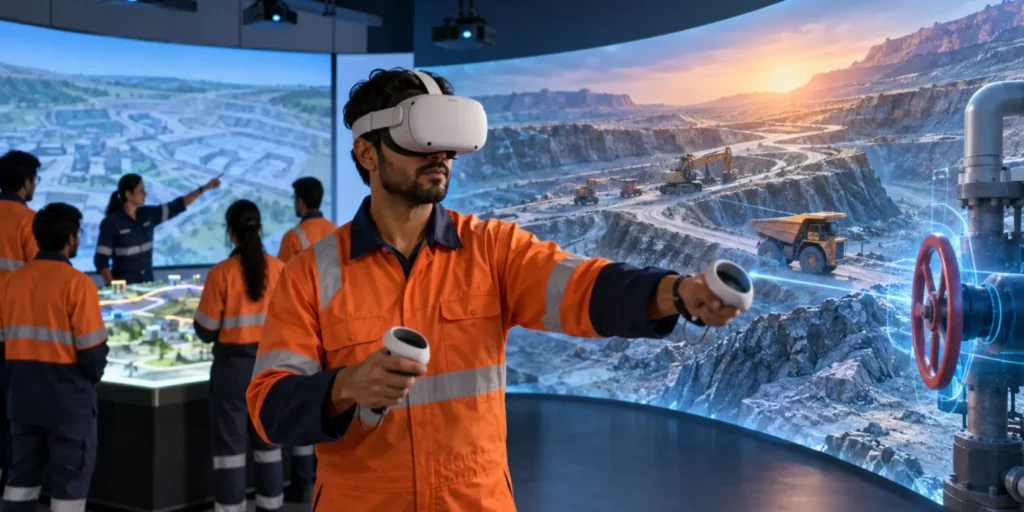
For simulation-based learning, we delivered the Adani Centre of Excellence, a photorealistic mining education environment with interactive topic demonstrations, plus a VR simulator where students practise drilling and blasting safely.
For large-scale visualisation, our holographic digital twin of Noida International Airport lets planners examine infrastructure on an interactive 3D display. We operate as one immersive experience company with immersive design studio capability, engineering and content in one team, which is what point two of the checklist demands.
If you are scoring vendors right now, send us your brief through our contact page. We respond within 24 hours with a proposal mapped against all ten checklist points, including the ones that cost us margin.
The Bottom Line
Choosing an immersive experience company in India is a verification exercise. Score vendors on delivered evidence, in-house capability, measurement and post-launch support. Discount the demo. The right partner will welcome that level of scrutiny, and the wrong one will resist it.
Frequently Asked Questions
What does an immersive experience company do?
An immersive experience company plans, designs, builds and operates interactive environments such as experience centres, VR training, expo activations and 3D digital platforms. One team covers spatial design, software engineering, content production and visitor analytics.
How is an immersive experience agency different from an event agency?
An event agency manages staging, logistics and rentals for a fixed date. An immersive experience agency designs custom interactive content and technology built to run permanently, measures visitor behaviour and supports the installation after launch.
How much does it cost to hire an immersive technology company in India?
Costs depend on scope. Event activations, VR training modules and permanent centres occupy separate price bands driven by content volume, hardware grade and integration depth. Ask any immersive technology company for line item pricing before you sign.
What should we check in an immersive design studio portfolio?
Look past the finished visuals. Confirm the immersive design studio designed and engineered the work itself, ask which parts were subcontracted, and request one client reference you can call directly.
How long does a typical project take?
Discovery and concept run 3 to 6 weeks, design and development 8 to 16 weeks, and installation with testing 2 to 4 weeks. Permanent centres take longer than single event activations.