Three Problems a Training Room Cannot Solve
Industrial training carries three problems that no classroom can fix:
- Rare, severe events: a gas leak or a misfire may happen once in a career, and nobody can stage one for practice
- Workforce churn: contractor crews rotate every few months, so induction repeats and standards drift between sites
- Language: one plant can run in two or three languages. A slide deck in one of them trains a fraction of the crew
The International Labour Organization estimates that nearly three million workers die every year from work-related accidents and diseases. Asia and the Pacific accounts for 63 percent of that total because of the size of its workforce.
Immersive learning addresses all three problems at once, and we consider it the biggest change in industrial training in a decade.
Three Formats of Immersive Learning, and the Job Each One Does
We match each format to a learning job.
VR simulation for individual procedure practice
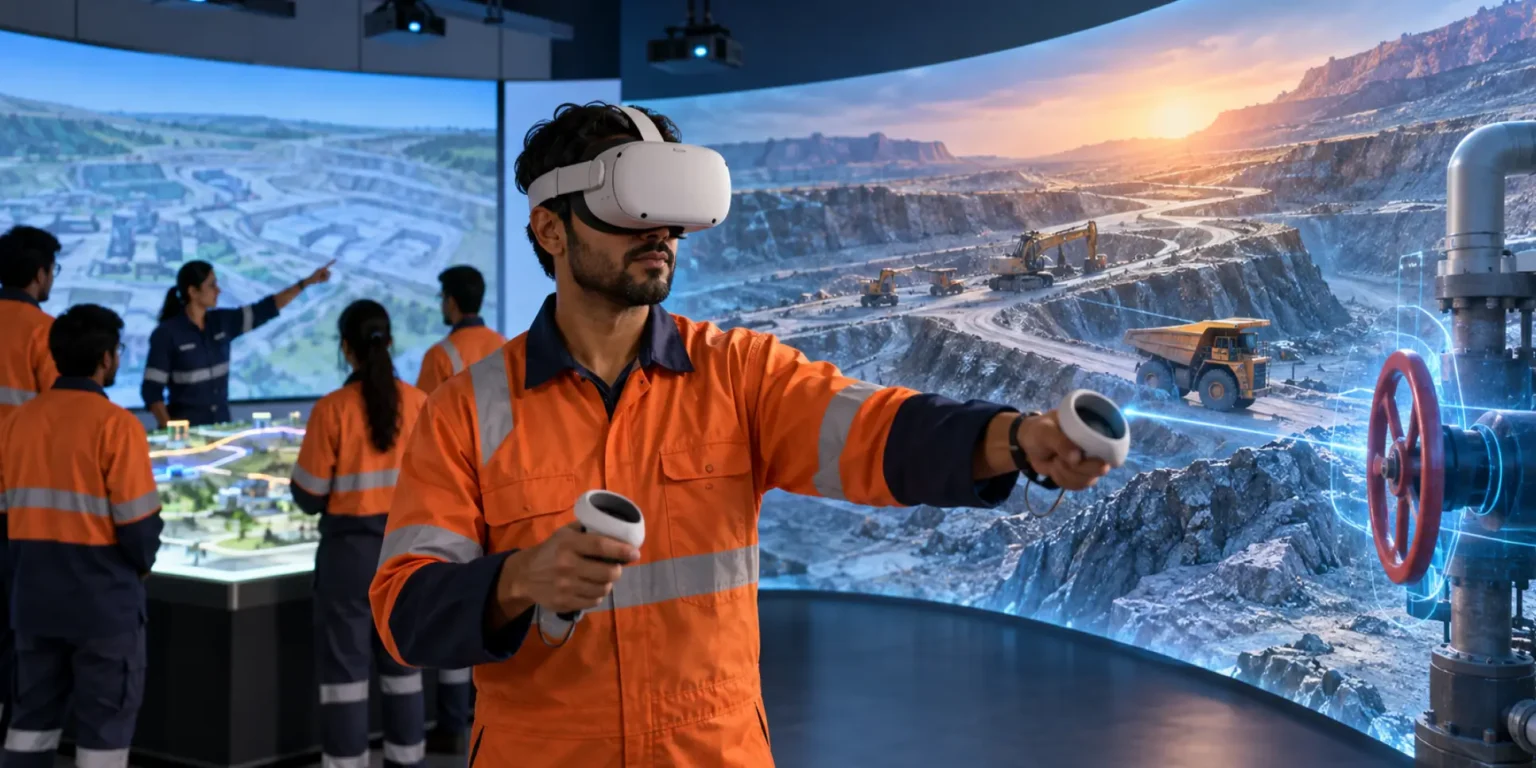
One worker, one headset, one task performed step by step. This is the core format for VR workforce training on blasting, isolation and emergency response. The worker acts instead of watching, which is why the benefits and ROI of VR training are strongest for physical, repeatable, high-risk tasks.
Phygital learning for group orientation
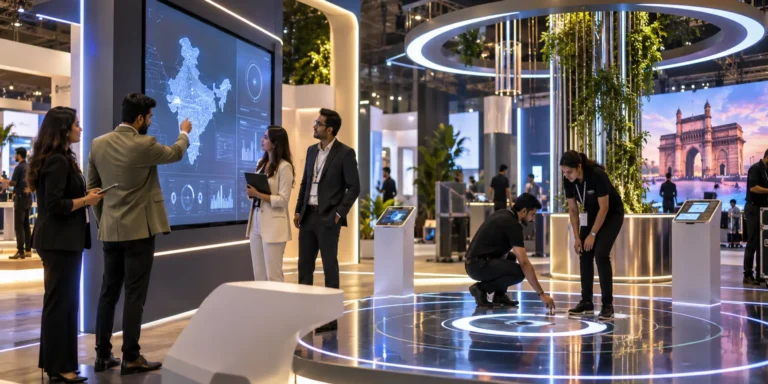
Phygital learning combines a physical space with synchronized digital content. A projected wall, a tabletop map and a narrated sequence take a full batch of trainees through a site’s layout, hazards and workflow before anyone puts on a headset. We use it for inductions and briefings.
Stereoscopic 3D environments for scale
The depth of an open pit or the length of a longwall face cannot be understood on a monitor. A curved 3D projection places a group inside that scale. In mining simulation training, it explains why a rule exists before the VR module teaches how to follow it.
Immersive, Experiential, Simulation: Which Word Means What
- Experiential learning: learning by doing, followed by reflection, in any setting including a live site
- Simulation: a model of a task or system, with or without a sense of presence
- Immersive learning: experiential learning inside an environment that creates presence and responds to the learner. VR workforce training is one format within it
In our view, only immersive learning gives workers experiential practice on tasks too dangerous to attempt for real.
Inside the Adani Centre of Excellence: Three Systems, Zero Live-Site Exposure
For the Adani Centre of Excellence at IIT (ISM) Dhanbad, Adani Group needed to train future mining professionals in drilling, blasting and excavation without access to a live mine. It also needed to present its Smart, Safe and Sustainable mining approach. With Futurotec, we designed three interconnected systems for one shared space.
What we built
- VR mining simulation training: an end-to-end module for drilling, blasting and excavation, optimised for Meta Quest 3, with bilingual voice-overs and real mine footage
- Phygital learning space: a synchronized dual-projection system with a tabletop map that delivers a seven-scene narrative on the collaboration
- Immersive 3D environment: a curved stereoscopic projection, mapped across multiple projectors, that places groups inside large-scale mine environments
What the numbers say
- 3 immersive systems: deployed as one unified project
- 3 core workflows: drilling, blasting and excavation in one VR environment
- 2 languages: Hindi and English, so every user trains in a language they know
- 100 percent safe operations training: zero live-site access required for students
Our lesson from this project: mining simulation training works best as an ecosystem. The phygital narrative explains the why, the 3D environment shows the scale, and the VR module drills the how. None of the three alone would have met the brief.
What Changes for the Three People Who Sign Off on Training
Immersive learning gives each decision maker a different result.
For L&D heads: a repeatable, measurable curriculum
The World Economic Forum’s Future of Jobs Report 2025 projects that 59 out of every 100 workers will need reskilling or upskilling by 2030. VR workforce training delivers one module to every learner at every site, and the system records each action. Competency evidence replaces attendance records.
For EHS heads: rehearsal for events that cannot be staged
Workers rehearse an emergency before one occurs. Repetition builds hazard recognition speed and procedural memory. We covered these mechanisms in our guide to VR safety training in high-hazard industries.
For plant and operations heads: no downtime for practice
No machine is taken offline for training, new hires reach productive work sooner, and every site trains to one standard on a digital twin of its own layout.
Making Immersive Learning Part of the Operating Model
A pilot that sits outside the training system fails. We build every VR workforce training programme to plug into the way the plant already runs:
- Competency scoring: every action is logged and scored, and a pass can gate hazardous task authorisation
- LMS integration and compliance reporting: completion and scores flow into the existing LMS. Our simulation-based learning offering includes both by default
- Adaptive difficulty and AI scenario variation: scenarios grow harder over time, and variation stops learners memorising one fixed sequence
- Language coverage: every module ships in the languages the workforce speaks
Experienced workers reject a simulation that does not match their equipment within the first minute, so we build to the site. Our virtual reality development process starts with site footage, real procedures and the plant’s own permit formats.
When Immersive Learning Is the Wrong Choice
We turn down work when the format does not fit the task. Skip immersive learning when:
- The content is knowledge only: a policy update needs a document, not a simulation
- The group is small and the risk is low: a classroom costs less
- Final dexterity sign-off is the goal: certification on real equipment stays in place
- The procedure changes monthly: the simulation would date faster than you could update it
The Adani Model, Applied to Your Site
The three-system model we delivered for the Adani Centre of Excellence scales down. Most industrial teams start with one VR module for their highest-severity task, add a phygital learning space for induction batches, and expand once the competency data supports it. We have delivered more than 100 immersive projects over ten years at a 96 percent success rate. To see a mining simulation training module or a phygital induction space in operation, book a demo with our team. We will map the first scenario against your site’s incident data.
What Industrial Leaders Should Take From This
Immersive learning has moved from pilot to standard practice because it solves the three problems a training room cannot: rare events, workforce churn and language. The format matters as much as the technology. VR drills procedure, phygital learning orients groups and 3D environments teach scale. Pick one high-severity task, build it to your site, measure competence, then expand. Teams doing this now run safer, more consistent operations than teams still relying on slides.
FAQs
What is immersive learning?
A training method in which a learner performs realistic tasks inside a simulated or technology-enhanced environment that responds to their actions. Industrial formats include VR simulation, phygital learning spaces and stereoscopic 3D environments.
What is an example of immersive learning in industry?
The Adani Centre of Excellence is one. Trainees practise drilling, blasting and excavation in a VR mining simulation training module, in Hindi or English, with zero access to a live mine.
What is phygital learning?
Phygital learning combines a physical space with synchronized digital content, such as a projected wall paired with a tabletop map. It is used for group inductions before individual VR practice.
How is immersive learning different from experiential learning?
Experiential learning is learning by doing in any setting. Immersive learning adds an environment that creates presence and responds to the learner, which makes it usable for tasks too dangerous to practise for real.
What does VR workforce training measure?
Completion, time to competence, each action, errors and time at each step. Scores feed the LMS and can gate hazardous task authorisation.
Does immersive learning replace hands-on certification?
No. It prepares workers and produces competency evidence. Final certification on physical equipment stays in place.