What Museum Exhibit Design Has to Protect Before It Can Persuade
Museum exhibit design is the planning of objects, text, media, light and space so a visitor understands one clear story while every object stays within its safe limits for light, climate and handling. Curation decides what is true. Conservation decides what is safe. Exhibit design decides what the visitor sees and from how close.
A strong story needs the object bright, close and open to view. Safe display needs it dim, distanced and behind glass. The wider museum design process still applies; this article covers the point in museum exhibit design where the two meet.
The Four Conflicts Every Exhibit Brief Leaves Out
Museum exhibit design briefs list story goals and conservation limits on separate pages, so the conflicts appear only when drawings start. We name all four in the first meeting.
Light Against Legibility: Fix the Lux Ceiling First
Light damage is permanent, so the exhibit design team receives light limits before the storyline:
- Textiles, paper, photographs and dyed leather: 50 lux and about 150,000 lux hours a year; silk, newsprint and early photographs only 15,000
- Oil and tempera paintings, wood, lacquer, bone and ivory: about 200 lux
- Stone, metal, ceramic and glass: 300 lux, no practical annual limit
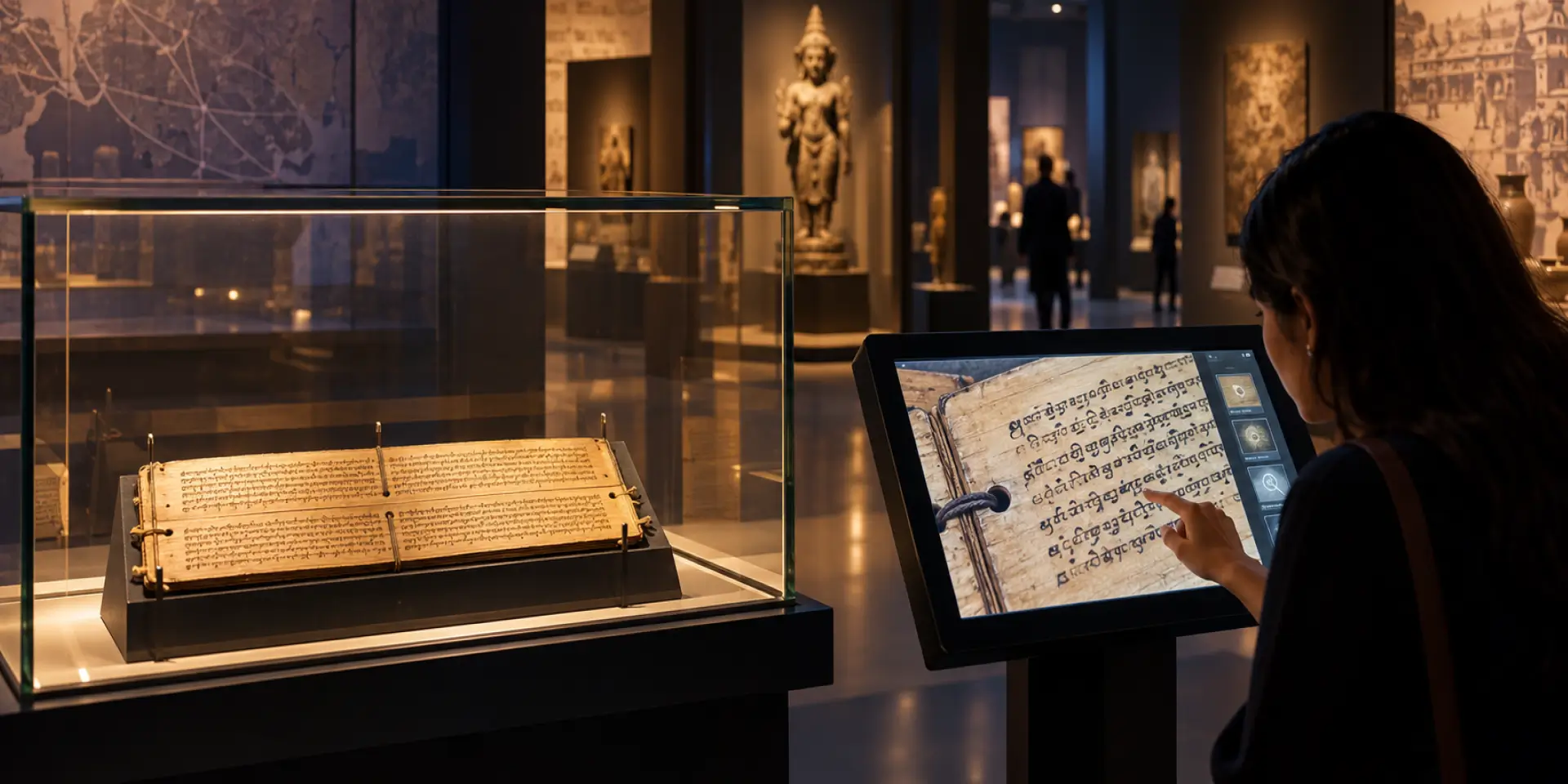
A 50 lux room looks dark, so we lower the ambient level, raise graphic contrast, and add a screen beside the case that magnifies the object ten times. The visitor sees more; the object receives no extra light.
Proximity Against Protection: Let the Screen Do the Zooming
Visitors lean in. Glass, a 60 cm rail and low-reflection glazing keep them safe and also flatten the object. AR interpretation of collections and touch magnification restore the detail with no hand near the object, and gallery design places that detail on the route away from the case.
Immersion Against the Microclimate: Every Screen Is a Heat Source
LED walls, projectors and media players warm the air around them, and a nearby case loses stability. In museum exhibit design we hold 40 to 60 percent relative humidity and 16 to 25°C, with no more than a 10 percent swing in 24 hours, and keep active media out of the airflow that feeds sensitive cases.
Participation Against Handling: Actions That Never Touch the Object
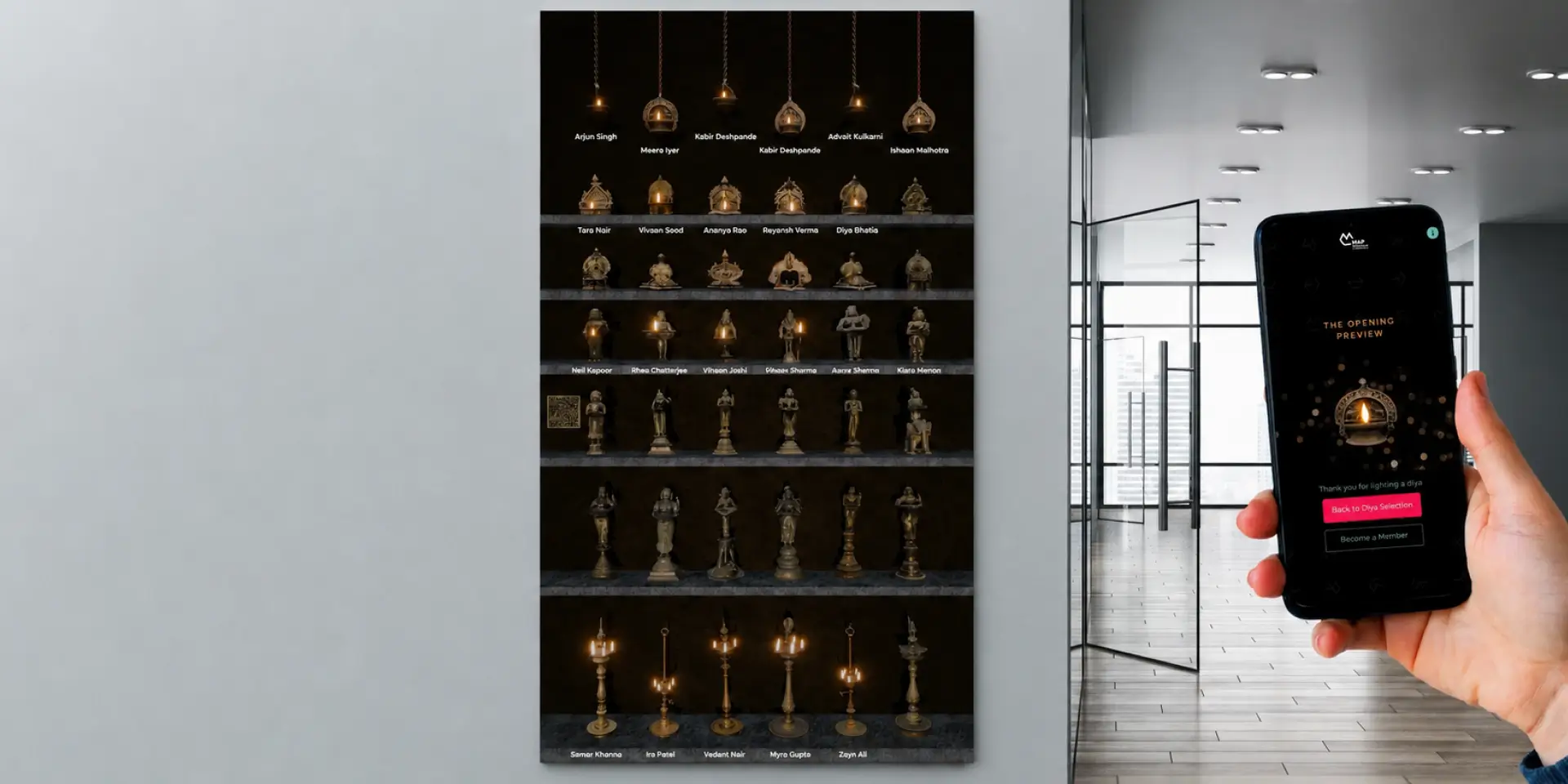
Participation holds attention longer than any label, and it usually means touching. A traditional lamp-lighting ceremony brings open flames into a building full of textiles, paper and photographs. For the opening of the Museum of Art & Photography (MAP) we rebuilt that ritual as a virtual diya ceremony: guests lit a flame from a phone browser and saw it appear on six 86-inch LED screens. More than 15,000 lamps have been lit, the installation is now permanent, and no object was touched.
Exhibition Content Design: A Silk Textile Gets Five Weeks a Year
Exhibition content design decides what each zone says, which object carries each message, and how much text a visitor reads. Conservation limits shape it more than most museum exhibit design teams expect: at 50 lux for eight hours a day, a silk textile uses its 15,000 lux hour annual budget in about five weeks.
Our exhibition content design rules:
- One message per zone, in one plain sentence: every object and screen supports it
- Layered text: introductions under 150 words, section text under 100, object labels under 50
- Rotation in the script: a fragile object’s label and its digital surrogate are drafted together
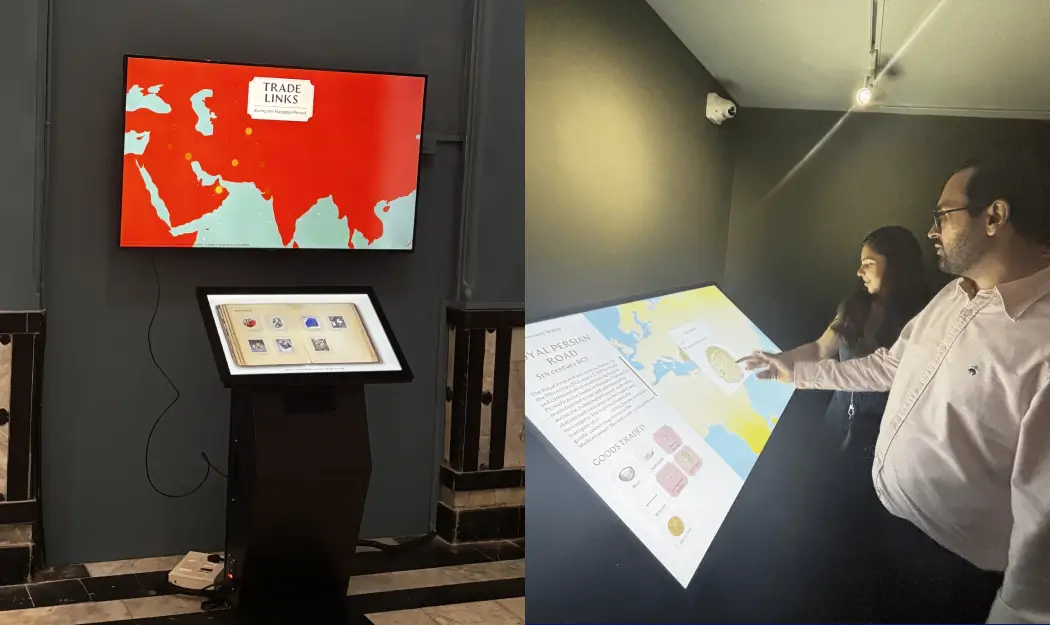
At Chhatrapati Shivaji Maharaj Vastu Sangrahalaya (CSMVS), the Networks of the Past exhibition gathered more than 250 artefacts from 14 museums in six countries. Our four interactive installations carried the context, from an LED table tracing trade routes to a tablet kiosk decoding the three scripts of a digital Rosetta Stone, while the artefacts stayed at conservation light levels.
Borrowed Objects: When the Lender’s Conditions Set Your Gallery Design
A loan agreement is a museum exhibit design document. Lenders specify lux, humidity, case type, security and sometimes position. With several lenders, the strictest condition sets the whole gallery design, because objects share air and light. Our rules:
- Facility report first: we read every lender’s conditions before the first floor plan
- Zone by environmental class: gallery design groups objects that share limits in one room with one climate setting
- Design to the strictest lender: one manuscript at 50 lux sets the ambient level for its zone
Original, Replica or Digital Twin: The Rule We Apply
The choice in museum exhibit design follows a fixed order:
- Original: when it meets its light and climate budget for the full run and authenticity matters
- Replica: when touch, weight or scale is the point, labelled as a replica
- Digital twin: when detail, interior or context cannot be seen in the object; it interprets while the original rests
3D scanning and digital twins record an object once and serve every future visitor without a second handling.
Honesty with visitors is part of the rule. The revised ICOM Code of Ethics for Museums, adopted in June 2026, asks museum leaders to weigh the benefits of digital technologies and ensure they cause no harm. Our test for every surrogate: it protects the object, and the visitor knows what it is.
Gallery Design for Humid Months, Power Cuts and Dust
Most published museum exhibit design standards assume a temperate climate and constant air conditioning. Many galleries we work in have neither for part of the year: coastal humidity stays above 70 percent for months, the level at which mould begins, and power cuts remove climate control without warning. Our gallery design rules:
- Cases off exterior walls and out of direct sun: walls drive the largest temperature swings
- Sealed cases with conditioned silica gel for organic material: a tight case buffers the object through a day-long outage
- Backup power for case climate units ahead of media: a dark screen recovers, a damp manuscript does not
We check every plan against the Canadian Conservation Institute’s ten agents of deterioration, from physical forces and water to pests, light and dissociation.
Who Holds the Veto in Museum Exhibit Design?
Balance fails when nobody owns the trade-off. Our sign-off matrix, with the conservator’s veto absolute within its row:
| Role | Decides | Holds the veto on |
| Curator | Story, objects, accuracy | Unsupported claims |
| Conservator | Light, climate, mounts, handling, rotation | Conditions outside object limits |
| Exhibit designer | Space, sightlines, media | A broken visitor route |
| Director or trust head | Budget, risk, opening date | Showing the original at all |
Every other disagreement goes to the director with a cost attached.
The Exhibit Planning Checklist We Bring to First Meetings
Every museum exhibit design project we take on starts with four questions:
- Facility report: does one exist, and has the conservator checked the object list against it?
- Strictest limit: which object sets the lowest light and humidity ceiling, and which zone holds it?
- Heat: where will screens and projectors sit, and how far from the nearest sensitive case?
- Surrogates: which replicas or digital twins are planned, and how is each labelled?
We work through these in zone-by-zone story and content design before any technology is chosen. The record behind our museum exhibit design method: four installations at CSMVS that made more than 250 artefacts easier to read, an installation at MAP made permanent after 15,000 lamps, and 92 percent client satisfaction across more than 100 projects.
If a new gallery, a loan exhibition or a refresh is on your calendar, send us a short note about your collection and we will return the full checklist with a written view of where your story and objects will conflict.
The Standard a Good Exhibit Has to Meet
Museum exhibit design succeeds when a visitor leaves with one story they can retell and the condition report reads the same on closing day as on opening day. Both come from decisions made before the first drawing: the lux ceiling, the climate band, the exhibition content design rules, the surrogate rule, the loan conditions and the veto. Set them early, and the two goals no longer conflict.
Frequently Asked Questions
What light level is safe in museum exhibit design for textiles and manuscripts?
50 lux for textiles, paper, photographs and dyed leather, about 150,000 lux hours a year. Silk, newsprint and early photographs get 15,000 lux hours, roughly five weeks at 50 lux.
How does exhibition content design differ from exhibit design?
Exhibition content design decides what each zone says, which object carries each message and how much text appears. Exhibit design decides how that content sits in space.
How much does a museum exhibit design project cost?
Floor area, the number of conservation-grade cases, climate control and the depth of the digital layer drive the cost. Cases and climate usually form the largest share.