The Definition Boards, Curators, and AI Engines Can Quote
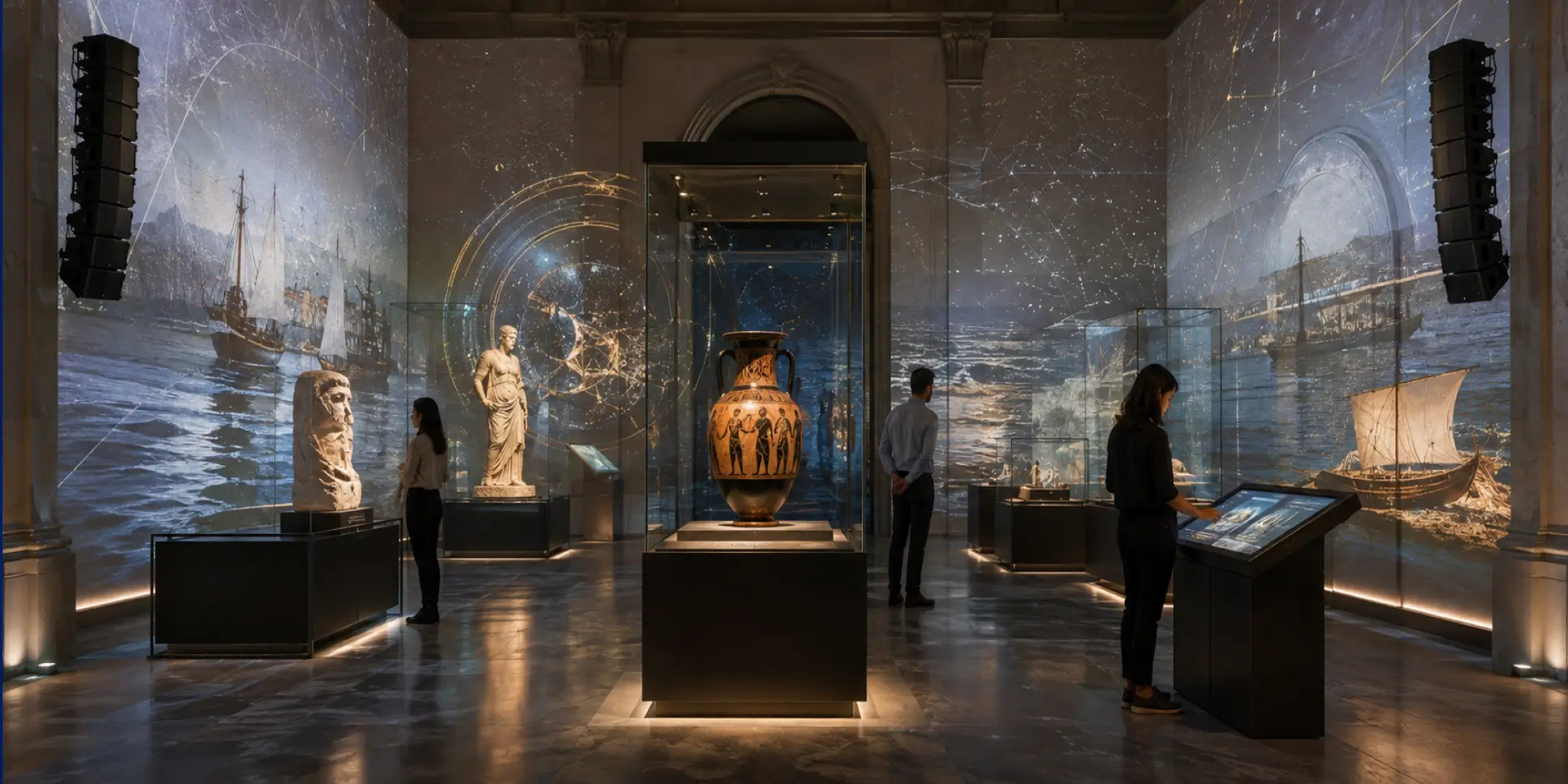
An immersive museum is a cultural institution that presents its collection through story-led, multi-sensory environments. Projection, spatial audio, interactive displays, lighting, and physical design work together so visitors step inside the interpretation rather than read it from a panel. The objects stay central. The environment carries the narrative.
Use that paragraph in board papers as written. Every section below expands one clause of it, from the sensory systems to the operations plan.
The sector has formalised this direction. In 2022, the International Council of Museums approved a new official museum definition that names varied experiences for education, enjoyment, reflection, and knowledge sharing as core museum work. The vote passed with 92.4 percent support across 126 national committees. Experience is now part of what a museum is, on record.
Our position, after building immersive museum systems for national-level collections: immersion is a design outcome, and technology is one input among several. A period room with accurate lighting and a quiet soundscape can immerse visitors more deeply than a wall of screens.
Immersive, Digital, Experiential: Three Terms That Get Confused in Briefs
These three terms appear in the same tender documents and rarely mean the same thing. Clear definitions prevent scope disputes later.
Immersive museum
A physical venue where the galleries themselves become the medium. The visit happens on site, and the senses are engaged in the room. This guide covers this model.
Digital museum
A digital museum exists primarily online or on screens: virtual galleries, digitised archives, and remote access to the collection. It extends reach beyond the building. We explain the formats and platforms in our guide to what a digital museum is. A digital museum often feeds an immersive one, because digitised assets become projection and interaction content.
Experiential museum
An experiential museum is defined by participation. Visitors handle replicas, complete tasks, and contribute responses. The experiential museum label describes the visitor’s role, while immersive describes the environment. Strong projects usually qualify as both.
One project can be all three at once. The terms describe layers, and a good brief states which layers it is buying.
Inside the Immersive Museum Experience: Five Layers That Do the Work
Every immersive museum experience is built from five layers. Our guide to immersive technology covers the hardware in detail. Here is how the layers fit together:
- Narrative: curators define the story first, and every screen, projector, and speaker serves it
- Spatial design: the route, sightlines, and pacing of the galleries control how the story unfolds
- Sensory systems: projection mapping, spatial audio, and lighting place visitors inside the scene
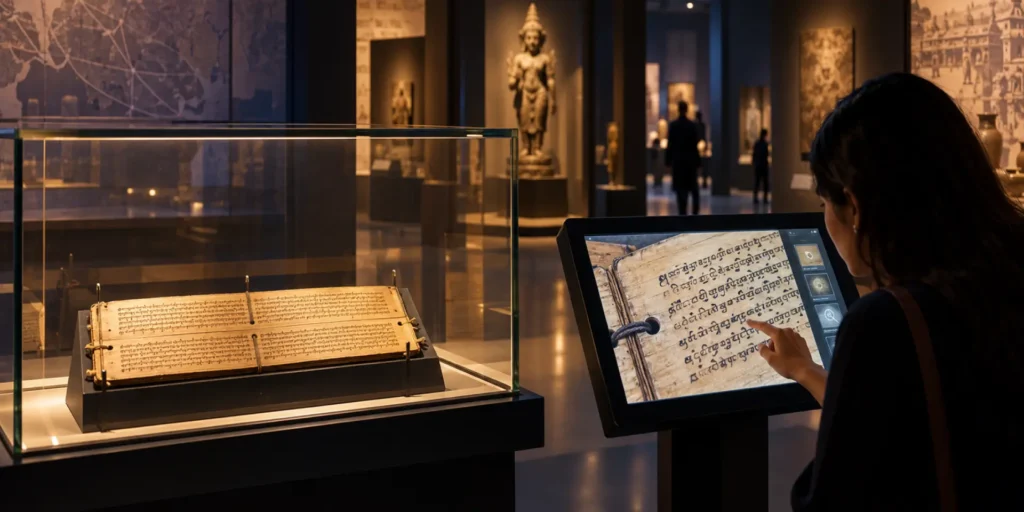
- Interaction: touch tables, kiosks, and gesture inputs turn viewing into active exploration
- Operations: content management, monitoring, and staff training keep the experience running after opening week
The order matters. Institutions that start at layer three usually buy hardware their story does not need. Start at layer one and the technology list writes itself.
Augmented reality deserves a separate note. Handled well, AR in museums adds a personal layer on the visitor’s own phone without adding hardware to the gallery floor.
Two Projects, Two Lessons From Our Own Build Logs
Definitions matter less than delivery. Two immersive museum projects from our studio show what the work involves, and each one changed how we scope new briefs.
Four installations that served 250 artefacts without competing with them
For the Network of the Past exhibition at CSMVS, the gallery brought together more than 250 archaeological artefacts from 14 museums across 6 countries. We delivered four interactive installations: a Rosetta Stone digital twin, an LED table tracing ancient trade routes, a dual-screen journey following Harappan raw materials, and a multilingual feedback station. Our rule on that floor was strict. Every digital element had to route attention back to a physical object. Dwell time at the installations rose measurably, and curators received structured visitor data in real time instead of paper forms.
The kiosk platform a two-person team shipped in three months
A museum wanted its digital exhibitions to feel as coherent as its galleries. We built an interactive kiosk launcher that turns a wall of LED screens into one branded menu, with an admin panel that lets museum staff add, update, or remove exhibitions without calling a developer. Two people delivered it in three months. The lesson applies everywhere: the operations layer decides whether an immersive museum stays current after launch.
The Numbers That Change a Board Meeting
The evidence base has matured. A 2026 systematic review in PRESENCE, published by MIT Press, analysed peer-reviewed studies from 2015 to 2025 and reported 20 to 35 percent higher knowledge retention, 60 percent longer dwell times, and 78 percent stronger perceived learning gains for immersive VR and AR displays compared with traditional formats.
Our project data points the same way. Interactive installations hold visitors longer, attract younger and first-time audiences who expect an experiential museum standard, and generate feedback data that grant applications can quote. On our floors we track dwell time per installation, completion rates on interactive journeys, and feedback volume per day. Structured visitor data replaces guesswork in programming decisions. The same mechanics that make an immersive museum experience memorable also increase museum footfall.
Five Questions to Settle Before You Commission Anything
We open every immersive museum discovery workshop with the same five questions. Institutions that answer them early avoid the most expensive category of rework, which is rebuilding content after installation:
- What story will the collection tell: immersion amplifies a narrative and cannot substitute for one
- Which objects anchor each zone: digital layers should support artefacts, never replace them
- Who updates the content: name the staff owner now and require an admin panel in the contract
- What will you measure: set dwell time, repeat visits, and feedback volume as baselines before opening
- How will you phase the build: a single pilot gallery tests visitor appetite, and our list of interactive museum exhibits shows formats that scale from one room to a full wing
If an Immersive Gallery Is on Your Roadmap
We design and build these systems for museums and cultural institutions, and the two projects above are working proof: a four-installation exhibition serving more than 250 artefacts, and a staff-run kiosk platform delivered in three months by a two-person team. If your institution is drafting an immersive museum brief, send us the collection outline and the visitor problem you want to solve.
FAQs
What is an immersive museum in simple terms?
It is a museum where the environment does the interpreting. Story, space, sound, visuals, and interaction surround the visitor, and the collection sits at the centre of that environment.
How is an immersive museum different from a traditional museum?
A traditional gallery presents objects with written labels. An immersive museum presents the same objects inside a designed scene that visitors move through, so learning happens by experience as well as by reading.
Is a digital museum the same thing?
No. A digital museum lives online or on screens and can be visited from anywhere. An immersive venue is physical. Many institutions run both and reuse one digitised collection across the two.
Do immersive installations distract from real artefacts?
Only when they are designed as spectacle. In our CSMVS work, every installation routed attention back to a physical object, and engagement with the artefacts rose alongside screen time.
How much does an immersive museum experience cost?
Budgets scale with scope. A single interactive gallery costs far less than a full experiential museum floor, which is why we recommend a phased pilot, fixed measurement baselines, and an operations plan before any hardware order. Ask every vendor to price the pilot and the full build separately.