12 Interactive Museum Exhibits That Keep Visitors Engaged
Each of these interactive museum exhibits stands on its own, and most work well together. We have ordered them from simple to advanced, so you can start with one format and expand as budget allows.
1. Touch Walls That Put the Whole Collection Within Reach
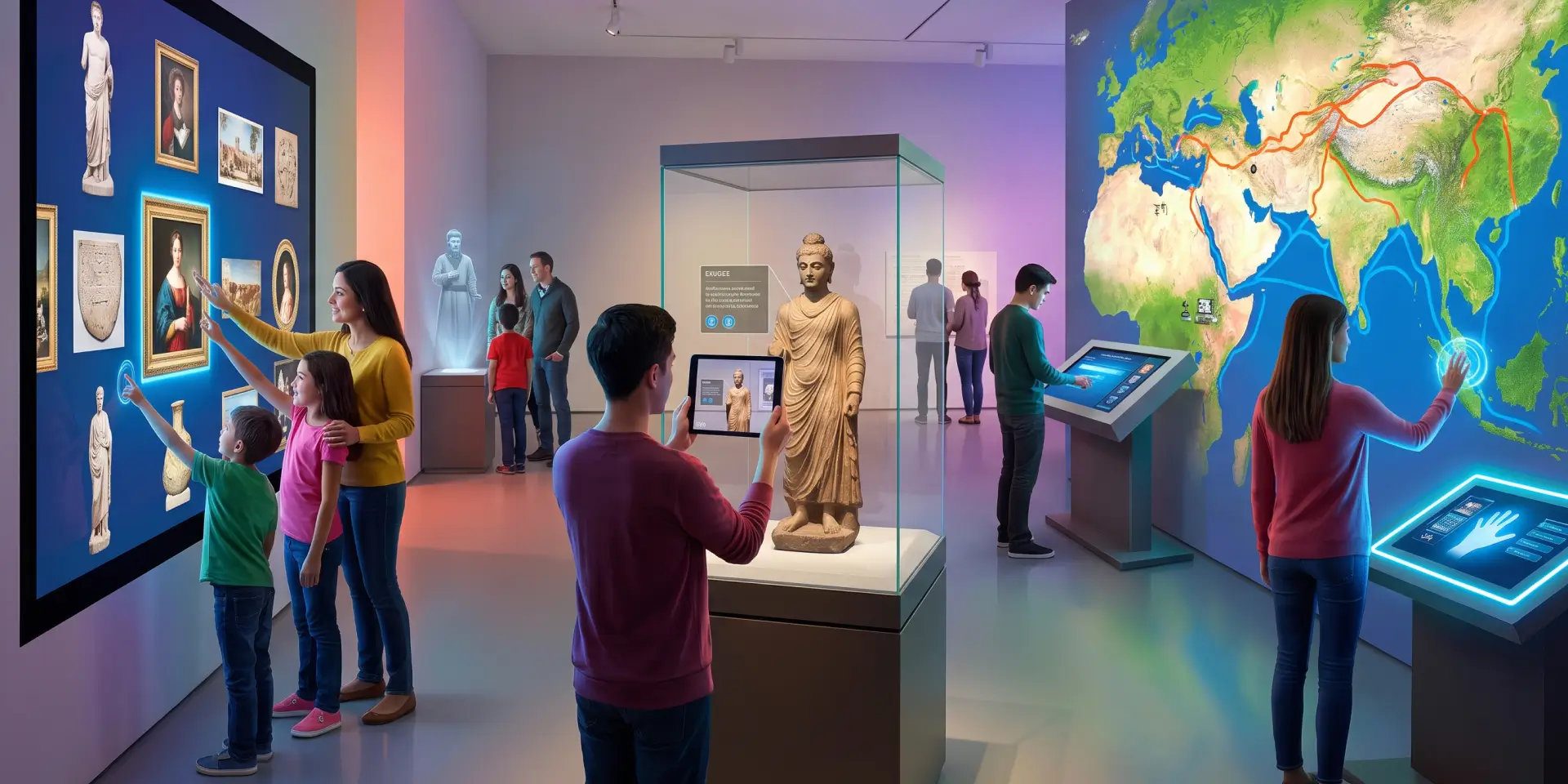
A touch wall shows your full collection on one large surface. Visitors zoom into a painting, read its story, and build a personal tour in a few taps. These hands-on displays suit entrances and busy galleries, because several people can use them at once. The Museum of Art & Photography in Bengaluru runs a 40-foot interactive wall that shows its artworks in real time and lets guests create their own routes.
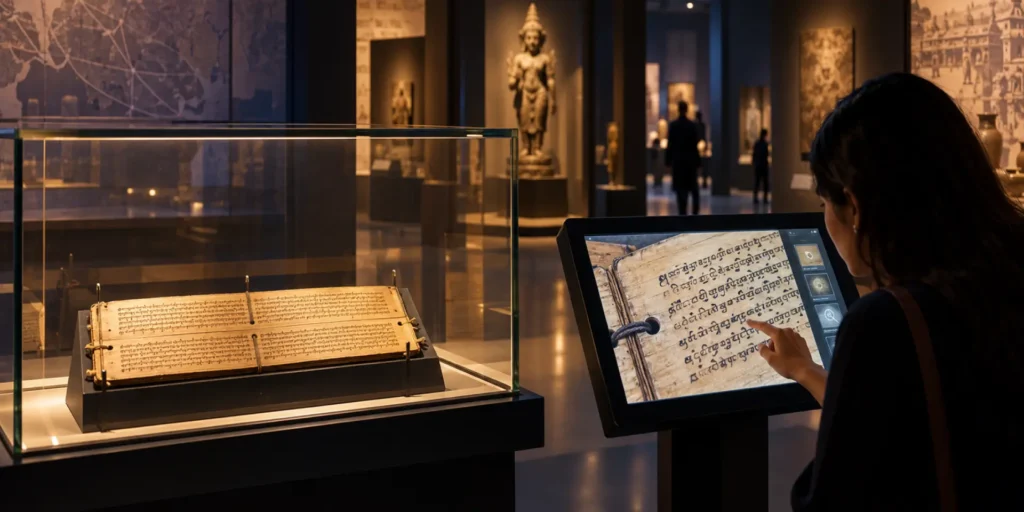
2. Digital Twins That Let Visitors Decode a Single Object
A digital twin turns one object into a station of its own. Visitors tap parts of a high-resolution model and unlock the meaning behind each detail. We built a digital twin of the Rosetta Stone for the CSMVS “Networks of the Past” exhibition, where visitors tap the Hieroglyphic, Demotic, and Ancient Greek scripts to see how each one was read. This format also makes dense history clear for students and first-time visitors.
3. Interactive Maps That Show Where History Traveled
An interactive map shows movement that a fixed panel cannot. Visitors trace trade routes, migrations, or supply chains and see how distant places connect. For the same CSMVS gallery, we built a Global Trade Links table on a large LED surface, where guests follow routes such as the Silk Road and link each one back to the artefacts on display. A map like this is one of the most engaging hands-on displays for history, archaeology, and natural science collections.
4. Synchronized Screens That Carry One Story Across a Room
Synchronized screens move a single story across several displays at once. An action on a small kiosk triggers a change on a large wall screen, so a group watches the same sequence together. Our Harappan installation for CSMVS traced raw materials such as carnelian and lapis lazuli from their source to distant workshops. Setups like this reward visitors who stay to watch, which raises dwell time.
5. Augmented Reality That Adds Context to the Real Object
Augmented reality places digital content over the real world through a phone or tablet. Point a device at an artefact and see it labelled, animated, or shown in its original setting. The object stays at the center, and the digital layer sits around it. The choice among AR, virtual reality, and mixed reality depends on the goal, a topic we cover in our overview of immersive technology.
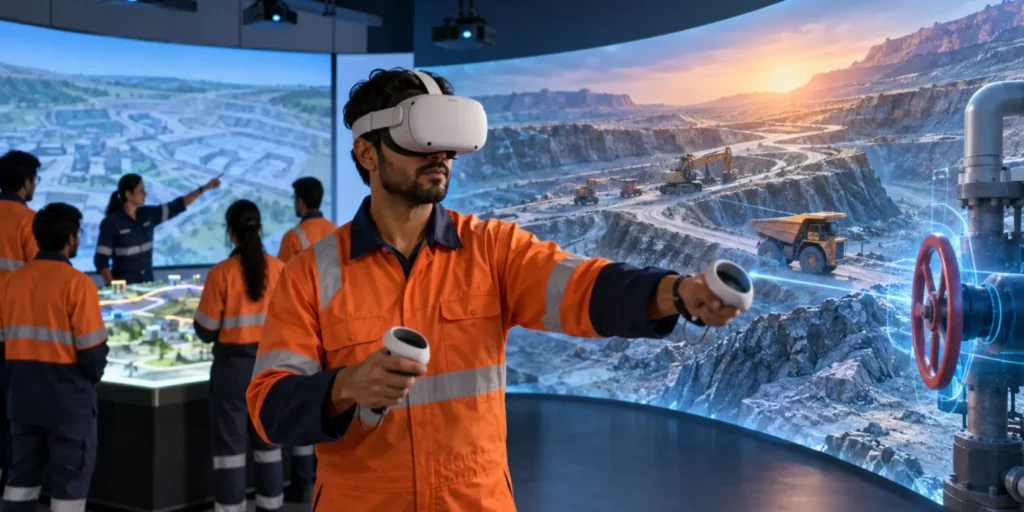
6. Virtual Reality That Rebuilds What No Longer Stands
Virtual reality replaces the room with a place. Visitors put on a headset and stand inside a building, a landscape, or an event that no longer exists. VR fits heritage sites where the original structure is gone. We used this approach for a government tourism immersive centre that recreated a historic site with LiDAR scanning and VR. Keep each session short so queues stay manageable.
7. Holograms That Bring Figures and Objects to Life
A hologram shows a three-dimensional image that visitors can walk around. Museums use holograms to show how a tool worked, how an extinct animal moved, or how a historic figure spoke. The effect draws a crowd and needs no wearable device. Holograms perform best in a darker, dedicated area so the image stays sharp.
8. Projection Mapping That Turns a Plain Wall Into a Scene
Projection mapping projects video onto walls, floors, ceilings, or objects. It can add motion and light to a static gallery or wrap a whole room in one scene. This is one of the most flexible pieces of museum technology, because you can refresh the content without rebuilding the space. Projection mapping is one of the installations we build for immersive experience centres.
9. Motion and Gesture Displays That React to a Wave
Motion and gesture displays respond to movement instead of touch. A visitor waves a hand or steps closer, and the content reacts. These interactive exhibits stay hygienic because no one touches a surface, and they invite play from people of all ages. Sensors also help visitors with limited mobility take part.
10. Games and Quizzes That Reward Curiosity
Games turn passive looking into active problem-solving. A short quiz, a matching task, or a build-your-own challenge gives visitors a goal and a small reward. In the CSMVS project we added a “Draw the Hieroglyph” game, so younger visitors could copy ancient symbols by hand on a screen. Games are among the most shared interactive exhibits, because people compare scores and photos.
11. Feedback Stations That Turn Comments Into Usable Data
A feedback station works as a display and a research tool. Visitors answer a short, friendly prompt on a screen before they leave. We replaced paper feedback forms at CSMVS with a multilingual digital station that records responses in real time. Curators then read clear, structured data instead of sorting a box of paper slips. Support for several languages also makes these hands-on displays welcoming to international guests.
12. Visitor Analytics That Show What Actually Works
Analytics tell you which interactive exhibits earn attention and which ones people skip. Sensors and software log dwell time, taps, and traffic flow across the gallery. That data shows where to place a display, when to refresh content, and how to plan the next room. Analytics are the least visible museum technology in a gallery, and often the most useful. We treat measuring engagement as part of the build, and we report it the way we would for any brand experience centre.
Start With One Idea, Then Grow
You do not need all twelve ideas at launch. A single touch wall or one well-placed game can lift engagement right away. Match the format to your collection and your budget, measure how visitors respond, and add the next piece from there. Strong interactive museum exhibits share three traits:
- They are easy to use without instructions.
- They add to the object rather than pull focus from it.
- They are simple to update as your programming changes.
How We Build These Exhibits for Museums
We design and build interactive museum exhibits from first concept to installed gallery. The CSMVS “Networks of the Past” project shows what that looks like in numbers:
- 250-plus artefacts from 14 museums across 6 countries, made accessible through four digital installations.
- Three ancient scripts decoded by visitors at a single kiosk.
- Paper feedback forms replaced by real-time data for curators.
- Measurably longer time spent at every digital touchpoint.
Our team plans the visitor journey, produces the content for every screen, and supports the museum technology after launch. We do this work across museums and cultural institutions, where interactive exhibits sit at the center of the visit.
The Takeaway for Directors and Curators
Interactive museum exhibits earn attention because they give visitors a role. The right mix of hands-on displays, sound, and screen-based museum technology turns one visit into a longer, more useful one, and it gives your team real data to plan the next exhibition. Choose one idea, measure the response, and build from there. The collection is why people arrive. Interactive exhibits are how you hold their attention.
FAQs
What are interactive museum exhibits?
Interactive museum exhibits are displays that respond to a visitor’s actions. Instead of only reading a label, people touch a screen, move to trigger a scene, play a game, or explore an object in three dimensions.
How do interactive exhibits raise visitor engagement?
Interactive exhibits raise engagement by giving visitors a task and a choice. Active participation holds attention longer than passive viewing, so people stay longer, remember more, and are more likely to return and recommend the visit.
Which museum technology suits a smaller budget?
For a smaller budget, start with one touch wall, a quiz, or another set of hands-on displays before adding advanced museum technology such as holograms or virtual reality. These simpler formats cost less, are easy to maintain, and update quickly.