Why Museum Footfall Stalls Even When Marketing Spend Rises
Museum footfall recovered across the sector after the pandemic, but the recovery has a ceiling. Sector wide visitor data from the Museums Association showed visits climbing sharply year on year while still trailing pre pandemic levels. The audience did not vanish. Their expectations changed. Analysts track this as museum attendance. Front of house teams call it footfall. Both count the same thing: people through the door.
Three patterns appear in almost every gallery we audit:
- The experience gap: visitors raised on interactive media walk past static display cases without stopping, and label text alone rarely holds them
- Single visit behaviour: museum visitor numbers plateau when nothing changes between visits, because nobody needs a second trip
- Silent exits: gate counts and paper forms record how many people came, never why the rest stayed away
Marketing multiplies whatever the building offers. If the offer is static, extra promotion produces smaller returns each year. To attract museum visitors sustainably, fix the experience first.
The Footfall Flywheel: How One Good Installation Feeds the Next Visit
Every successful plan to increase museum footfall follows the same loop. We describe it to boards as a flywheel with four stages:
- Attract: an immersive installation gives press, schools, and social feeds something concrete to talk about
- Engage: hands on interaction lifts dwell time and deepens museum engagement beyond label reading
- Capture: digital touchpoints record what visitors do, choose, and say in real time
- Return: that data shapes fresh programming, which gives past visitors a reason to come back
Each turn of the loop compounds. This is the operating model behind our work for museums and cultural institutions, where interactive exhibits, visitor analytics, and AR interpretation of collections run as one connected system built to attract museum visitors long after opening week.
A Six Step Framework to Increase Museum Footfall
We follow this sequence on every deployment. Each step produces the evidence the next step needs.
Step 1: Map Your Attention Gaps First
Walk the galleries as a visitor would. Note where people pause for under thirty seconds and which rooms they skip entirely. These attention gaps are your candidate sites. Rank them by the importance of the artefact and the depth of current neglect. The output is a shortlist of two or three locations where immersive technology can change visitor behaviour in a measurable way.
Step 2: Pilot One Gallery Before You Commit the Building
Start with a single funded pilot, a fixed budget, and a ninety day evaluation window. A contained scope keeps procurement simple and gives trustees a clean decision point. Pilots often stall between concept and launch, a failure pattern we broke down in our guide to virtual reality development. Treat the pilot as the business case for phase two and scope it around proof.
Step 3: Design Around the Artefact
Technology should interpret the collection and stay subordinate to it. Screens face the object. Content answers the questions a wall label cannot. Where objects are fragile, remote, or lost, digitisation methods such as LiDAR scanning and VR reconstruction let visitors examine what glass cases keep at a distance. Bring curators into the design process from day one and give them sign off at every stage.
Step 4: Build the Data Layer Before Opening Day
Decide what you will measure before anything goes live: interactions per hour, average session length, completion rates, and structured visitor feedback. Replace paper forms with a multilingual digital station. This becomes your museum engagement baseline. Without a baseline there is no before and after, and the before and after is what secures the next budget.
Step 5: Give Visitors a Documented Reason to Return
Rotate content each season, add gamified layers for school groups, and announce what changed. Peer reviewed research on immersive experiences in museum tourism found that higher levels of immersion raise a visitor’s intention to repeat the experience. Repeat intent is the leading indicator of museum footfall growth. Write seasonal content refreshes into the vendor contract so the installation stays a reason to visit.
Step 6: Measure, Publish, and Scale What Worked
Compare the pilot gallery against your baseline after ninety days. Report dwell time, museum engagement scores, and school booking changes to trustees and local press. Published results attract partners and grant bodies, and they justify the next phase of your museum footfall plan. Then extend the system to the next attention gap on your shortlist.
Before and After: What Changed When CSMVS Went Interactive
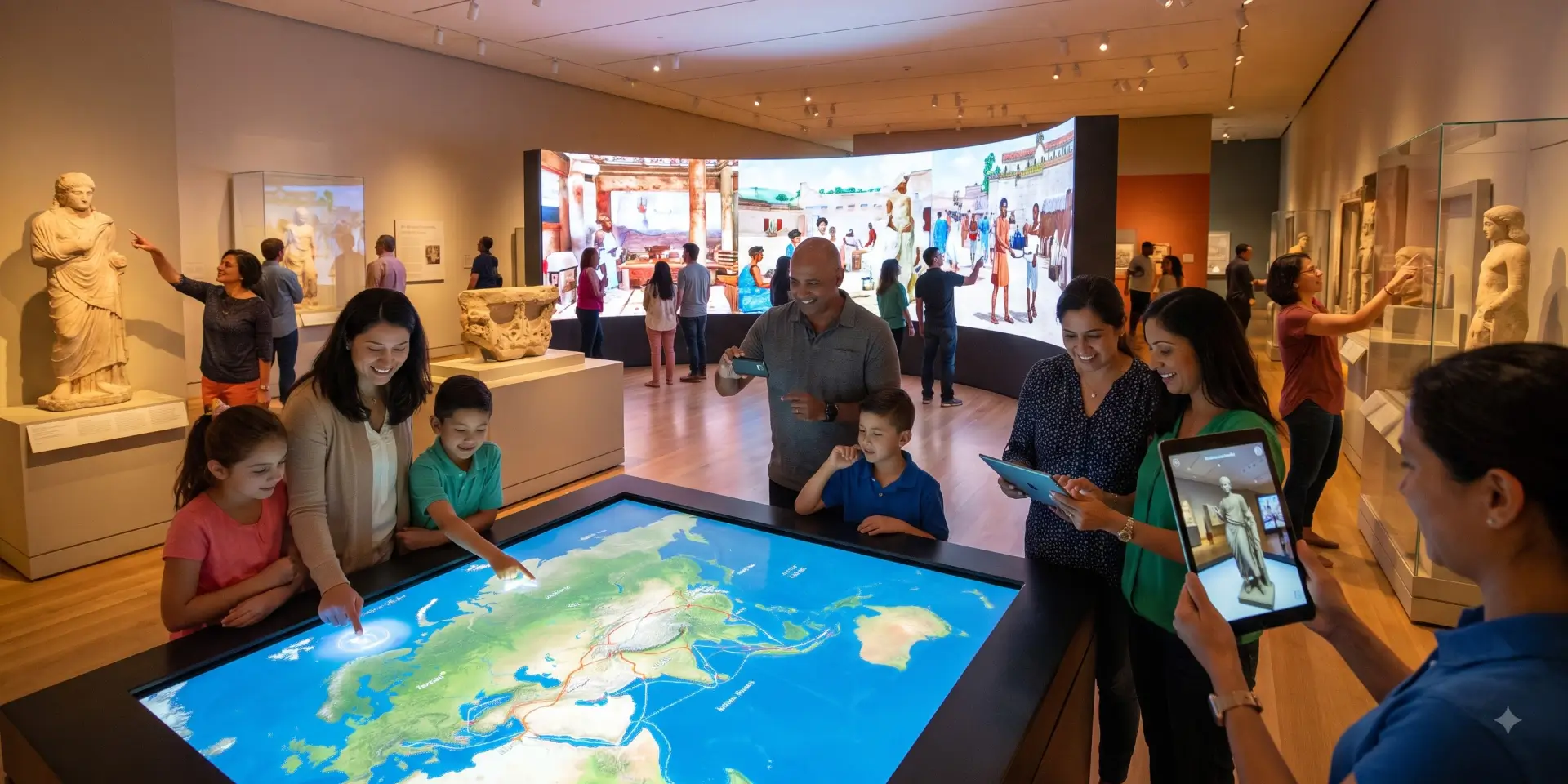
Numbers persuade better than adjectives, so here is a deployment we can describe first hand. For the Networks of the Past exhibition at CSMVS, the landmark museum in Mumbai, we built four interactive installations around more than 250 artefacts loaned by 14 museums across 6 countries.
- Static panels became participation: visitors now trace ancient trade routes on an interactive LED map table and decode three ancient scripts on a Rosetta Stone digital twin
- Passive viewing became measurable engagement: dwell time at the digital touchpoints rose measurably compared with the adjacent static displays
- Paper forms became live curatorial data: a multilingual feedback station replaced manual collection and now delivers structured visitor insight in real time
- Dense archaeology became self directed learning: a gamified draw the hieroglyph activity turned younger visitors and school groups into active participants
The pattern repeats across projects. Museum engagement rises first. Museum visitor numbers follow, because engaged visitors talk, post, and bring other people back with them.
The Three Objections Every Director Raises, Answered
Every serious conversation about how to increase museum footfall reaches the same three concerns. Here is how we answer them:
- Budget: a building wide transformation is unnecessary, because a phased rollout that starts with one installation from our immersive experience offerings fits annual budget cycles and proves value before scale
- Heritage sensitivity: the artefact remains the focus, since a well designed digital layer carries the interpretation while conservation standards govern light, placement, and housing
- Maintenance: specify uptime targets, staff training, and content update cycles in the contract, because an installation that fails quietly in month six costs more than it ever returned
Where ViitorX Fits Into Your Footfall Plan
ViitorX is an immersive experience studio. We have delivered interactive installations for museums, heritage bodies, and large public infrastructure programmes, and the CSMVS deployment described above ran from curatorial alignment through fabrication, installation, and data handover.
Teams drafting next year’s exhibition plan can request the footfall strategy checklist we use on live projects. It covers attention gap audits, pilot scoping, and the exact metrics trustees ask for. Tell us which gallery you would pilot first. That single answer usually shapes the entire plan, and it costs nothing to share.
Conclusion
You increase museum footfall by giving people an experience worth describing to someone else. Audit your attention gaps, pilot one gallery, design around the artefact, capture data from day one, refresh the content, and publish the results. Marketing then has something real to promote. Museum visitor numbers respond to what the building offers, and immersive technology is currently the most dependable way to attract museum visitors and keep them. Start with one room. Measure everything. Let the results argue for the rest.
FAQs
How can we attract museum visitors without a large marketing budget?
Invest in one shareable installation. Visitors, teachers, and local media handle the amplification. Earned coverage of a new experience outperforms paid reach for most cultural institutions.
Does immersive technology increase museum visitor numbers?
Yes, when it is measured and refreshed. Immersive technology lifts dwell time and repeat intent first. Footfall follows through word of mouth, school bookings, and press coverage. A single static gadget does not produce the same effect.
How do we measure museum engagement?
Track session length, interactions per visitor, completion rates, and structured feedback from digital stations. Compare every result against a baseline gallery so the change is provable.
How long does it take to increase museum footfall this way?
Plan a ninety-day pilot, then expect six to twelve months of compounding growth as content rotates, school programmes book in, and word spreads.