The Footfall Trap Sitting Behind Every Monument Ticket Counter
The same dataset breaks the pattern down site by site. Taj Mahal footfall climbed 31.27 percent while revenue rose 1.48 percent. Qutub Minar footfall jumped 45.1 percent against an 18 percent revenue gain. Humayun’s Tomb gained 16.6 percent more visitors and lost 29.8 percent of its ticket income.
Three forces produce that result.
- Daytime capacity is fixed: conservation limits keep lowering the ceiling on how many people a site can hold.
- Entry pricing is politically sensitive: raising domestic ticket rates invites objection, so revenue per head stays flat.
- The higher-yield segment is shrinking: foreign visits fell 16.03 percent, from 27.56 lakh to 23.15 lakh.
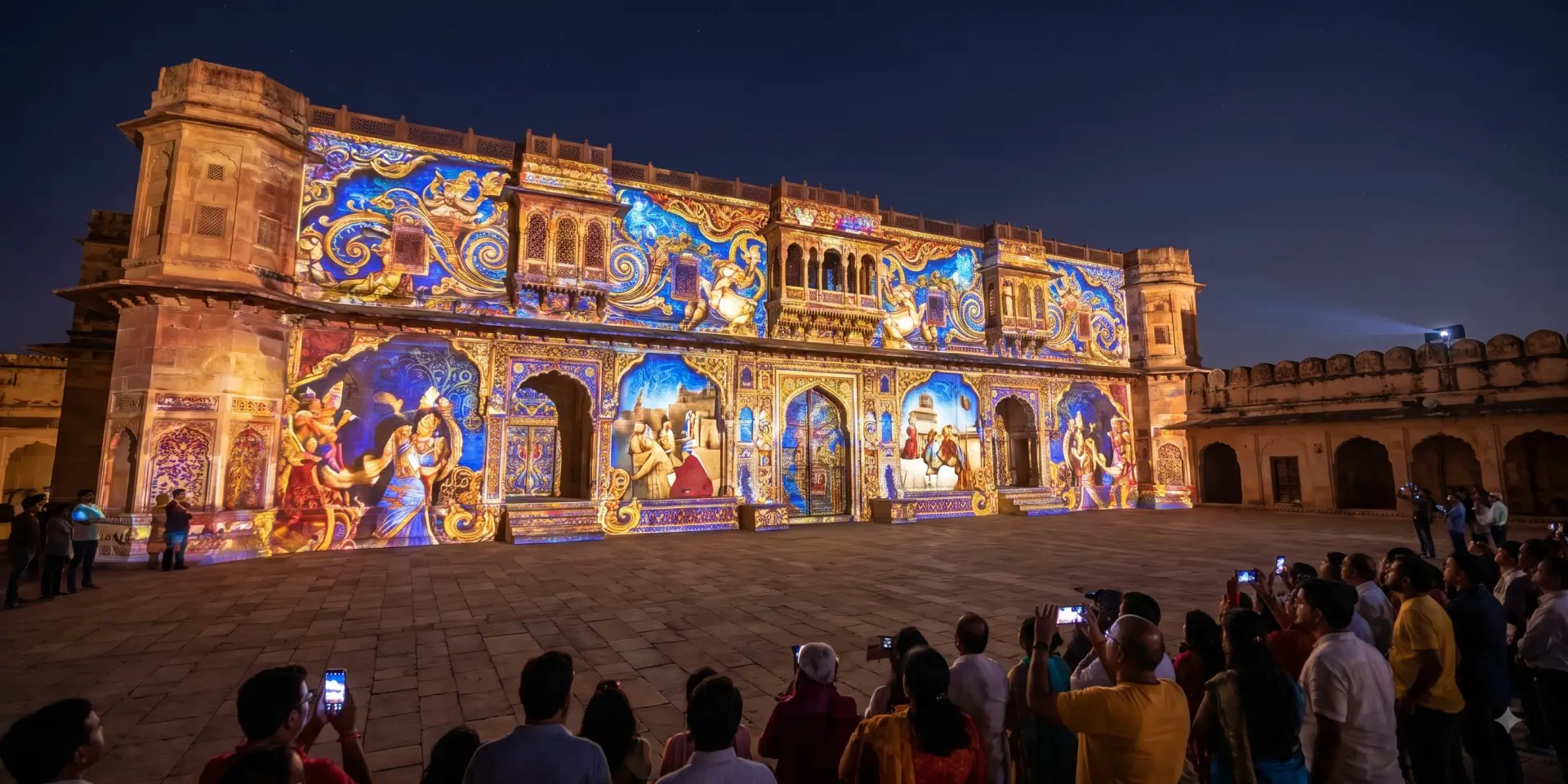
An evening show changes the arithmetic. It sells a second window on the same asset after daytime traffic clears. This is why projection mapping for monuments now enters state planning as infrastructure rather than an event. Our work across government heritage and tourism usually begins with a revenue brief, not a creative one.
Why Light Is the Only Thing You Can Safely Add to a Protected Wall
Building near a centrally protected monument is difficult by design. The first 100 metres form a prohibited zone where new construction is barred. The next 200 metres form a regulated zone requiring a No Objection Certificate, applied for through a mandatory online portal since 1 July 2025.
That rules out most physical attractions. It does not rule out light. A heritage projection show is one of very few interventions that satisfies the conservation rule and the revenue need together.
Monument projection mapping places no load on a historic surface. No anchors, no drilling, no permanent alteration. Switch the projectors off and the site returns to its original condition. Reversibility is what carries these schemes through conservation review, and it is why light-based interpretation now sits beside the off-site immersive centre model in state planning.
The Permission File Decides Your Timeline, Not the Projector Order
Most delays we see are documentary. A board approves a budget, shortlists a vendor, then finds the assessment work should have started nine months earlier.
Heritage authorities evaluate interventions through impact assessment. The joint framework issued by UNESCO with ICOMOS, ICCROM and IUCN, the Guidance and Toolkit for Impact Assessments in a World Heritage Context, sets out the method. The Committee has requested assessments at 148 properties across six years. Projection mapping for monuments scores well against it, because a reversible installation answers what reviewers ask.
What reviewers ask to see
- Equipment positions on a survey drawing: every projector, speaker, cable route and control cabin against zone boundaries.
- Non-contact structural evidence: towers free-standing or ballasted, with nothing fixed into historic material.
- Measured thermal and radiation load: values recorded at the surface, not manufacturer averages.
- A written reversal method: how the installation comes out and the ground goes back.
- Crowd and egress planning: capacity, exit routes and emergency lighting independent of the show.
Assembling this file early shortens approval. Assembling it late stops the project.
Inside a Heritage Projection Show: Four Things That Must Be Right
A heritage projection show fails in predictable places. These are the four we check on every survey.
The scan
Content is only as accurate as the geometry beneath it. A laser or photogrammetric survey produces the mesh visuals attach to. Guesswork here shows up as soft edges on carved stone.
The script
Heritage content carries a factual duty. We work from material supplied by site historians and archaeologists, then build the visual treatment around it. Sequences that invent history damage credibility faster than weak image quality.
The optics
Surface reflectance sets brightness, not facade size. Dark basalt, weathered sandstone and wet stone absorb light very differently. Projector count and lumen output follow reflectance readings taken on site after dark.
The control layer
A permanent show needs a system that starts it, holds sync across projectors and audio, logs faults and recovers without an engineer present. Our projection-mapped installations and show systems are specified around that from the first drawing.
The Light Discipline Clause Most Tenders Forget
Brightness is a compliance variable. International practice sorts sites into environmental zones from E0, intrinsically dark, to E4, high district brightness. The lighting zone framework based on CIE 150:2017 sets the spill limits for each.
Several heritage and wildlife destinations now pursue night tourism and dark-sky programmes at once. Kaziranga began a stargazing and astro-guide initiative in January 2026 built specifically around limiting light and sound pollution. A monument projection mapping specification written without spill angles and shutter zones can put a tourism board in conflict with its own conservation commitments.
We worked within comparable limits on the Dhari Experience Centre, a forest-department-led project where wildlife sensitivity shaped every lighting and audio decision.
Seven Clauses That Separate a Working Show From an Expensive One
Tenders for a heritage projection show usually specify hardware and skip operation. Monument projection mapping runs for years, so we ask clients to add these.
- Reflectance-based brightness calculation: site-measured readings, submitted with the technical bid.
- Laser hour budget and replacement schedule: expected annual run hours, and who funds light-source replacement.
- Content refresh cycle: how often sequences change, and who owns the source project files.
- Language versions at handover: audio tracks delivered, and the price of adding more later.
- Enclosure protection rating: dust, humidity and salt-air standards set by location.
- Spares held on site: parts stocked locally rather than shipped after a failure.
- Operator training and sign-off: named site staff running the show unaccompanied before final payment.
Capital cost is the easy number. Ten-year operating cost decides whether the show still runs in year four. The same principle governs experience centre budgeting, where hardware is rarely the largest lifetime expense.
How to Read a Projection Mapping Company’s Bid
Bids from every projection mapping company look similar on paper. Three questions separate them.
Ask what the projection mapping company has surveyed, not what it has projected. Monument projection mapping rewards survey and permission experience more than a reel of finished shows.
Ask who operates the system after handover. A projection mapping company with no operations plan is proposing an event.
Ask for the fault log from a live installation. Any projection mapping company running permanent shows keeps one, and reluctance to share it is informative.
When Projection Mapping for Monuments Is the Wrong Answer
We advise against it in five situations.
- No viable throw distance: roads or buildings leave nowhere to place projectors outside restricted zones.
- Very dark or heavily textured stone: absorption pushes acceptable brightness beyond budget.
- No holding area: an audience needs somewhere safe to stand or sit, with usable exits.
- A short usable season: long monsoon periods can leave too few nights to recover cost.
- Low evening footfall: below a certain visitor base, operations cannot pay for themselves.
Two of those have a different answer. An indoor interpretation centre delivers the same story without the throw distance problem.
Year Two Is Where Most Heritage Shows Fail
Launch night is straightforward. Projection mapping for monuments usually fails in year two, once the warranty has lapsed, content has gone stale, a projector has drifted and nobody on site knows how to correct it.
Sustained operation needs three things: a content system site staff can use without a developer, engagement data showing what visitors actually watch, and a maintenance rhythm tied to run hours. We built Cuenect for that layer, managing content across connected displays and reporting engagement in real time.
Handing content control to the institution matters as much as the hardware. The drag-and-drop configurator we built for a museum’s digital gallery lets curatorial staff publish new material without writing code.
Where ViitorX Fits
Our record covers the cultural side of this work as much as the equipment. At the first G20 Culture Working Group meeting in Khajuraho in February 2023, we produced a holographic experience for the National Museum Institute in which eight repatriated artefacts, including the Parrot Lady, narrated their own history to an international delegation. That project demanded accuracy and restraint.
We have since delivered interpretation work for Chhatrapati Shivaji Maharaj Vastu Sangrahalaya (CSMVS), a state forest department, and several smart city agencies. If your team is scoping projection mapping for monuments or drafting the technical annexure for a tender, we can review site constraints, brightness assumptions, and the operating model with you. Speak to our team.