Your Room Matters More Than Your Hologram Projector
Every hologram projector shows an image made of light against a dark field. The darker the field behind the image, the more solid the image looks. No specification sheet changes that.
For museum directors and AV leads, this sets the order of decisions:
- Survey the space first: measure light, height and depth before you ask for a quote.
- Pick the format second: the room decides between a Pepper’s ghost stage, gauze, an LED fan or a holographic table.
- Choose the hardware last: the 3D hologram projector or LED source follows from the first two steps.
Stray Light Ends More Hologram Installations Than Any Hardware Fault
In our project work, stray light is the most common reason a hologram installation disappoints. Light from windows or ceiling spots lands on the backdrop, the black turns grey, and the depth is lost.
Galleries start with an advantage. The Canadian Conservation Institute describes 50 lux as the benchmark light level for museums, and that suits holographic projection well. Atriums and exhibition halls often run at several hundred lux, with daylight shifting through the day.
Measure Light at Three Points
- Backdrop: the surface directly behind the floating image.
- Image plane: the film, gauze or screen surface itself.
- Viewer eye level: the spot where visitors will stand or sit.
Take readings in the morning, at midday and during your busiest hour.
Working Light Levels by Hologram Projector Format
- Pepper’s ghost with holographic film: keep the backdrop below about 10 lux and stop all direct light from reaching the film.
- Holographic gauze: keep the area behind the gauze close to dark, with the viewer zone below about 50 lux.
- LED hologram fan: works in a lit room of a few hundred lux, but not in direct sunlight.
- Holographic table: works in normal office light if overhead fittings do not reflect in the surface.
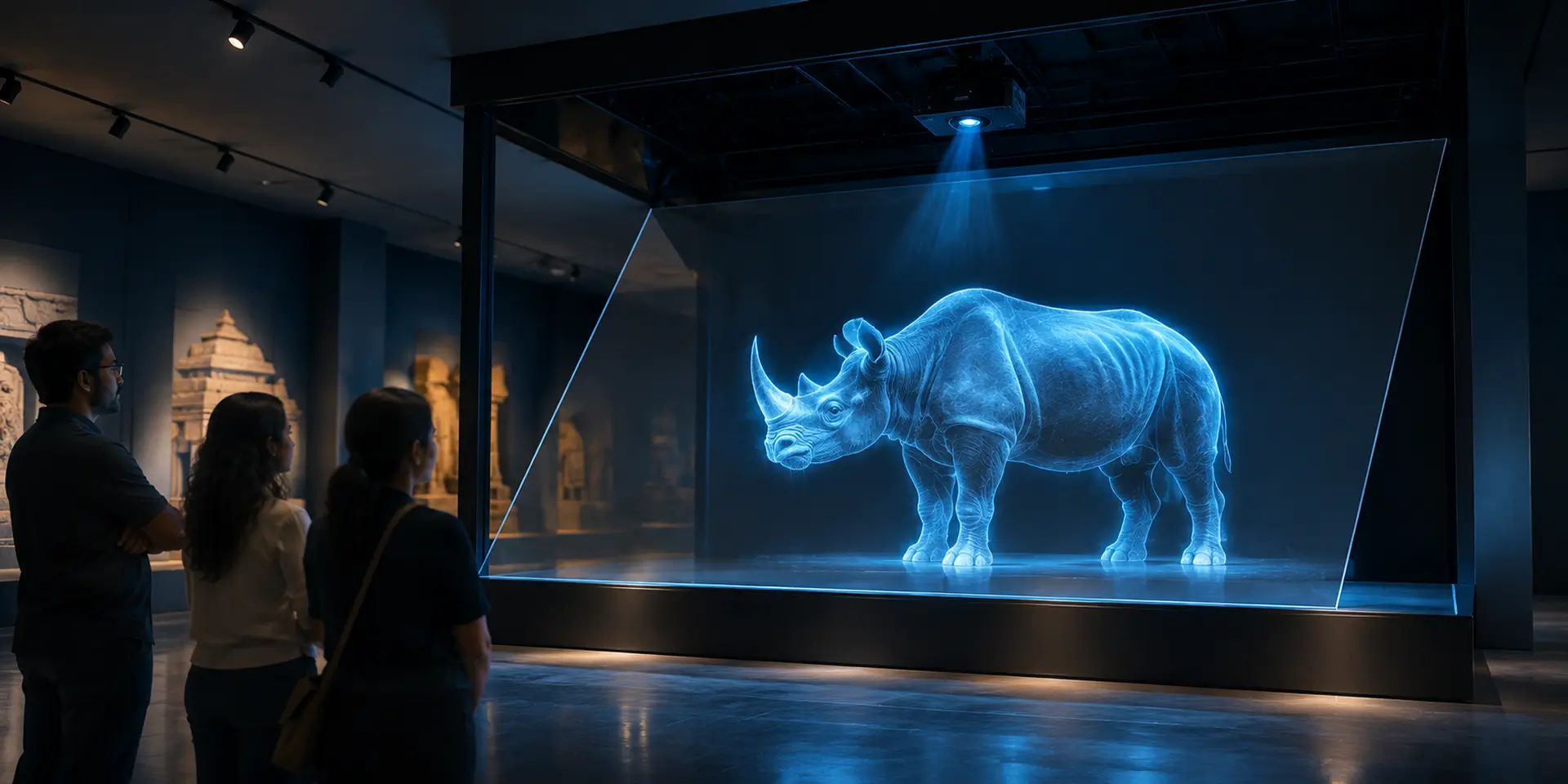
Some venues cannot be darkened. Our life-size Kaziranga rhino hologram had to perform on an open summit exhibition floor. We mastered the content for contrast and commissioned it on site.
How Much Ceiling Height Does a Hologram Projector Need?
Height is the second check. Every hologram projector format needs hardware above or below the image, and it must stay out of view.
Pepper’s Ghost Stages
The holographic film sits at 45 degrees between the audience and a bright LED source. For a life-size presenter about 1.8 m tall, plan a film around 3 m high and a clear height of 4.5 m to 5 m for rigging and masking.
Gauze and Projection Screens
Gauze hangs from a truss with the projector in front. A human-scale image needs about 4 m of clear height, plus a border to hide the truss.
Fans and Tables
Wall-mounted fans and tabletop 3D hologram projector units fit standard rooms of 2.7 m to 3 m. Allow clearance for the safety guard around fan blades.
Measure to the lowest beam, duct or sprinkler head. In heritage buildings, rigging loads can affect permissions, so our approach to museum exhibit design treats fixing points as a preservation question.
Throw Distance Fixes Where the Holographic Projector Goes
A projection-based holographic projector needs a clear line between lens and screen. The formula is simple:
Throw distance = throw ratio × image width
A 4 m wide image with a 1.2:1 lens needs the projector 4.8 m away. A 0.8:1 lens brings it to 3.2 m. Short-throw lenses save floor space but cost more.
Plan brightness and contrast together. The AV industry’s Image System Contrast Ratio standard measures contrast across the whole system, including the room’s own light. A brighter holographic projector cannot fix a backdrop that is already grey.
- Beam path: keep visitors, signage and doorways out of the line between lens and screen.
Who Sees the Illusion and Who Sees the Hardware
Every holographic projection has a viewing sweet spot. Outside it, visitors see a reflection, an edge or a projector.
- Pepper’s ghost: best within about 30 degrees either side of centre.
- Gauze: about 45 degrees either side, with brightness falling at the edges.
- Hologram fan: wide angle, but the image flattens beyond about 60 degrees off axis.
- Holographic table: viewable from all sides, looking down.
Draw Sightlines at Real Eye Levels
Standing adults see from about 1.5 m to 1.7 m. Seated delegates and wheelchair users see from about 1.1 m to 1.2 m. Draw both lines on a section drawing. Neither line should reveal the film edge, LED floor or truss. Keep viewers at least 2 m to 3 m from the image.
At the G20 Culture meeting in Khajuraho, eight repatriated artifacts appeared as holograms before international delegates. For a hologram show at that level, we draw every seat and approach path before building the stage.
Power and Heat for a Show That Runs Without an Operator
Teams often plan power in the final week, which is too late for a permanent hologram installation.
- Dedicated circuits: a large laser hologram projector can draw 1.5 kW to 2.5 kW, and LED floors and media servers add more. Keep them off circuits shared with catering or stage lighting.
- UPS and clean earth: protect the media server so a voltage dip does not stop playback.
- Heat load: give your HVAC team the total load in kW before handover.
- Scheduled start: set the system to power on, play and shut down on a timer.
Our ECHO holographic stage at the G20 summit in Goa ran unattended for the full programme in a busy, access-restricted venue. That needs power, playback and recovery designed in from day one.
The Hologram Projector Room-Readiness Checklist
Run these steps before you request a hologram projector quote. You need a tape measure, a lux meter and floor plans.
- Measure light: record lux at the backdrop, image plane and eye level, three times a day.
- Map daylight: mark windows, skylights and glass doors on the floor plan.
- Measure clear height: record floor to the lowest beam, duct or sprinkler.
- Measure depth: record the distance behind the image plane and in front of it to the first viewer.
- Mark the viewing zone: draw standing and seated sightlines on a section.
- Check power: confirm circuit capacity, earthing and space for a UPS.
- Check access: note door widths, lift sizes and rigging points for delivery.
- Define the audience: set visitors at one time and running hours per day.
If the hologram installation is part of a wider gallery upgrade, combine this list with our buyer’s checklist for interactive museum displays.
Where These Rules Were Tested in Live Venues
We built these rules over 10+ years and 100+ projects. Each holographic projection project below pushed a different limit:
- Kaziranga rhino: a life-size animal on an open summit floor with limited light control.
- G20 Goa ECHO stage: an unattended stage in a busy ministerial venue.
- G20 Khajuraho: eight heritage artifacts shown to an international delegation.
- Dholera smart city: an interactive 3D hologram of a full masterplan for decision-makers.
For museums and visitor centres, our immersive experience centre team handles the site survey, content and commissioning in-house.
For summits, launches and exhibitions, our event and brand activation team builds temporary hologram show stages.
If budget is the open question, our guide to experience centre cost shows where the money goes. Share your floor plan and three lux readings with us, and we will tell you which format your room can support.
The Bottom Line
A hologram projector performs only as well as the room around it. Control the light, confirm the height, fix the throw distance, draw the sightlines and plan the power. Complete these five checks before you buy, and your holographic projection will look the way it did in the demo.
FAQs
How dark should a room be for a hologram projector?
For Pepper’s ghost and gauze formats, keep the backdrop below about 10 lux. LED fans tolerate brighter rooms but not direct sunlight.
What ceiling height does a hologram installation need?
Plan about 4.5 m for a life-size Pepper’s ghost stage and 4 m for gauze. A tabletop hologram projector fits a standard 2.7 m room.
Can a holographic projector work in daylight?
LED fans and some LED formats cope with bright rooms. Projection-based formats need shade or a masked enclosure.
Is a hologram projector a real hologram?
Most commercial holographic projector systems use optical methods such as Pepper’s ghost or spinning LEDs. Visitors see a floating 3D image without glasses.