What Is a 3D Hologram?
A 3D hologram is an image formed from projected light that shows real depth and perspective. The image changes as the viewer moves, the way a physical object would, and most formats need no special glasses. This depth behaviour separates a 3D hologram from a flat video or standard projection.
The term covers two things. Classic holography records the interference pattern of laser light. Modern holographic display systems render 3D content in real time and present it with depth on a stage, table or wall. Public institutions buy the second kind, because it can show anything from a scanned artifact to a full city model.
The 1947 Physics Problem That Created the Hologram
Hologram technology began as an attempt to improve the electron microscope. In 1947, Dennis Gabor found a way to record both the brightness and the phase of light. That double record is the hologram. Lasers arrived in 1960 and made it practical.
The Nobel Prize in Physics 1971 went to Gabor for the invention. His principle still runs every serious holographic display today: reconstruct the light of an object instead of painting a flat picture. When a visitor walks around a 3D hologram and the perspective shifts correctly, that is Gabor’s method working.
How a Holographic Display Works, From Scan to Stage
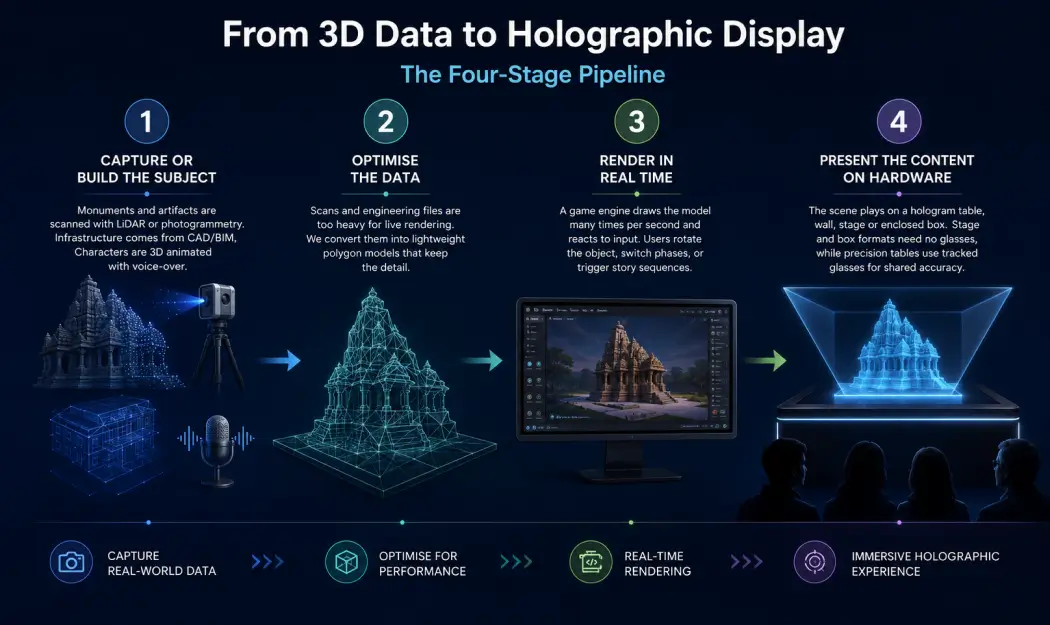
Every 3D hologram we deliver follows one four-stage pipeline.
1. Capture or build the subject
Monuments and artifacts are scanned with LiDAR or photogrammetry. Infrastructure arrives as CAD and BIM files. Characters, such as a narrating animal, are built as 3D animation with voice-over.
2. Optimise the data
Scans and engineering files are too heavy for live rendering. We convert them into lightweight polygon models that keep the detail. This stage decides whether the final image runs smoothly or stutters.
3. Render in real time
A game engine draws the model many times per second and reacts to input. Users rotate a temple, switch masterplan construction phases, or trigger a story sequence.
4. Present the content on hardware
The scene plays on a hologram table, wall, stage or enclosed box. Stage and box formats need no glasses, while precision tables use tracked glasses so reviewers share one accurate model. We match the format to the room when we design immersive experience centres around these systems.
Most ‘Holograms’ You See in Malls Are Not Holograms
The market uses one word for several systems, and the differences decide cost, audience size and lighting, so buyers should know them before tendering.
| Format | How it creates the image | Viewers at once | Typical use |
| Laser hologram | Recorded light interference on film | One or two | Security marks, archival records |
| LED hologram fan | Spinning LED blades and persistence of vision | Small groups | Retail logos, short product loops |
| Pepper’s ghost stage | Angled transparent film reflecting a bright screen | Large audiences | Concerts, summit stages |
| Hologram table or wall | Real-time 3D viewed through tracked glasses | 4 to 15 reviewers | Masterplans, design review |
| 3D holographic projection room | Projected depth content across walls and floor | Tour groups | Museums, interpretation centres |
A fan and a 3D holographic projection room solve different problems at different prices. We say this plainly, because the wrong format wastes public money.
Outdoor monument facades sit outside this list. For stone at night, projection mapping is usually the correct tool.
Four Public Projects Where a 3D Hologram Replaced the Slide Deck
Cultural diplomacy on a G20 stage
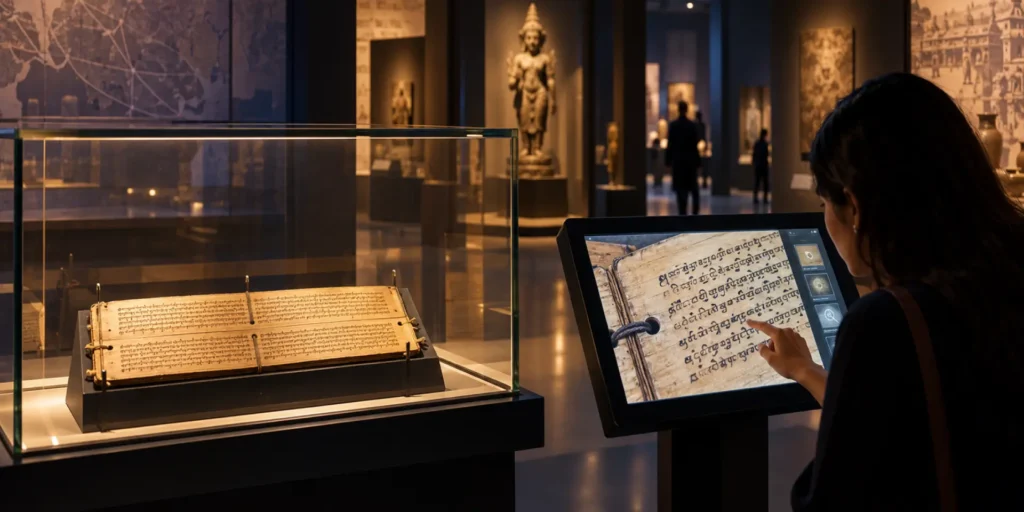
At the first G20 Culture Working Group meeting, we produced a holographic heritage experience in which eight repatriated artifacts narrated their own journeys home. The Parrot Lady of Khajuraho anchored the show, which became the venue’s most photographed spot.
A rhino that narrates its own survival story
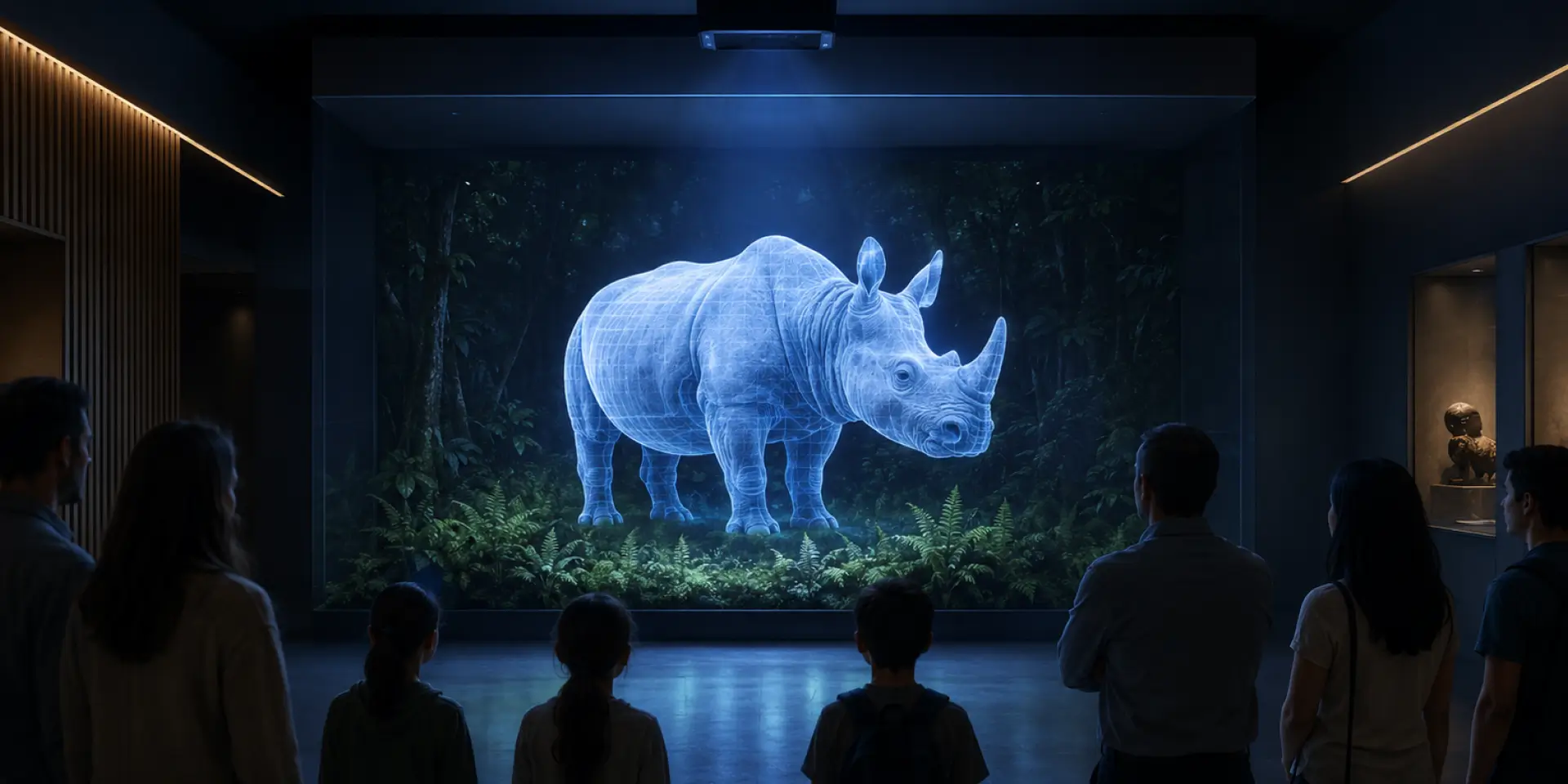
At Kaziranga National Park, we created a first-of-its-kind holographic experience in which the one-horned rhino tells its own story of survival and conservation. Visitors hear it describe the threats it outlived, and awareness turns into advocacy. It runs daily without disturbing a single animal.
Heritage bodies treat digital records as part of conservation itself. The UNESCO digital heritage programme describes this duty, and hologram technology carries those records to visitors in a form people stop to watch.
An airport masterplan checked before construction
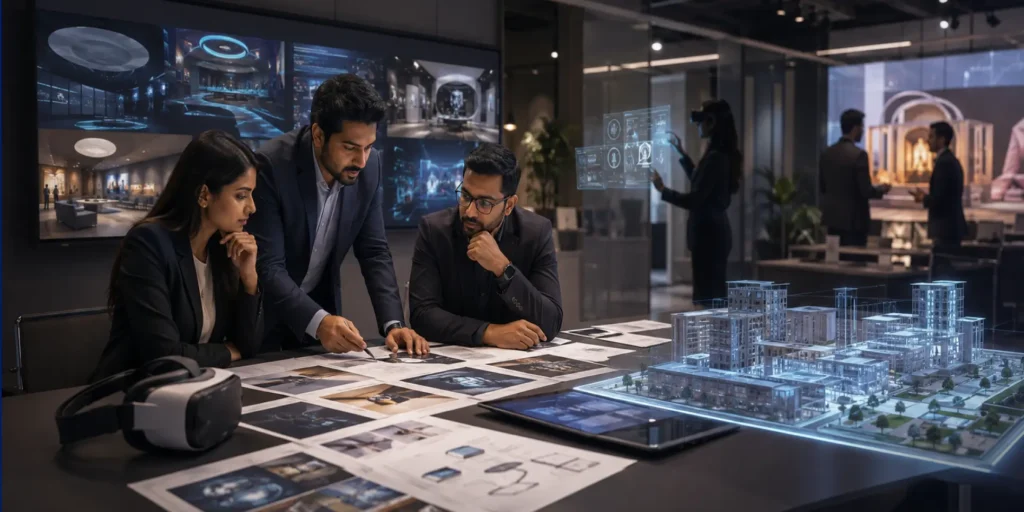
For a greenfield international airport, we engineered a holographic digital twin of the masterplan. Decision-makers reviewed construction phases in three view modes and flagged spatial errors before construction began. National leadership saw the model live at the ground-breaking.
A visitor centre that protects the monument it explains
Conservation laws restrict new construction around protected monuments. A holographic display inside an immersive centre outside the regulated zone shows the site restored, at scale, with zero contact with the original stone. Footfall grows and the structure stays untouched.
What a 3D Holographic Projection Project Involves Before Hardware Arrives
Hardware is the visible part of a 3D holographic projection. The outcome is decided earlier. We settle five questions with every government and heritage client before equipment is ordered.
- Content source: A scanned artifact, a CAD masterplan and an animated narrator need different production pipelines. Data quality limits image quality.
- Audience size: A hologram table serves a small review group, while a stage serves hundreds, and the choice changes the hardware class.
- Lighting: Every holographic display has a brightness limit. Controlled indoor light works best; bright atriums need stronger formats.
- Interactivity: Navigation, construction phases, language options and visitor-triggered stories belong in the content plan. Adding them later costs more.
- Cost structure: Content creation is usually the largest cost line, hardware second, installation and calibration third.
For museums, this planning sits best inside a wider digital museum programme, so one scan set feeds the hologram, the archive and the website.
Weighing a Hologram for Your Site? Check the Track Record First
We have spent over ten years on immersive work, with over one hundred projects delivered and a 96 percent success rate across government, museum and corporate clients. That record includes a 3D hologram showcase at a G20 summit, a rhino that tells its own conservation story in a national park, and an airport masterplan reviewed live as a holographic model by national leadership.
If your department is considering a 3D hologram for a museum, monument, park or city project, tell us about the site and the goal. We will give a direct answer on format, realistic budget and timeline.
Summing up…
A 3D hologram is light arranged to behave like an object. Hologram technology records or reconstructs depth, and a modern holographic display renders that depth in real time. For public institutions, the value is practical: artifacts that speak, animals that advocate for their protection, and masterplans that reveal errors before construction. Institutions that treat a 3D holographic projection as an infrastructure decision get results the public remembers.
Frequently Asked Questions
What is a 3D hologram in simple terms?
A 3D hologram is an image made from light that shows real depth. It changes with your viewing angle the way a physical object does, and most formats need no special glasses.
Do you need glasses to see a hologram?
Stage, fan and projection formats need no glasses. Precision hologram tables use tracked glasses for accurate group review. No format requires a VR headset.
Is a hologram fan a true hologram?
Technically, no. A fan spins LED blades and relies on persistence of vision to fake a floating image, while a true 3D hologram reconstructs depth. Fans still suit small, simple visuals at low cost.
What is the difference between a 3D holographic projection and a normal projection?
A normal projection places a flat picture on a surface. A 3D holographic projection presents content with depth and parallax, so the subject appears to occupy space rather than sit on a screen.
How much does a 3D hologram cost?
There is no single price. Content production is usually the largest cost, followed by hardware class and installation. A small fan display costs a fraction of a hologram table or stage system.
What is hologram technology used for in heritage and tourism?
Hologram technology lets artifacts narrate their own history, shows monuments fully restored, gives wildlife a voice for conservation storytelling, and turns masterplans into interactive review tools.