What Is Virtual Reality Development?
Virtual reality development is the process of designing, building and deploying interactive 3D environments used through a headset or immersive display. For industrial teams it covers eight stages: use case selection, scoping, learning design, VR content development, engineering, testing, deployment and measurement.
VR is one branch of a wider toolset. Our guide to immersive technology explains where VR, AR and MR each fit.
Why Safety and Plant Heads Are Funding VR Development Now
Three operational pressures drive current VR development budgets:
- Risk: crews cannot rehearse fires, gas releases or blasting sequences on a live site.
- Cost: live practice consumes machine hours, materials and production time.
- Reach: distributed sites and multilingual crews need identical quality, which custom VR solutions deliver and generic content rarely does.
PwC compared classroom, e-learning and VR cohorts: VR learners finished up to four times faster and were 275% more confident applying skills. The same PwC study reports cost parity with classroom delivery at 375 learners and a 52% saving at 3,000.
Stage 1: Pick the Problem Before You Pick the Headset
Hardware questions arrive early in most virtual reality development conversations. We postpone them. The first decision is the task, and we score candidates against four filters:
- High risk: live practice can injure people.
- High cost: training consumes fuel, materials or machine availability.
- High frequency: many people must learn it, then relearn on a cycle.
- Hard to access: the site is remote, restricted or not yet built.
A strong first module scores on two or more. Drilling and blasting scored all four in our mining work, so that programme started there.
Stage 2: The One Page Brief That Saves Six Weeks
Custom VR solutions fail at scoping more often than at coding. A vague brief produces a vague quote, then revisions consume weeks. We ask for six inputs before estimating anything:
- Procedures: the current SOPs for the task.
- Incident history: what has gone wrong, and how often.
- Experts: named SMEs and their real availability.
- Systems: the LMS and compliance tools already in use.
- Devices: hardware limits and network rules on site.
- Languages: every language the workforce trains in.
We collect these on a one page project brief, and teams reach a fixed scope in days.
Stage 3: Decide How People Fail Before You Build Anything
Learning design precedes visual design. For each module we define objectives, decision points, failure states and pass criteria. If a trainee skips energy isolation before maintenance, the simulation must allow the mistake and show its consequence.
Safety researchers work the same way: NIOSH built its VR Mine Rescue Training platform so crews rehearse emergency decisions and measure performance without exposure.
These definitions set cost too: every scene, branch and assessment becomes the asset list for VR content development, with a price attached.
Stage 4: VR Content Development: Your Site Data Is Half the Work
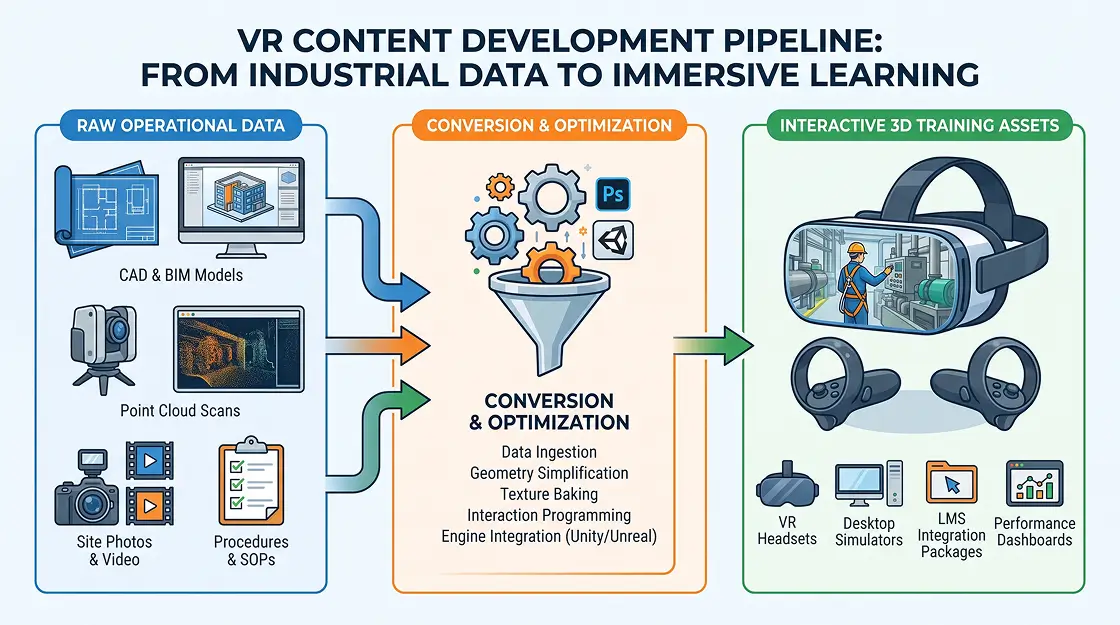
VR content development converts operational data into interactive 3D assets. The raw material usually exists: CAD, BIM, point cloud scans, photographs and site video. The work is conversion and optimisation, because engineering files are far too heavy to render inside a headset. This is the longest stage of virtual reality development on most industrial builds.
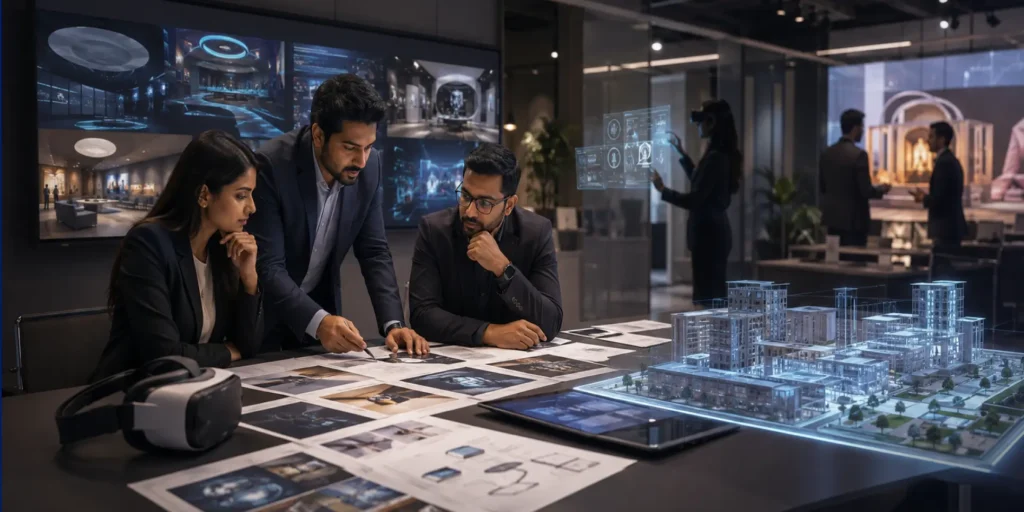
We ran this pipeline at infrastructure scale for the holographic digital twin of Noida International Airport, converting dense CAD and BIM data into lightweight real time models and flagged errors before construction.
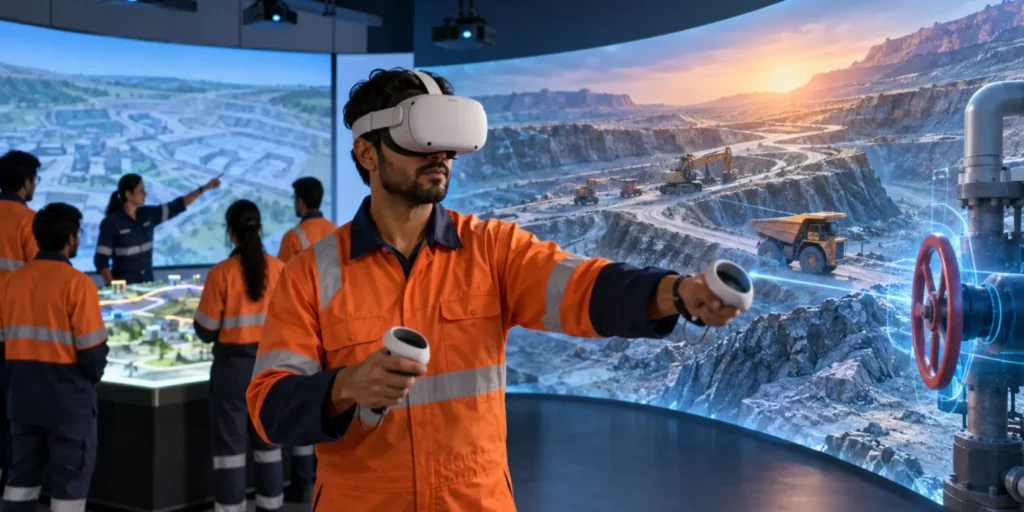
Real footage builds operator trust. For the Adani Centre of Excellence, we produced drilling, blasting and excavation modules and integrated actual mine video, with bilingual voice-overs so every crew trains in its own language.
Stage 5: The Engineering Choices That Decide Comfort and Cost
Custom VR solutions assemble from proven components, and five choices shape budget and comfort:
- Engine: Unity and Unreal Engine cover most industrial builds; fidelity needs and asset pipeline decide between them.
- Hardware: standalone headsets such as Meta Quest suit large training fleets; tethered rigs suit high fidelity reviews.
- Frame rate: we lock it, because dropped frames cause motion sickness and stalled rollouts.
- Format: headsets suit individual practice; projection rooms and stereoscopic displays suit group inductions. We deployed three formats in one facility.
- Connectivity: plant networks are restricted, so modules run offline and sync records later.
Stage 6: Hand It to Operators and Let Them Break It
Testing is where virtual reality development earns operator trust. We test with the people who do the job, on site where possible. Operators catch what designers miss: a valve that turns the wrong way, a step order that no longer matches practice.
Comfort checks run in parallel. Session length, movement and reach are tuned until a first time user finishes comfortably. Sign off from an SME and a safety owner closes the stage.
Stage 7: Deployment, Where Most Projects Stop
Deployment is operations work, and skipping it is why pilots stall. A deployed solution needs:
- Device management: enrolled headsets, remote updates and a hygiene routine for shared units.
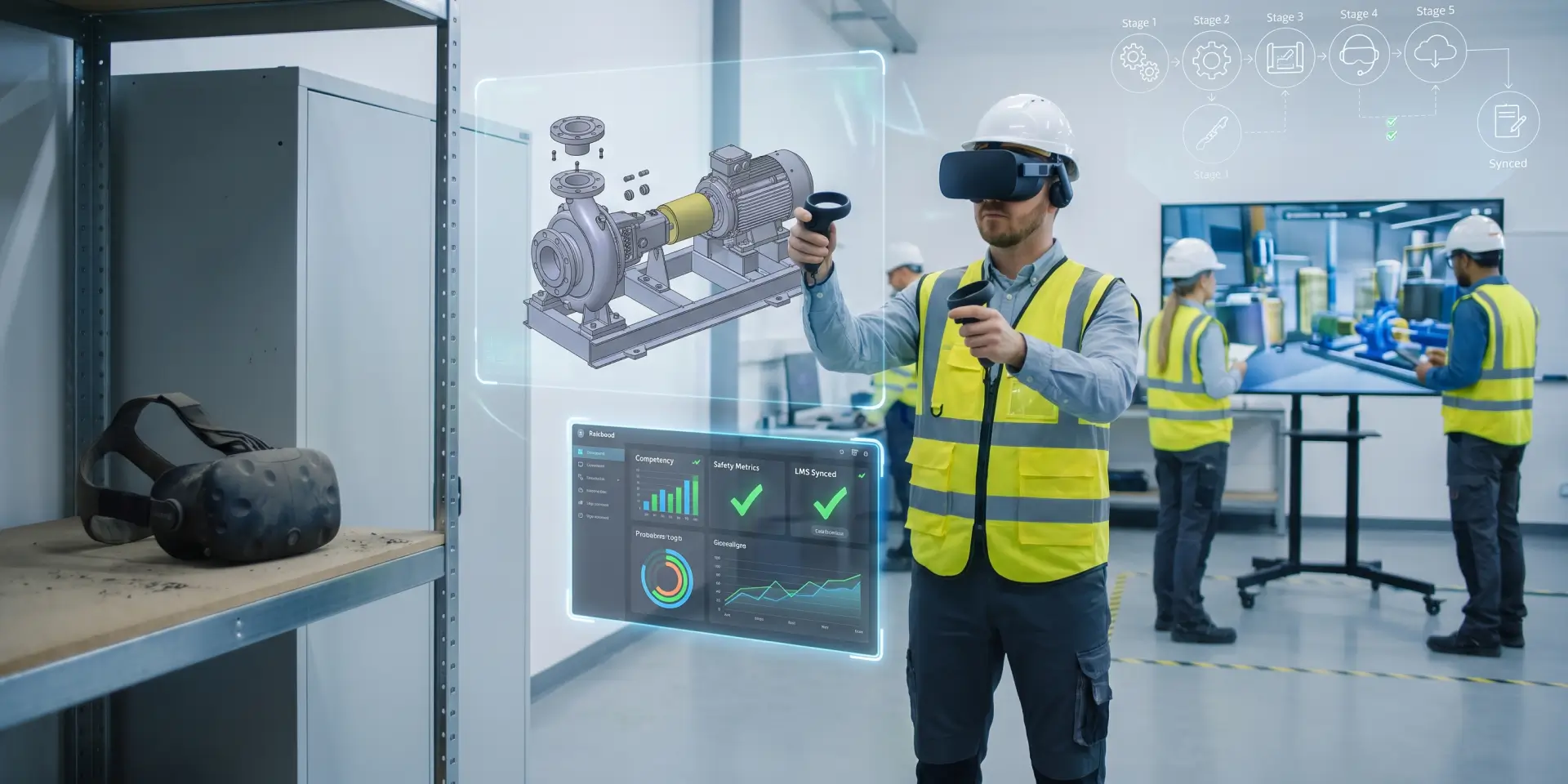
- LMS integration: completions, scores and competency records flow into the system your auditors already check.
- Compliance reporting: dashboards showing who is trained, who is due and who failed.
- Physical setup: a training room or kiosk with charging, floor space and supervision.
Our simulation-based learning services cover this stage, including LMS integration and compliance dashboards, because VR development without deployment produces a demo, and demos train nobody.
Stage 8: Measure It Like Any Other Operations Programme
Set the metrics during design, then report against them monthly:
- Time to competency: days from first session to assessed pass.
- First attempt pass rate: tracked by module, site and language.
- Refresher completion: renewals delivered on schedule against the compliance calendar.
- Safety indicators: near miss reports and incident trends on trained tasks.
Procedures change, so budget content updates from day one. Once a module proves itself at one site, the next thousand learners cost little. That curve is the strongest case for virtual reality development at plant scale.
How Long Does Virtual Reality Development Take?
In virtual reality development, a single procedural module with assessment takes 8 to 12 weeks from brief to deployment. A multi scenario programme with branching and LMS integration runs 3 to 5 months. Multi format facilities follow a phased plan.
Five drivers move every VR development estimate: scene count, asset fidelity, interaction depth, languages and integrations. Asset fidelity is usually the largest line, which makes disciplined VR content development the main cost control. The same drivers govern physical spaces, and we broke them down in our analysis of experience centre costs.
Two Projects, Real Numbers: What a Deployed Solution Looks Like
The Adani Centre of Excellence runs three immersive systems we delivered inside one facility: a VR simulator for three core mining workflows, a synchronised projection experience and a curved stereoscopic environment. Trainees practise all three with zero live site exposure, in two languages.
For a greenfield airport masterplan, our holographic digital twin replaced static presentations, gave decision makers three view modes and surfaced errors before construction, then went live before national leadership at the groundbreaking ceremony.
If a first module is on your roadmap, book a scoping call. Bring your SOPs and incident data. We will score them against the Stage 1 filters and return a realistic scope, timeline and budget, whether for one module or custom VR solutions across sites.
The Bottom Line
Virtual reality development succeeds when teams treat it as an operations project with a technology component. Choose a high risk, high cost task and scope it with real inputs. Design the learning first, build from your site data, and plan deployment before the first asset is modelled. That sequence turns a concept into a solution people use every shift.
FAQs
What is virtual reality development?
Virtual reality development is the end to end process of planning, designing, building and deploying interactive 3D experiences delivered through headsets or immersive displays. Industrial teams apply it to safety training, procedural skills and infrastructure visualisation.
What do we need before a VR development project starts?
Six inputs: current SOPs, incident history, named SMEs, LMS details, device constraints and workforce languages. With these we scope custom VR solutions and commit to a fixed timeline.
Can VR content development reuse existing CAD and BIM files?
Yes. Engineering files are the best starting point. We convert and optimise them into real time assets, the same pipeline we used for an airport scale digital twin.