On 16 November 2026, the culture ministry switched on an AI assistant that answers in 22 languages and cites a source for every statement. Few museums can do either. Their labels use one or two languages, guides are few, and many collections are only partly online. AI in museums is now used to fix these problems.
AI in museums, short for artificial intelligence in museums, is software that reads a museum’s approved texts, records and images. It uses them to answer visitors, find objects and flag risks. Our earlier guide lists the use cases that work on real gallery floors. This one tracks what public institutions have switched on since 2025.
The culture ministry’s national museum directory lists 1,176 museums. The projects below come from a few of them, and each gives the rest a step to copy.
We build visitor experiences for museums and public bodies, so we read each launch with one question: what would a director need to copy it?
The Culture Ministry’s New Assistant Shows What an AI Museum Guide Should Do
The assistant, Sanskriti, draws on about 65 portals run by the ministry and its 43 organisations. Its design follows five choices:
- Approved sources only: It answers from the ministry’s portals and not the open web.
- A source for every statement: Numbered citations link to the original page.
- Hosted and owned by the ministry: Data stays on its servers, and the ministry can swap the open-source models later.
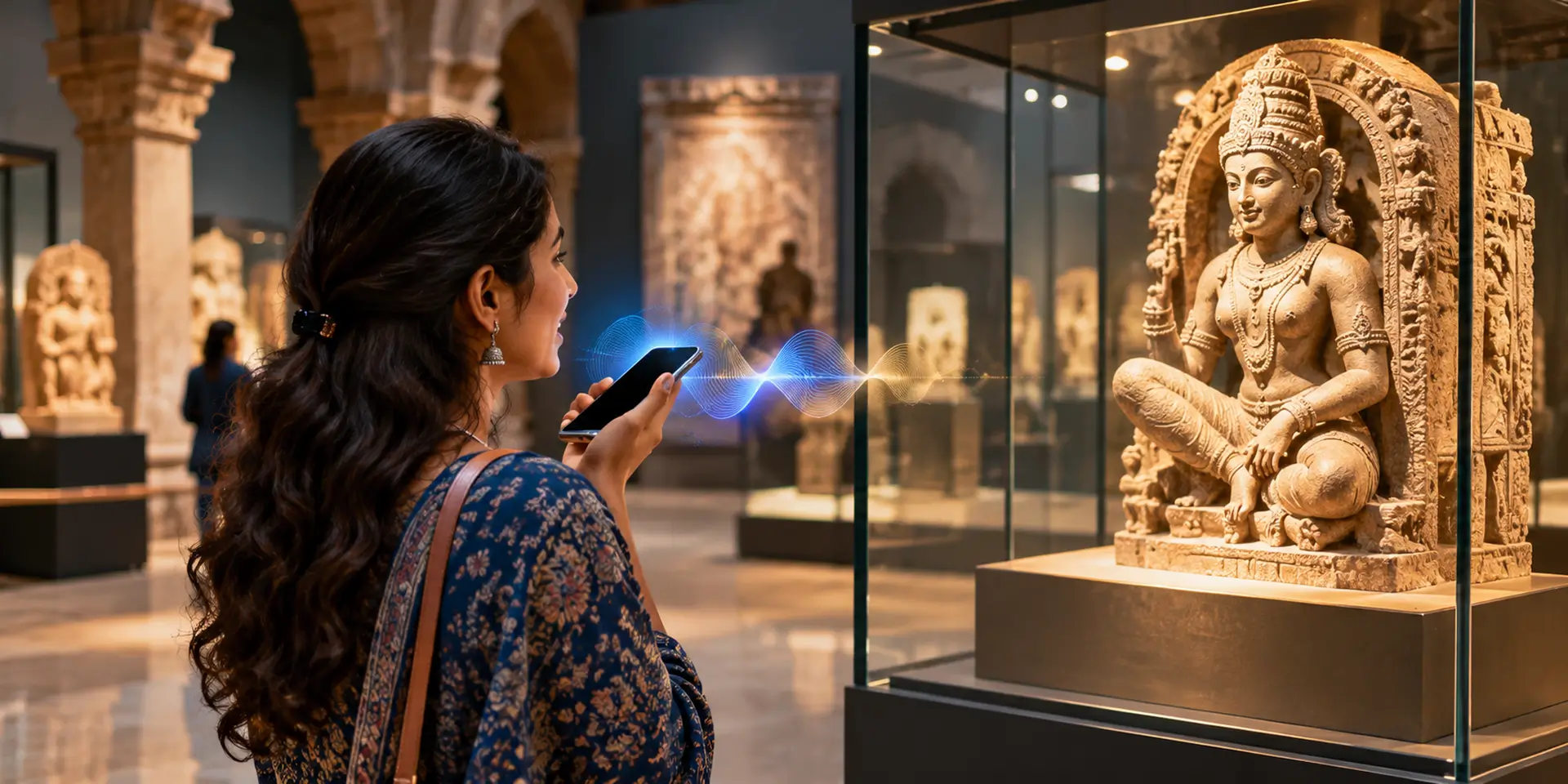
- 22 languages by voice: It works in all 22 scheduled languages through Bhashini, takes spoken questions and reads answers aloud.
- A way to report errors: Users can flag a wrong answer.
We think these choices matter more than the screen or the avatar. They apply to AI in museums of every size, and any AI museum guide should meet all five. When museums ask us for a chatbot, we ask about sources, citations and hosting first.
AI in Museums Right Now: Six Public Projects Worth Copying
Six more projects show how AI in museums works in public institutions. Each ends with a first step for smaller museums.
A Kolkata Museum Is Using AI to Restore Artefacts
The Indian Museum in Kolkata works with IIT Kharagpur on AI-based restoration of archaeological artefacts. The culture minister confirmed this in a written reply to Parliament on 3 August 2026, which also notes AI interactives in the museum’s galleries.
We see restoration as one of the safest uses of AI for cultural heritage, because conservators check every result.
First step: Partner with a nearby engineering institute and photograph damaged objects at high resolution.
Seven in Ten National Museum Objects Are Now Online
The same reply counted 4,78,971 artefacts in eight national museums, with 3,36,359 (70.23%) online through the JATAN software. The National Museum stands at 51.15%.
In our projects, preparing records takes longer than setting up the AI, because every use of AI in museums depends on clean records.
Visitor data needs the same care. At CSMVS, our multilingual feedback kiosk replaced paper forms with structured responses that curators read in real time.
First step: Move object records into structured fields before buying any AI tool.
Old Manuscripts Can Now Answer Visitors’ Questions
At the AI Impact Summit in February 2026, the ministry showed AI that turns manuscripts into readable text in several languages. Visitors could also ask the manuscripts questions. The Gyan Bharatam portal held over 3.5 lakh manuscripts by August 2026.
This is AI for cultural heritage that a small museum can join without building anything.
First step: Catalogue your manuscript holdings so they are ready for national digitisation.
An AI Image Library for Stolen Antiquities Is Next
The ministry plans an AI image library of stolen antiquities and AI cataloguing of museum objects. If a stolen piece appears at an auction, AI can match it against the original’s photographs. Physical checks follow, but a fast match can stop the sale.
We see this as the most urgent use of AI for cultural heritage.
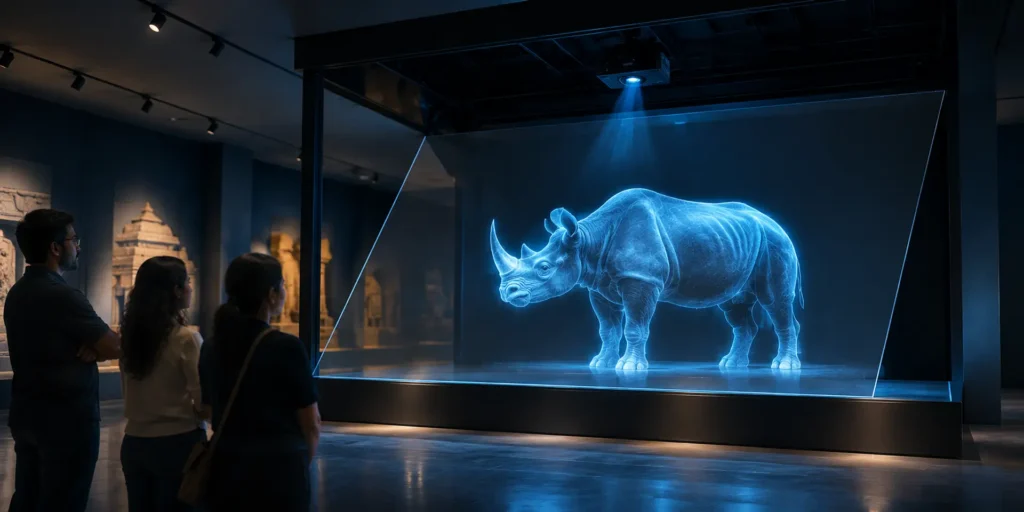
Returned objects also need their story told. For the National Museum Institute, we turned eight repatriated artefacts into 3D holograms that narrated their return at the first G20 Culture meeting.
First step: Photograph high-risk objects from several angles and record exact dimensions now.
Science Centres Are Developing Adaptive Exhibits
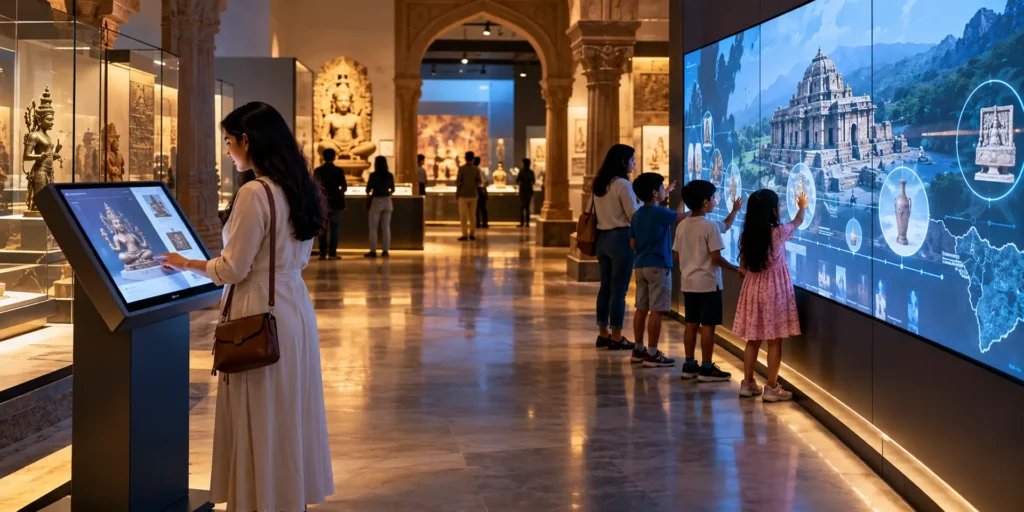
The National Council of Science Museums, with 26 centres, is researching AI, computer vision, eye-tracking, touchless interaction and content that adapts to each visitor.
Adaptive exhibits run on interactive displays. We advise measuring first, because anonymous dwell-time data shows what to change.
First step: Track anonymous dwell time at three exhibits for one month.
Visitors Search Art by Drawing a Shape
For a museum, we built Draw to Search. A visitor sketches a shape, and image recognition returns matching works from over 20,000 artworks.
The same method can support online collection discovery, where people browse by what they see.
First step: Pick one well-photographed collection and test visual search with real visitors.
Six Rules to Settle Before Your Museum’s AI Answers a Visitor
Trust is a museum’s main asset, and artificial intelligence in museums can damage it with one wrong answer. These rules apply to any AI in museums that speaks to the public:
- Approved sources: Answers come only from texts your curators have signed off.
- Citations: Every answer names the label, record or publication behind it.
- A clear label: Visitors know they are talking to AI.
- Sign-off for historical figures: A family member or estate approves the voice, likeness and script.
- Refusal lines: The AI museum guide says what it cannot answer and points visitors to staff.
- Consent first: Staff ask before recording a voice or a face, and camera analytics stay anonymous.
Talking figures on holographic displays also need hardware that runs all day without staff. Our holographic stage for the Ministry of Women and Child Development ran unattended through a full G20 summit programme.
A 90-Day Plan for a State or District Museum
A first project in artificial intelligence in museums needs a clear order of work:
- Days 1 to 30: Pick one use case. Put approved labels, catalogue text and publications into one source set. Structure object records and photograph high-risk objects.
- Days 31 to 60: Choose three languages by visitor numbers. Write refusal lines, the AI disclosure label and a consent notice.
- Days 61 to 90: Pilot in one gallery. Log every unanswered question, review the log weekly and decide whether to expand.
Records come first. Our guide to museum digitisation explains photography, 3D scanning and cataloguing.
How We Help Museums Start Their First AI Project
We have delivered over 100 projects in more than 10 years, including museum and government work. Three show our work on AI in museums and heritage display:
- Draw to Search: Image search across 20,000+ artworks, built for a museum.
- Networks of the Past: Four installations at CSMVS covering 250+ artefacts from 14 museums in 6 countries.
- G20 Khajuraho: Eight repatriated artefacts presented as narrating holograms for the National Museum Institute.
Our immersive experience centre work covers AI-driven installations, anonymous computer-vision analytics and adaptive content. Builds take 6 to 12 months from brief to opening, longer with public procurement.
If you plan a first AI project, share your object records and visitor numbers with us. We will tell you which use case your data supports today.
What Museum Directors Should Do This Year
AI in museums is now a working tool in public institutions. The ministry’s assistant shows the safe defaults: approved sources, citations, local hosting and 22 languages.
Artificial intelligence in museums starts with clean records. Fix yours, choose one use case and test it in one gallery. We expect museums that do this now to adopt national AI tools first.
FAQs
What is an AI museum guide?
An AI museum guide is the most visible form of AI in museums. It answers visitor questions by voice or text from approved texts only. A good AI museum guide cites its source and says when it cannot answer.
How does AI in museums avoid wrong answers?
Artificial intelligence in museums gives fewer wrong answers when it uses approved sources only, cites each answer and lets visitors flag errors. Refusal lines cover questions outside those sources.
Can AI answer visitors in regional languages?
Yes. Bhashini, the government’s language platform, covers all 22 scheduled languages, and the ministry’s assistant uses it. Test each language with native speakers first.
How is AI for cultural heritage used outside the galleries?
AI for cultural heritage now supports artefact restoration, manuscript reading and stolen-antiquity tracking. Examples include AI-based restoration at the Indian Museum, Gyan Bharatam’s manuscript AI and the ministry’s planned image library.
Where should a small museum start with AI?
Start with records, because AI in museums depends on clean object data and approved text. Then run a 90-day pilot of one use case in one gallery.