Why Classroom Safety Training Fails Where It Matters Most
Traditional methods transfer information. They do not build behaviour. We see the same four failures across industrial sites:
- Rehearsal is impossible: no trainer can expose a worker to a real fall, an arc flash, or a gas leak to teach the response
- Memory decays fast: classroom content fades within weeks, long before the worker faces the hazard
- Attendance is not competence: a signature proves presence, nothing more
- Supervisors get no data: nobody knows who hesitates until the hesitation happens at height
We covered the broader benefits, use cases and ROI of VR training in an earlier guide. This article answers one question: how VR safety training actually brings the risk down.
How VR Safety Simulation Training Reduces Risk: Five Mechanisms That Matter
A VR safety simulation reduces incidents through five mechanisms. Each one is measurable.
- Safe failure: workers make the wrong choice, see the consequence, and repeat the task until the right choice becomes automatic
- Faster hazard recognition: repeated exposure trains workers to spot an open edge, a damaged harness, or a missing guard in seconds
- Stress rehearsal: trainees practise decisions under realistic pressure, so a real emergency is never their first
- Procedural memory: physical repetition turns the correct sequence into habit, and habit survives stress better than recalled theory
- Measurable competence: the system logs every action, so safety teams replace attendance records with evidence of readiness
Peer-reviewed evidence supports this. A meta-analysis of 52 studies found that VR safety Simulation training outperforms traditional methods on both knowledge acquisition and retention. One published study of miners recorded a 43 percent drop in lost-time injuries after immersive training.
Which Hazards Deserve a VR Safety Simulation First?
Not every task belongs in a headset. We score each scenario on three factors: failure severity, event rarity, and how hard physical rehearsal is. High severity, low frequency, and no safe rehearsal option make a scenario ideal for VR safety training. The National Safety Council’s Work to Zero initiative lists virtual and augmented reality among the technologies it recommends for hazardous work training.
Six Scenarios Worth Building
- Work at height: harness checks, anchor point selection, and safe movement across scaffolds, towers, and rooftops
- Confined space entry: gas testing, permit steps, and rescue response
- Fire and gas leak response: detection, containment, and evacuation decisions
- Electrical isolation: lockout tagout sequences and arc flash awareness
- Chemical handling: spill response and PPE discipline around invisible hazards
- Heavy machinery interaction: pedestrian zones, blind spots, and start-up checks
Where Industrial VR Training Pays Off Across Sectors
Industrial VR training delivers the largest returns in sectors where a single error carries severe consequences:
- Mining: drilling, blasting, and excavation practice without underground exposure
- Power and energy: switching operations, work near live equipment, and emergency shutdowns
- Chemicals and process plants: gas leak response and emergency isolation drills
- Steel and heavy manufacturing: furnace areas, molten metal zones, and crane movements
- Construction and infrastructure: fall protection and lifting operations across changing sites
Two workforce realities strengthen the case in fast-industrialising regions: large contractor populations with high turnover, and crews that speak different languages. A single safety training VR programme delivers one standard to every worker, in the language each worker understands. Simulations built on a digital twin of the actual site remove the transfer problem: workers train on the layout they will walk the next morning.
Six Steps to Launch VR Safety Simulation Training Without Wasting Budget
We refined this sequence across ten plus years of industrial VR training deployments. Treat it as a checklist.
- Baseline your risk data: pull two years of incident, near-miss, and training records to prove change later
- Pick one scenario, not ten: choose the hazard with the worst severity and the weakest current training
- Build to your site: generic environments lose experienced workers in the first minute. Our virtual reality development process starts with site footage, real procedures, and your permit formats
- Set competency gates: connect the safety training VR module to your LMS and make a passing score a prerequisite for hazardous task authorisation
- Run a 60 to 90 day pilot: train 25 to 50 workers, keep a comparison group on the current method, and hold everything else constant
- Measure, then scale: expand only after the pilot data clears the success criteria you set on day one
Most safety training VR projects that fail skip steps one and five. Without a baseline there is nothing to compare, and without a pilot there is no evidence to fund the rollout.
How to Prove the Risk Reduction to Your Board
A VR safety simulation produces its own evidence. Track two layers:
- Leading indicators: hazard identification scores, hesitation points recorded in the simulation, time to competence, and near-miss reporting rates
- Lagging indicators: TRIR, LTIFR, and first-aid case counts, tracked against your baseline over six to twelve months
Leading indicators move first. Lagging indicators carry the financial argument. Our simulation-based learning modules include assessment and competency scoring by default, so safety training VR reporting exists from the first session.
Our view after a decade of this work: hesitation data is the most underused safety metric in industry. When many workers hesitate at the same anchor point, you have found a gap no incident report would show.
What Mining and Construction Deployments Taught Us
We have delivered more than 100 immersive projects at a 96 percent success rate. Two deployments shaped our view of risk reduction.
Mining: The Adani Centre of Excellence
For the Adani Centre of Excellence at IIT-ISM Dhanbad, we built VR modules for drilling, blasting, and excavation on Meta Quest 3, grounded in real mine footage. The programme runs in Hindi and English and delivered 100 percent safe operations training with zero live-site exposure. The bilingual build proved a simple point: language coverage decides whether training reaches the whole workforce.
Construction: Work@Height
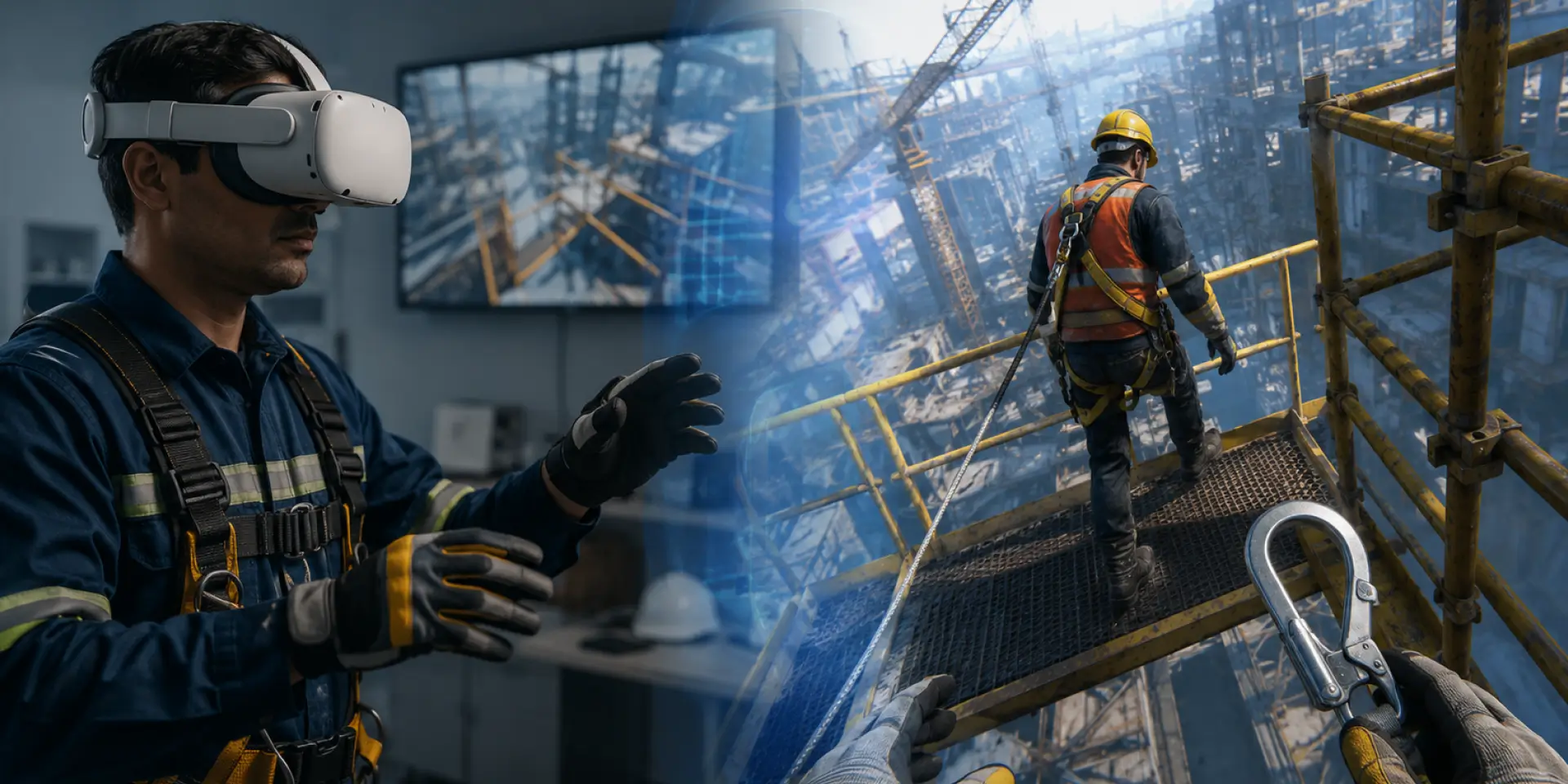
Work@Height is our VR safety simulation training simulation for crews on scaffolds, towers, and rooftops. Workers perform inspections, harness checks, and movement tasks, with gamified progression to hold engagement. The system records every decision, so supervisors see where each worker hesitates or makes an unsafe choice before reaching a live site. For EHS leaders, this turns a one-off briefing into repeatable practice and a consistent benchmark of readiness.
Where VR Is the Wrong Tool
Honest scoping protects budgets. Skip the headset when:
- The content is pure policy: a rule update needs an email, not a simulation
- Fine motor certification is the goal: final sign-off on physical dexterity belongs on real equipment
- The procedure changes monthly: a simulation would date faster than you could update it
VR safety training complements physical assessment and toolbox talks. It does not replace them.
Thinking About a Pilot? Start With One Scenario
Teams that move fastest start small. A scoped VR safety simulation training pilot for one scenario, usually work at height or confined space entry, produces decision data within weeks and board-ready evidence within a quarter. We support this with an ROI calculator that models your headcount, incident costs, and training hours against pilot pricing. If a pilot fits your 2026 safety plan, share a project brief and we will map the first scenario with your EHS team.
The Bottom Line for EHS and L&D Leaders
VR safety training reduces risk because it changes what workers practise, how often they practise it, and what safety teams can measure. Industrial VR training will not remove every hazard from a site. It removes the most dangerous condition of all: a worker facing a critical moment for the first time. Start with one scenario, measure honestly, and scale what the data supports.
FAQs
What is VR safety simulation training?
VR safety simulation training uses headset-based simulations of real worksites so workers can practise hazardous tasks, make mistakes safely, and repeat procedures until the correct response is automatic.
How does a VR safety simulation reduce incidents?
It builds hazard recognition speed and procedural memory through repetition, and it flags unsafe decisions during practice, so corrections happen before live exposure.
Which sectors gain the most from industrial VR training?
Mining, construction, power, chemicals, and heavy manufacturing see the strongest returns, because their highest-risk tasks cannot be rehearsed physically.
How long does a safety training VR pilot take?
A focused pilot typically runs 60 to 90 days: one scenario, 25 to 50 workers, and success criteria agreed up front.
Does VR replace hands-on certification?
No. A VR safety simulation prepares workers and evidences readiness, while final certification on physical equipment stays in place.