What Immersive Technology Actually Means
Immersive technology is a group of tools that change how a person perceives the space around them, by adding digital content to the real world or replacing that world with a digital one. It covers augmented reality (AR), virtual reality (VR), mixed reality (MR), and spatial computing. The shared idea is presence: digital content appears to sit in real space, not inside a flat screen.
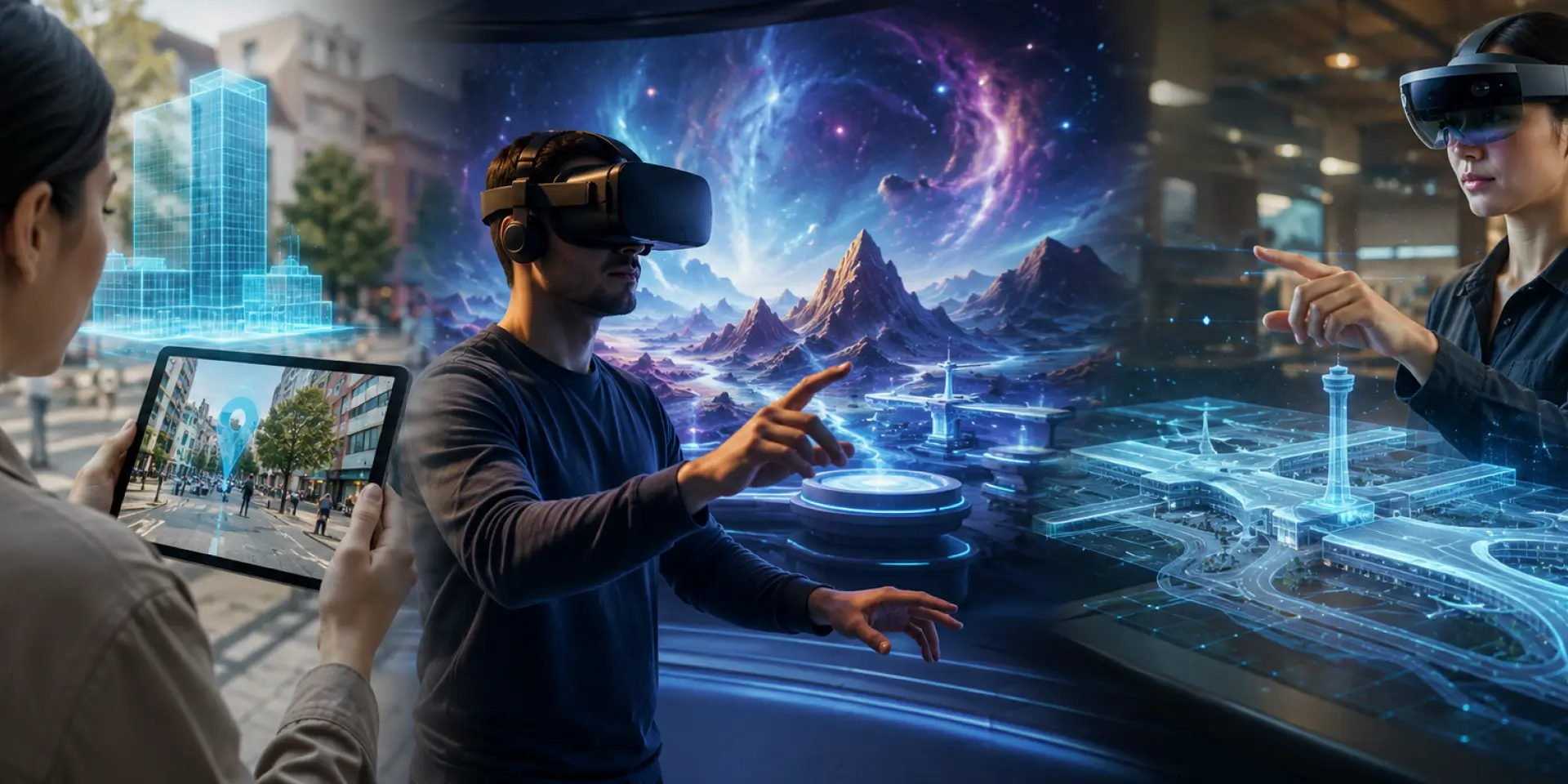
Picture them on a spectrum. At one end is the real world with no digital layer; at the other, a fully digital world. AR sits near the real end, VR at the digital end, and MR in the middle, where real and digital objects react. Researchers call this the reality-virtuality continuum.
AR, VR and MR: How the Three Really Differ
People mix up AR, VR, and MR because they share hardware and overlap in use. The difference comes down to two things: how much of the real world you still see, and whether digital objects can react to it.
Augmented Reality (AR)
AR adds digital content over a live view of the real world, so the user stays aware of their surroundings. It is the easiest to reach, running on hardware people already carry.
- Runs on a smartphone, tablet, or lightweight glasses.
- Common uses: product try-ons, live navigation, and on-site guidance.
Virtual Reality (VR)
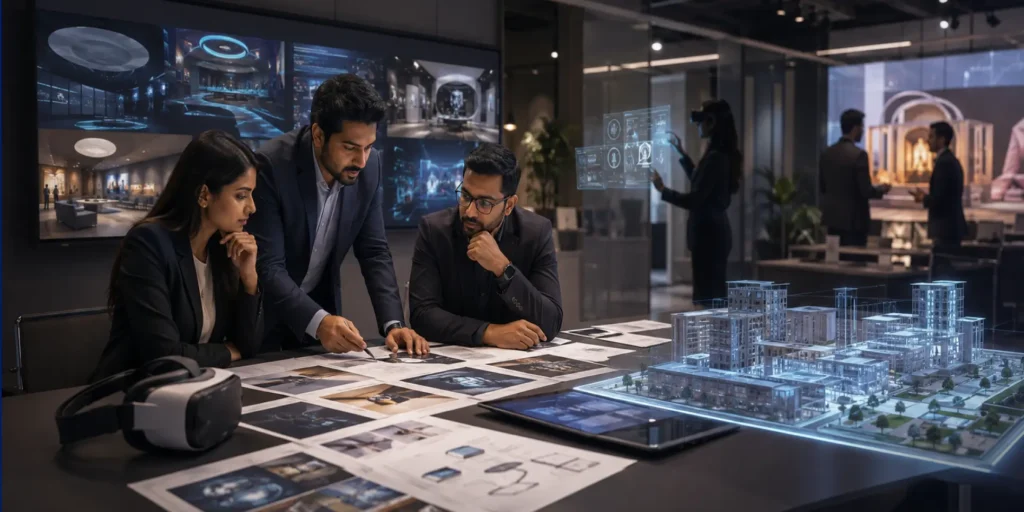
VR replaces the real world with a full digital one. A headset blocks the physical view while motion tracking lets the user look around. It suits tasks that need full focus, like high-risk training. We used it to build a VR walkthrough of a planned ropeway so stakeholders could review the design before building.
- Needs a headset such as Meta Quest or Apple Vision Pro.
- Common uses: skills training, therapy, and design review.
Mixed Reality (MR)
MR lets digital and physical objects share space and react to each other. A virtual object can sit behind a real one, or react as a real tool nears. MR needs spatial-mapping hardware that maps the room. This is the mode behind our holographic digital twin of a new airport, letting planners study a large site as an interactive 3D model.
- Needs devices such as Microsoft HoloLens or Apple Vision Pro in passthrough mode.
- Common uses: industrial work, remote support, and site planning.
| Technology | Real world visible? | Typical hardware | Best-fit uses |
| Augmented reality (AR) | Yes | Phone, tablet, AR glasses | Try-ons, navigation, on-site guidance |
| Virtual reality (VR) | No | Meta Quest, Apple Vision Pro | Training, therapy, design review |
| Mixed reality (MR) | Yes | HoloLens, Magic Leap, Vision Pro | Industrial work, remote support, planning |
| Spatial computing | Varies | Vision Pro, smart glasses | Enterprise platforms, multi-mode projects |
Where Spatial Computing Fits In
Spatial computing is the wider term for technology that treats physical space as its interface. It includes AR, VR, and MR rather than sitting beside them. The phrase spread after Apple called the Vision Pro a spatial computer in 2024.
Extended reality, or XR, is the shorthand teams use for the same AR, VR, and MR range. So spatial computing and XR both act as umbrella terms, while AR, VR, and MR are the modes underneath. We break down the room-scale display formats in our guide on how holographic displays work.
Immersive Media and the Experiences It Creates
Immersive media is the content that runs on these technologies. It surrounds the viewer or reacts to them instead of playing inside a frame. Immersive media includes 360-degree video, spatial video, projection-mapped rooms, spatial audio, and installations that respond to touch or movement.
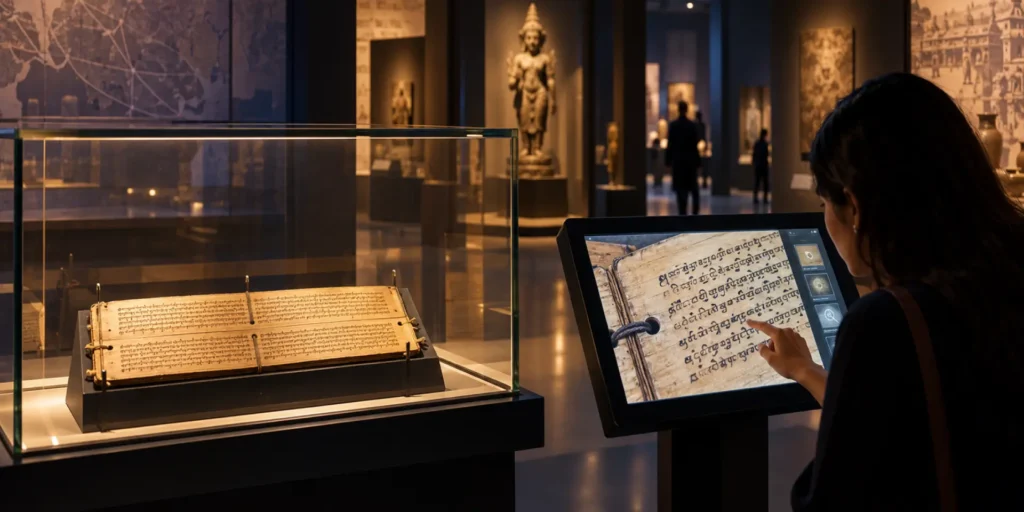
For brand and cultural work, immersive media is often the point of the project. We produced interactive digital experiences for a museum exhibition where each station used immersive media to turn a historical topic into something visitors could explore themselves.
Where Immersive Technology Pays Off Across Industries
Immersive technology returns value differently by sector. These are where we see the clearest results.
- Cultural institutions and heritage sites: Museums and heritage venues use immersive media and interactive displays to explain a subject and keep visitors engaged.
- Public infrastructure and tourism: Holographic models and VR let planners and the public understand a large project before it is built.
- Corporate brand and visitor centres: Brands use immersive technology in permanent spaces to explain what they do and build trust with buyers.
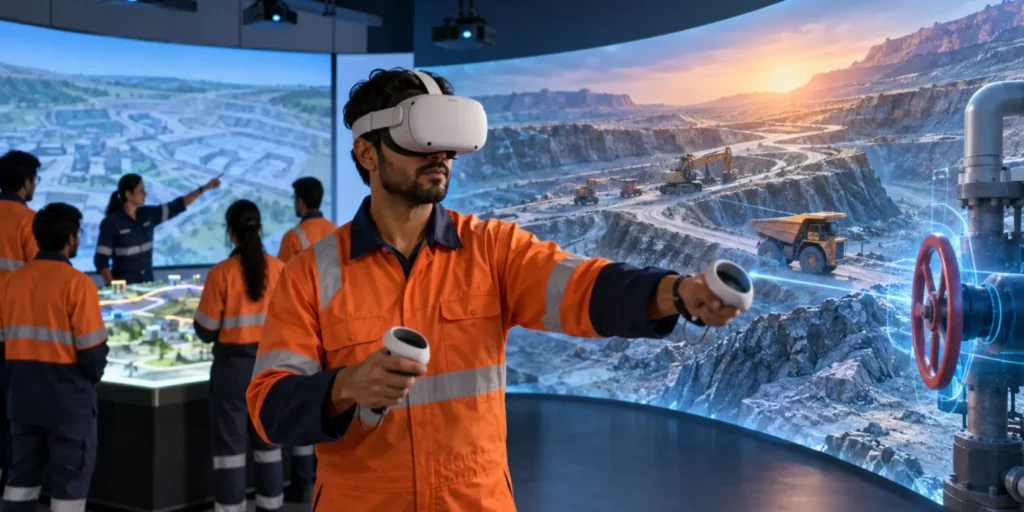
- Training and safety: Simulation-based learning lets staff practice dangerous or costly procedures in a controlled setting.
Training is where the numbers are strongest. A PwC study found that employees trained in VR finished up to four times faster than classroom learners and were 275% more confident applying what they learned.
We put the same approach to work in an immersive mining training simulation that let people rehearse operations without physical risk.
How to Choose Between AR, VR and MR
The right choice depends on the problem, the setting, and the budget:
- Pick AR when users should stay in their own environment, as in retail, live guidance, or a mobile campaign. It carries the lowest entry cost.
- Pick VR when full focus and a safe practice space matter, as in training, therapy, or design review.
- Pick MR when digital and physical objects must interact, as in industrial work, remote support, or site planning.
- Choose spatial computing when a project spans more than one mode or needs a shared platform.
AR reaches the most people at the lowest cost; VR and MR give more depth for focused tasks. Setting metrics early keeps a project honest, a point we cover in our note on the ROI of a brand experience centre.
What the 2026 Data Says About Immersive Technology
In 2026, immersive technology is becoming standard business equipment. Global XR device shipments reached about 14.5 million units in 2025, up roughly 41.6% on the year, according to IDC. Lightweight smart glasses drove most of that growth and climbed sharply again in early 2026.
Two shifts matter for planning:
- AI is now built into immersive technology: New devices use AI for real-time object recognition, voice help, and adaptive content.
- Form factors are splitting by job: Smart glasses handle quick tasks; headsets handle deep work like training and design.
For brand and training teams, this means immersive technology is easier to deploy and cheaper to reach an audience than two years ago.
Build Immersive Experiences That Show Real Results
At ViitorX, we design and build immersive technology projects that are made to be measured. Our work covers four areas: immersive experience centres, simulation-based learning, event and brand activations, and 3D digital experiences. Each ships with analytics such as dwell time, interaction rates, and completion scores.
Recent work spans a VR ropeway experience, a holographic airport twin, an immersive mining training simulation, and interactive museum installations. The experiences we have built set out each project in full.
When a project is ready, our team can help scope it, pick the right mode, and set the metrics that prove its value. Start a conversation with our team to plan yours.
The Bottom Line on Immersive Technology
Immersive technology is a spectrum. AR adds a digital layer to the real world, VR replaces it, and MR lets the two interact, with spatial computing and immersive media across the range. The strongest projects start with a clear problem and the one mode that fits it, then measure the result to prove the value in 2026.
FAQs
What is immersive technology?
Immersive technology is a group of tools, including AR, VR, MR, and spatial computing, that change how a person perceives space by adding digital content to the real world or replacing it entirely. The shared goal is a sense of presence in three-dimensional space.
What is the difference between AR, VR, and MR?
AR adds digital content to a live view of the real world. VR replaces it with a full digital one. MR lets digital and physical objects share space and react. The main test is how much of the real world you still see, and whether the two can interact.
Is spatial computing the same as XR?
Both act as umbrella terms for AR, VR, and MR. Spatial computing describes treating physical space as the interface, while XR is the shorthand teams use for the combined AR, VR, and MR range.
What is immersive media?
Immersive media is content that surrounds or responds to the viewer, such as 360-degree video, spatial video, projection mapping, spatial audio, and interactive installations. It is the material that runs on immersive technology.