Why Flat Websites Lose the Attention Game
Most brand sites still behave like brochures. They show photos, list features, and wait for a form fill. That format keeps losing ground, for reasons that are easy to name:
- Visitors scan and rarely read: A wall of text gives them little reason to stay.
- Sites look alike: Shared templates make it hard for one brand to stand out.
- Static pages give no feedback: Nothing responds to the user, so nothing holds focus.
Immersive website design fixes this by giving people something to do. When a visitor spins a product or moves through a scene, the page responds, and that response keeps them there longer. This is the gap that 3d website design is built to close.
What 3D Website Design Actually Means
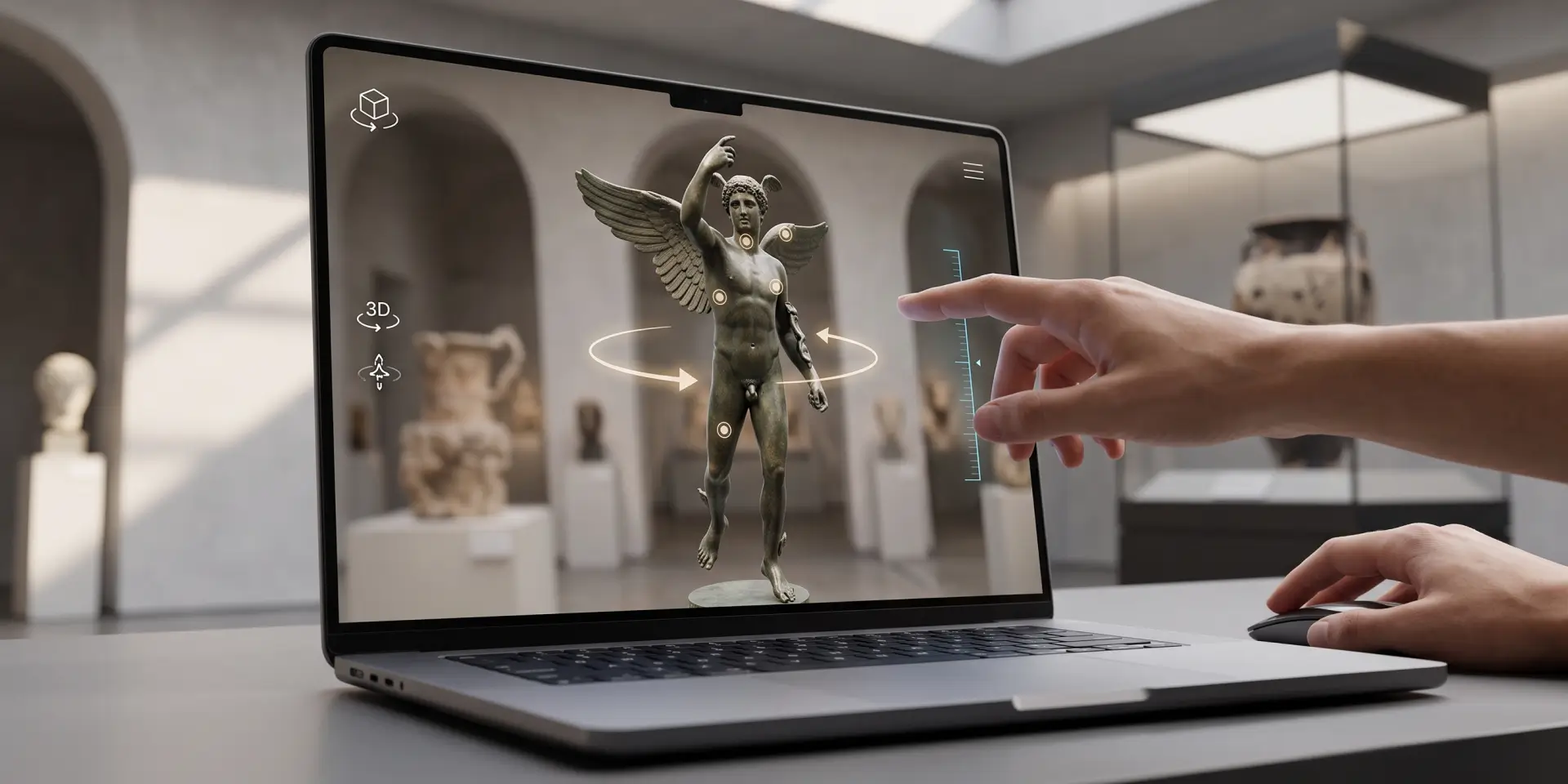
3D website design is the practice of building web pages with three-dimensional, interactive elements that run inside a browser. Users control these elements in real time. They can turn an object, zoom into a detail, or trigger animation as they scroll. A 3D modeling tool only creates the object. A 3d website takes that object and makes it part of a live, clickable page. We build these experiences, and the pattern holds: pages people can touch keep attention longer than pages they only read.
The building blocks
A webGL website combines a few core parts:
WebGL. The browser technology that draws 3D graphics in real time without plugins. It follows an open standard defined in the WebGL API reference that every major browser supports, which is why a webGL website runs on ordinary phones and laptops.
- Motion graphics: Animated type, shapes, and transitions that guide the eye and set the pace. Clean motion graphics make a page feel alive without a heavy 3D scene.
- Real-time rendering: The engine that redraws the scene the moment a user interacts, so the experience feels instant.
- 3D assets: Lightweight models, usually in glTF format, that keep file sizes small and load fast.
Together, these parts form an immersive website design that reacts to the visitor in real time.
How Immersion Lifts Brand Engagement
Engagement measures how much people interact with a page and how long they stay. A 3d website raises it through three plain mechanics:
- Depth invites exploration: When an object has volume, people want to look around it, so they spend more time on the page.
- Interaction builds memory: Actions stick better than text. A visitor who rotates a product recalls it more clearly than one who saw a photo.
- Motion directs attention: Well-placed motion graphics point people toward the next step and keep them moving down the page.
Higher engagement also feeds search performance, because longer time on page and a lower bounce rate signal quality to Google. Used with restraint, 3D website design lifts brand engagement more than a visual refresh of static pages.
The same principle drives formats like 3D holograms, where depth and light hold the eye. On the web, immersive website design applies that pull to a screen the visitor already holds in their hand.
The Performance Rule Most Brands Get Wrong
Heavy 3D can slow a page, and a slow page loses the engagement it was meant to earn. This is where many projects fail. Google measures real user experience through Core Web Vitals, and those scores affect both search rankings and how a site feels to use. Three numbers carry the most weight:
- Largest Contentful Paint (LCP): The main content should appear in 2.5 seconds or less.
- Interaction to Next Paint (INP): The page should respond to a tap or click in under 200 milliseconds. This metric replaced First Input Delay in 2024.
- Cumulative Layout Shift (CLS): The layout should stay stable, scoring under 0.1.
Google checks these against real visitors, not lab tests, and rates mobile and desktop separately. Fast pages also tend to help with AI search, since answer engines favor sources that load reliably. A webgl website can still pass all three. In our builds, we hold scores in the green by:
- Compressing 3D models and streaming textures so the page loads in stages.
- Loading the 3D scene only when it scrolls into view.
- Reserving space for every element so nothing jumps as it loads.
A well-built webGL website proves that speed and immersion can sit together. Strong 3d website design treats performance as part of the brief, not a repair made at the end.
A Process That Keeps 3D From Becoming a Gimmick
Immersion works when it serves a goal. Added for decoration, it slows the site and distracts the buyer. We follow a fixed order so every 3D element stays tied to a purpose.
The 3D website design process in five steps
- We set the business goal first, a product launch, a demo, or a lead form, then decide whether 3D supports it.
- We map the user journey and mark the exact moments where interaction adds value.
- We build the 3D scenes and motion graphics, keeping each asset light and each animation purposeful.
- Performance engineering. We test the webgl website against Core Web Vitals through the whole build, not once at launch.
- We wire the site to analytics so results show from day one.
This order sits at the center of our digital brand experiences, where 3D website design, interactive campaigns, and immersive website design work toward one brand goal.
How to Measure Whether It Worked
A 3d website should prove its value with data. Good 3d website design makes that measurement straightforward. Raw page views say little about brand engagement, so these signals say more:
- Dwell time on the pages that hold 3D content.
- Interaction rate, the share of visitors who rotate, click, or explore.
- Scroll depth, which shows how far motion graphics carry people down the page.
- Conversion rate on the goal the page was built for, such as a demo request.
- Return visits, a sign the experience was worth repeating.
Set a baseline before launch so the lift from the new experience is clear. The goal is to tie these signals to pipeline, the approach behind our work on the return on a brand experience. When engagement maps to revenue, a 3D website earns its budget.
When a 3D Website Is Worth It, and When It Isn’t
The teams that gain most from 3d website design match the technique to the task. 3D is a tool, and it suits some jobs better than others. It works well when:
- A product has physical form that photos flatten, such as machinery, vehicles, or buildings.
- A story needs sequence, and motion can reveal it one step at a time.
- A brand sells a premium experience and the site has to match that standard.
It adds little when the job is a fast content read, a simple checkout, or any page where speed beats spectacle. Teams across manufacturing, culture, retail, and property use immersive website design where it earns attention and skip it where it does not. B2B brands often gain the most, because a shared 3D view can align a buying group faster than a slide deck, a point we cover in our work on immersive showrooms.
Where ViitorX Fits Your Next Build
We design immersive environments and digital experiences that brands can measure. Across 100+ completed projects, we hold a 92% client satisfaction rate and a 96% project success rate, numbers we track because engagement should show in results. Our teams have delivered interactive installations, holographic simulations, and interactive digital experiences for cultural spaces, each built to hold attention and report on it.
That same craft shapes how we approach 3D website design, joining real-time 3D, motion graphics, and immersive website design in pages engineered to load fast and prove their worth. When a 3D website sits on your roadmap, start a project with our team and we will scope it around your brand goal.
The Takeaway
3D website design earns its budget when it lifts engagement and clears the performance bar Google sets. The brands that win with it keep the goal in front, keep the pages fast, and measure every interaction. Built that way, a 3d website turns passive visitors into active participants, and that participation is what lifts a brand.