PEG Tube Simulation: Hands-Free VR Medical Training
A VR medical training simulation of the PEG tube procedure, built for Meta Quest 3 with hand tracking, so staff rehearse every step with their own hands, no controllers.
Project Overview
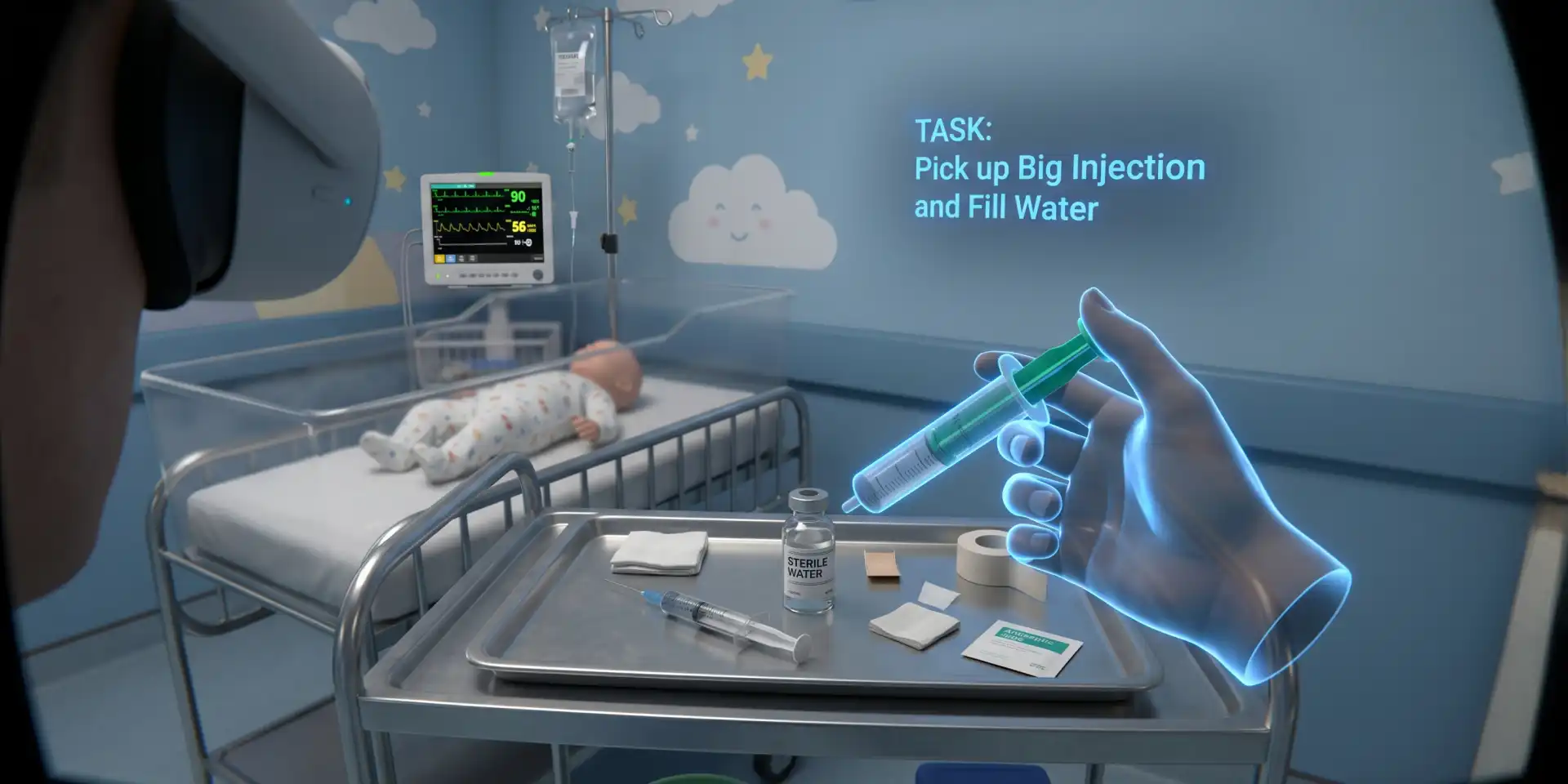
Some clinical procedures are too delicate, and too high-stakes, to learn for the first time on a real patient, especially when that patient is a child. ViitorX built a VR medical training simulation of the PEG tube (percutaneous endoscopic gastrostomy) feeding-tube procedure to give healthcare staff a place to practise safely. Built for Meta Quest 3, it uses hand tracking rather than controllers, so trainees carry out each step with their own hands inside a realistic paediatric ward, guided on screen, until the routine becomes second nature. A team of three delivered it in two months.
Objective
The client wanted to cut training time and modernise how staff learn hands-on procedures through virtual reality training. The simulation needed to:
- Recreate the PEG tube procedure faithfully in an immersive 3D environment.
- Use natural hand tracking so trainees practise with their hands, not controllers.
- Guide each step clearly so staff learn the correct sequence.
- Reduce the time and supervision needed to train staff to competence.
Challenges
Teaching a hands-on clinical procedure carries real constraints:
- Practising on real patients, particularly children, is not an option for early training.
- Controller-based VR feels nothing like handling real instruments.
- A procedure has a precise order, and a wrong step matters.
- Traditional training is time-intensive and needs constant expert supervision.
Solutions
We built the simulation around the trainee’s own hands. It includes:
- Hand tracking on Meta Quest 3: Trainees use their hands directly to pick up and use instruments, with no controllers, making the interaction feel close to the real thing.
- A realistic paediatric ward: The procedure plays out in a detailed 3D hospital environment, complete with patient, monitors, and instruments.
- Step-by-step on-screen guidance: Clear prompts on a virtual screen lead trainees through each step in the correct order, reinforcing accurate technique.
- Repeatable, multi-scenario practice: Staff repeat the procedure and other scenarios as often as needed, building confidence before they ever touch a real patient.
Where It Delivers Value
For hospitals, nursing schools, and medical training institutes, this kind of VR medical training compresses the learning curve for hands-on procedures. It lets staff reach competence faster, removes any risk to real patients during early practice, and reduces the demand on senior clinicians for one-to-one supervision, turning simulation based learning into a practical, repeatable part of clinical education.
Results & Impact
- Recreated the PEG tube procedure as a hands-free VR medical training simulation.
- Replaced controllers with natural hand tracking on Meta Quest 3 for realistic practice.
- Guided trainees step by step through the correct procedure on a virtual screen.
- Let staff rehearse safely and repeatedly, with no risk to real patients.
- Delivered by a team of three in two months for a healthcare client.
Conclusion
Confidence in a clinical procedure comes from doing it, not just watching it. By rebuilding the PEG tube procedure as a hands-free VR simulation, ViitorX gave medical staff a safe, realistic place to practise until they are ready. It is medical simulation that respects both the trainee’s time and the patient’s safety.