How an Immersive Showroom Design Company Solves the B2B Consensus Problem

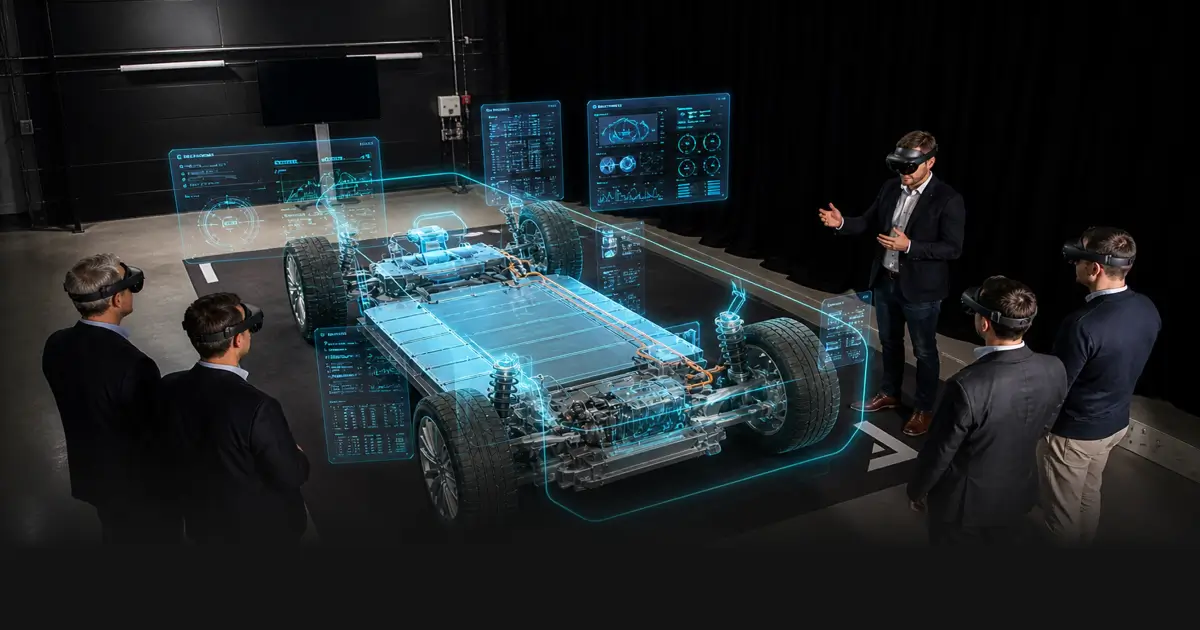
An immersive showroom design company addresses one of the most expensive problems in B2B sales: getting 5 to 16 decision makers to agree on a multi-million rupee purchase before the deal collapses under its own weight.

According to Gartner, 74% of B2B buyer teams experience unhealthy conflict during the decision process. Buying groups that reach consensus are 2.5 times more likely to report a high-quality deal outcome. The product is rarely the problem. Alignment is.

Let’s discuss how immersive showrooms resolve that alignment gap, why 3D virtual space walkthrough corporate environments are accelerating enterprise sales cycles, and what Indian B2B companies gain from investing in a structured corporate digital brand experience.

When the Deal Stalls, the Boardroom Is Usually to Blame

Gartner’s 2025 research on B2B buying groups shows buying committees now span 5 to 16 people across up to four business functions. Forrester’s State of Business Buying 2024 report puts the average number of stakeholders at 13, with 86% of purchases stalling due to internal complexity rather than vendor performance.

Here is what a typical enterprise purchase looks like in 2026:

  • 13 stakeholders on average, each with 4 to 5 pieces of independent research
  • Buying cycles cross IT, finance, operations, legal, compliance, and executive leadership
  • Buyers spend only 17% of their total purchasing time meeting with vendors (Gartner)
  • 54% of B2B decision makers say they would switch suppliers due to a poor omnichannel experience (McKinsey, 2024)

Every stakeholder enters the room with a different version of the product in their head. No one is working from the same reference point. That is where the conflict starts.

What an Immersive Showroom Actually Is (and What It Is Not)

An immersive showroom is a purpose-built digital or physical-digital space where B2B buyers explore a product, solution, or service through real-time, interactive experience.

It is not a product brochure. It is not a slide deck. It is not a recorded walkthrough video.

A well-designed immersive showroom includes:

  • Real-time 3D product or solution visualization
  • Configurable environments where buyers adjust specifications and see the impact immediately
  • Multi-user access so all stakeholders explore the same version simultaneously
  • Data capture on which features each stakeholder engaged with most
  • Guided narratives structured for different seniority levels and business functions

Working with an experienced immersive digital experience team, companies can build these environments across AR, VR, mixed reality, and web-based 3D platforms — without requiring buyers to own or install specialist hardware.

Why Stakeholders Cannot Agree on a PDF but Can Agree on an Experience

The Shared Reference Problem

Each stakeholder in a buying committee carries a different mental model. A CFO reads a financial summary. A CTO reviews a technical specification. An operations head studies an implementation timeline. None of them are looking at the same thing.

A corporate digital brand experience changes that dynamic. When every stakeholder moves through the same 3D virtual space walkthrough corporate environment, they build one shared reference point. Their conversations become more specific. Their objections are easier to resolve.

A PwC study found that VR-based product demonstrations led to a 40% acceleration in the decision-making process. Customers who engage with AR and VR experiences are 40% more likely to make a purchase than those who engage with traditional materials.

What Each Stakeholder Gets from an Immersive Showroom

  • CFO / Finance: Sees ROI through scenario-based simulations with real cost configurations
  • CTO / IT: Walks through integration architecture inside a live technical environment
  • Operations: Reviews workflow implications in a spatial simulation
  • Legal / Compliance: Accesses a documented environment with traceable configuration history
  • End Users: Tests the solution in a context that mirrors their actual working conditions
  • Executive Sponsor: Experiences the full brand narrative and long-term value in one environment

A 3D Virtual Space Walkthrough Corporate Buyers Can Actually Use

From Passive Viewing to Active Exploration

A 3D virtual space walkthrough corporate environment gives buyers agency. They explore rather than observe. This distinction matters when the purchase is complex and the stakes are measured in crores.

In sectors like manufacturing, infrastructure, real estate, and enterprise technology, the product is often too large, too technical, or too abstract to demonstrate in a conference room. A 3D walkthrough places the product inside a photorealistic environment that buyers can navigate, configure, and interrogate.

Capgemini research shows that VR-based virtual walkthroughs reduce site visit costs by up to 45%. For Indian enterprise buyers with decision-making teams spread across Mumbai, Delhi, Bengaluru, and Hyderabad, this is a material advantage.

How a 3D Virtual Walkthrough Fits into a B2B Sales Process

  1. Pre-meeting access: Stakeholders explore the environment before a formal presentation
  2. Guided demo: The sales team walks all stakeholders through the same experience at once
  3. Async review: Individual stakeholders revisit at their own pace and share observations
  4. Configuration session: The buying team adjusts specifications in real time
  5. Sign-off documentation: The final configuration is recorded and linked to commercial terms

This sequence compresses what previously required multiple rounds of meetings and revisions into a faster, more transparent process. The 3D immersive technology driving these environments has matured significantly; it now runs on standard enterprise hardware and standard internet connections.

The Corporate Digital Brand Experience Goes Beyond the Product Demo

An immersive showroom is also a corporate digital brand experience. It communicates what the company stands for and why it is a credible choice, alongside what the product does.

In a contested B2B evaluation, brand trust is the deciding factor when technical criteria are comparable. A corporate digital brand experience builds that trust before the formal evaluation begins, at every stakeholder level simultaneously.

Forrester reports that 65% of B2B buyers say in-person brand experience is very important in vendor selection. An immersive digital environment delivers that experience at scale. Deloitte research shows that emotionally engaged buyers are 3 times more likely to recommend and repurchase. The customer experience design principles that govern immersive showrooms are specifically structured to create that engagement consistently.

Why Indian B2B Companies Are Moving on This Now

India’s AR and VR market was valued at $4.84 billion in 2023 and is growing at a CAGR of 38.3% through 2032. The India VR market alone is projected to reach $3.95 billion by 2034.

EY India’s 2025 experiential marketing research confirms that immersive formats are becoming a strategic necessity for Indian brands, not a discretionary activation. The report identifies phygital engagement and immersive formats as direct responses to changing enterprise buyer expectations.

McKinsey data shows that 68% of Indian B2B decision makers believe omnichannel sales is more effective than previous models, one of the highest rates globally. This positions Indian enterprises as natural adopters of immersive showroom environments, which operate as the most integrated omnichannel sales tool available.

The combination of 5G rollout, over 2,000 active AR and VR startups, rising enterprise digital budgets, and distributed buying committees makes the business case for immersive showroom investment in India clear.

What to Look for in an Immersive Showroom Design Company

Before selecting an immersive showroom design company, evaluate the following:

  • Multi-platform capability: Can they build across VR, AR, mixed reality, and browser-based 3D environments?
  • B2B use case experience: Enterprise sales environments require different design logic than consumer AR
  • Stakeholder journey architecture: Does the experience address multiple roles and decision levels?
  • Data and analytics output: Does usage data feed back into the sales strategy?
  • India-relevant delivery: Does the team understand local infrastructure, connectivity, and enterprise culture?

An AI-powered digital experience capability within the showroom adds further value by personalizing the environment based on the stakeholder’s role, behavior, and engagement history.

ViitorX Has Built These Environments at National Scale

ViitorX is the digital experience studio built specifically to design immersive environments for complex B2B and enterprise audiences across India and globally.

The team built an interactive holographic masterplan for the Noida International Airport, designed to communicate a complex infrastructure vision to multiple stakeholder groups simultaneously. A second project delivered a cultural heritage holographic experience at the G20 summit in Khajuraho, combining spatial storytelling with technical precision for a high-visibility institutional audience.

These projects required the same capabilities that enterprise B2B immersive showrooms demand: multi-stakeholder navigation, real-time configuration, precise spatial representation, and a clear narrative that serves decision makers at different levels of technical depth.

ViitorX’s technology stack covers Meta Quest, Apple Vision Pro, Microsoft HoloLens, ARKit, ARCore, WebGL, and Three.js. The team supports the full delivery cycle, from experience strategy and spatial design to development, deployment, and post-launch analytics.

If your B2B sales cycle is stalling because stakeholders are working from different information, ViitorX builds the shared environment that moves them toward a decision.

Connect with our team to discuss your specific use case.

The B2B Consensus Problem Has a Design Solution

Multi-stakeholder B2B purchases stall when stakeholders carry different mental models into the same decision. An immersive showroom design company resolves this by creating a shared, navigable environment where every stakeholder sees, explores, and responds to the same information.

A 3D virtual space walkthrough corporate solution reduces internal friction, compresses decision timelines, and gives procurement teams a concrete shared reference for their final choice. A corporate digital brand experience builds the trust that moves consideration into commitment.

For Indian B2B companies operating in competitive, multi-geography, multi-stakeholder markets, the data, the technology, and the enterprise appetite are all aligned. The question is no longer whether to invest in immersive showroom design. The question is how quickly it can be deployed.

FAQs

What is an immersive showroom design company?

An immersive showroom design company builds interactive digital environments where B2B buyers explore products or services using AR, VR, or 3D visualization. These environments are structured to help multiple stakeholders engage with the same information at the same time, reducing misalignment and accelerating decisions.

How does a 3D virtual space walkthrough corporate solution help in B2B sales?

A 3D virtual space walkthrough corporate solution gives all members of a buying committee access to the same visual, interactive experience. It creates a shared frame of reference that reduces internal conflict. Research shows it can accelerate decision-making by up to 40%.

Why does a corporate digital brand experience matter for complex B2B purchases?

In a multi-stakeholder purchase, brand trust influences the final decision when technical criteria are comparable. A corporate digital brand experience communicates capabilities and differentiation in a consistent, scalable format that works for all stakeholders.

How is ViitorX positioned as an immersive showroom design company for Indian enterprises?

ViitorX has designed and delivered immersive environments for national infrastructure, government, and cultural institutions in India. The team builds enterprise-grade 3D experiences across AR, VR, mixed reality, and web platforms, with the technical depth and stakeholder design logic that complex B2B sales require.

Is immersive showroom technology viable for Indian B2B companies in 2026?

Yes. India’s AR and VR market is growing at 38.3% CAGR through 2032. With 5G rollout, high smartphone penetration, and rising enterprise digital budgets, the infrastructure for immersive showroom delivery is now available across major Indian cities.

Government Tourism Immersive Centre: Preserving the Past with LiDAR and VR

Government Tourism Immersive Centre: Preserving the Past with LiDAR and VR

A government tourism immersive centre provides a literal solution for managing high tourist traffic at fragile historical sites. Indian heritage sites face a direct conflict. The Ancient Monuments and Archaeological Sites and Remains (AMASR) Act strictly limits new construction near protected monuments.

Simultaneously, the Ministry of Tourism mandates an increase in global tourism footfall. State departments must accommodate thousands of daily visitors without physically altering or damaging ancient structures. Spatial technologies resolve this issue.

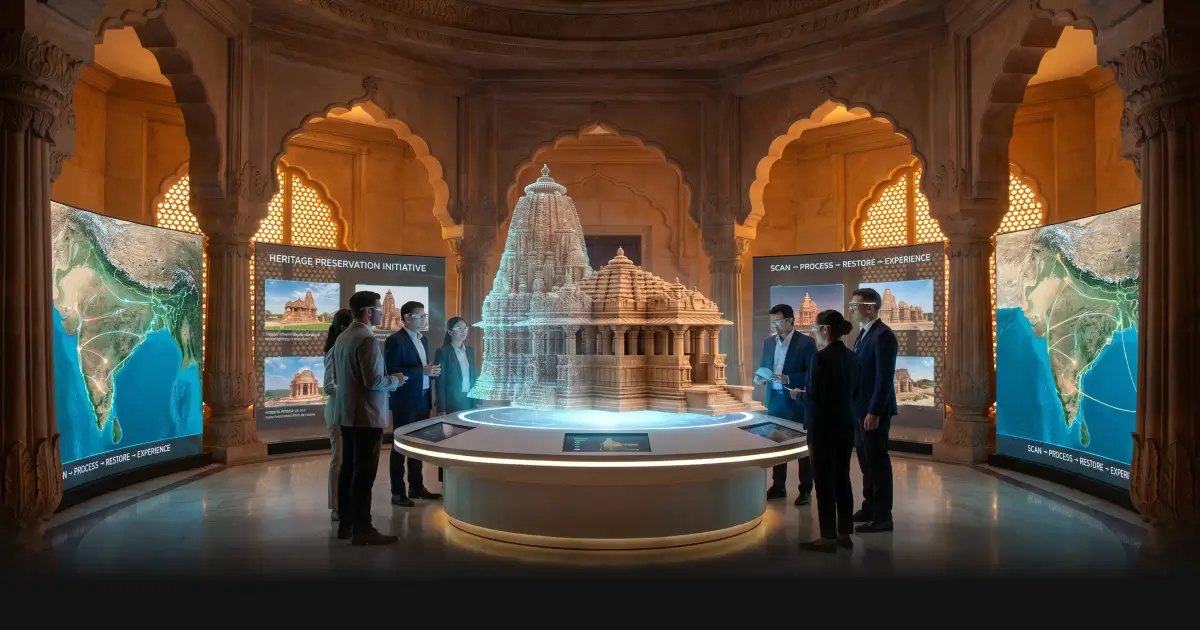
By utilizing Light Detection and Ranging (LiDAR) and Virtual Reality (VR), authorities build digital twins of these ruins. They construct the government tourism immersive centre outside the regulated physical zones. This approach diverts crowd pressure, preserves structural integrity, and delivers historical information accurately.

Why Does the AMASR Act Restrict Physical Tourism Expansion?

The AMASR Act categorizes land around protected monuments into specific zones to prevent structural decay from vibrations, pollution, and modern encroachment. The Archaeological Survey of India (ASI) monitors these boundaries strictly. State tourism boards cannot build modern visitor facilities, ticketing halls, or physical museums directly next to the ruins.

The table below outlines the specific restrictions enforced by the ASI around centrally protected monuments.

Zone Type Distance from Monument Permitted Activities Restricted Activities
Prohibited Area 0 to 100 meters Routine maintenance, essential ASI work No new construction, no heavy machinery
Regulated Area 100 to 200 meters Minor repairs to existing structures No large-scale commercial building, strict height limits

To comply with these rules, authorities must physically locate any new government tourism immersive centre beyond the 200-meter mark. This spatial separation requires a robust digital connection to the site so visitors still receive an engaging historical experience.

How Do LiDAR Scanners Document Heritage Sites Accurately?

LiDAR scanners emit laser pulses to measure exact distances between the sensor and the physical ruin. The system records millions of data points to generate a millimeter-accurate 3D point cloud of the structure. This process requires zero physical contact with the fragile monument.

  • Topographical mapping: LiDAR units mounted on drones capture the entire landscape, revealing buried structures without excavation.
  • Structural analysis: Ground-based LiDAR detects microscopic cracks and structural shifts over time.
  • Digital preservation: The 3D point clouds serve as permanent architectural records in case natural disasters damage the physical site.

Organizations utilize this geospatial data to monitor erosion. For instance, the Indian Space Research Organisation (ISRO) develops geospatial methodologies using LiDAR and satellite imagery for heritage documentation. Their data allows conservationists to track structural degradation accurately. The point cloud data also forms the foundational digital asset for any government tourism immersive centre. Developers convert the point cloud into optimized 3D meshes for interactive viewing.

What Are the Benefits of AR VR Heritage Site Interpretation?

Tourists expect detailed historical context when visiting monuments. Physical signboards often disrupt the visual aesthetics of the ruins and weather quickly. AR VR heritage site interpretation solves this problem by delivering information through digital devices.

In a government tourism immersive centre, visitors use VR headsets to walk through fully restored digital models of the monument. They observe the original paint, intact statues, and complete roofs that no longer exist in reality. The VR environment isolates the user, focusing their attention entirely on the historical timeline.

At the physical site, AR VR heritage site interpretation operates via augmented reality on smartphones or dedicated tablets.

How Does AR VR Heritage Site Interpretation Function?

  • Tourists point their device cameras at a ruined wall.
  • The AR software identifies the wall structure using spatial tracking.
  • The application superimposes a 3D reconstruction of the original wall onto the live camera feed.
  • Users tap digital markers on their screens to read literal translations of ancient inscriptions.

State departments invest in  to build these applications. This ensures tourists receive accurate educational content without requiring the installation of physical infrastructure near the monuments. A high-quality government tourism immersive centre relies entirely on this combination of on-site AR and off-site VR to manage visitor expectations.

Furthermore, AR VR heritage site interpretation allows museums to offer multilingual audio guides dynamically, adapting to the user’s selected language instantly. Proper AR VR heritage site interpretation scales easily, accommodating thousands of concurrent users through their personal mobile devices.

How Does Government Heritage VR Simulation Training Improve Staff Capacity?

Protecting ancient monuments requires highly trained personnel. The ASI and local tourism boards employ structural engineers, conservationists, and tour guides. Training these individuals on-site risks accidental damage to the fragile ruins. Government heritage VR simulation training provides a secure, digital environment for skill development.

Developers use the LiDAR data to program accurate physical physics and environmental conditions into a VR platform. Trainees wear VR headsets and use hand controllers to interact with the digital monument.

  • Disaster response: Staff practice emergency evacuation procedures for large crowds during simulated earthquakes or fires.
  • Conservation techniques: Archaeologists rehearse chemical cleaning methods on digital walls to observe simulated reactions before applying chemicals to real stone.
  • Crowd management: Guides learn how to route large tour groups through narrow ancient corridors to prevent bottlenecks.

Government heritage VR simulation training reduces the cost of logistical transport for trainees. State departments centralize the education process within a dedicated government tourism immersive centre. This ensures all staff meet consistent operational standards. The Press Information Bureau (PIB) frequently details how government ministries adopt modern spatial technologies to upskill their workforce and standardize operations. Utilizing government heritage VR simulation training allows authorities to evaluate trainee performance through exact digital analytics. The system tracks where trainees look, how quickly they respond to hazards, and whether they follow correct conservation protocols.

Repeated use of government heritage VR simulation training ensures high readiness levels without degrading the physical heritage site. Therefore, integrating government heritage VR simulation training into departmental workflows is a direct requirement for modern monument administration.

How Can ViitorX Assist in Building Your Digital Experience?

State tourism boards require technically proficient partners to develop these spatial tech implementations. ViitorX builds robust digital platforms for cultural preservation and visitor engagement. We develop the software systems that power a government tourism immersive centre.

Our teams specialize in converting heavy LiDAR datasets into optimized 3D models suitable for real-time mobile and VR rendering. We integrate these models into interactive platforms. For example, our developers build virtual reality and mixed reality solutions that allow multiple users to collaborate inside a 3D environment simultaneously.

ViitorX configures Geo-Dataset-based immersive platforms. We process topographical data and load georeferenced 3D models into multi-user environments. This exact capability supports both public-facing virtual tours and internal administration systems. Furthermore, we develop AI-powered interactive displays. Our teams build interfaces where users draw shapes on digital screens to search for matching historical artifacts within a museum database.

We deliver complete digital experience services. We handle UX design, 3D environment creation, and application deployment. State authorities rely on ViitorX to deploy precise AR VR heritage site interpretation applications that function efficiently on standard consumer hardware. We also program specific operational scenarios for administrative use, ensuring accurate skill development across all departments.

Conclusion

A government tourism immersive centre allows state authorities to handle increasing visitor numbers while obeying the AMASR Act. By utilizing LiDAR, organizations capture exact structural data without physical contact. They use this data to create accurate digital twins. On-site, AR VR heritage site interpretation provides tourists with immediate historical context through their smartphones, eliminating the need for physical signage. Off-site, these digital twins form the core of virtual museums and interactive exhibits.

Concurrently, administrative departments deploy government heritage VR simulation training to prepare their staff for conservation and crowd management duties safely. These spatial technologies provide direct, measurable methods to balance heritage preservation with national tourism objectives. State departments must adopt these digital tools to maintain the structural integrity of India’s historical monuments.

The ROI of a Corporate Brand Experience Centre: Moving Beyond Vanity Metrics to Pipeline Influence

A corporate brand experience centre is one of the most scrutinised capital expenditure proposals in any Indian enterprise boardroom. The investment is significant. The approval process is long. And the business case, when it is built on visitor counts and social media reports, often fails.

The problem is measurement. Teams present what is easy to collect. Footfall numbers, satisfaction scores, dwell time, and social impressions are visible. They are not the same as proof that the centre contributed to a deal, shortened a sales cycle, or helped retain a high-value client. That measurement gap is why many experience centre investments remain underfunded or unapproved year after year.

Here, we have discussed what corporate affairs brand centre ROI actually looks like when you measure what matters, and how to build a financial case that gets approved.

Indian Brands Are Spending More on Corporate Brand Experience Centres. Here Is What the Data Says.

The market signal in India is strong. According to an EY India 2025 report on experiential marketing, 78% of consumers prefer experiential interactions with brands, and 88% of Indian brands are already increasing their experiential marketing spending. India’s live events and experiential market stands at approximately INR 13,000 crore in 2025.

India is expected to register the highest compound annual growth rate among all countries in the immersive events and experiential marketing segment through 2030, in a global market projected to grow from $1.89 billion in 2024 to $9.29 billion by 2030.

For enterprises, this growth is not driven by aesthetics. It is driven by business outcomes. A corporate brand experience centre brings high-value clients, investors, government partners, and senior decision-makers into an environment where the company controls the quality of engagement.

The shift from passive sales presentations to active, immersive stakeholder engagement reduces objections, accelerates deal timelines, and gives enterprise sales teams a measurable advantage over competitors who rely on brochures and slide decks.

Why Most Experience Centre Investment Proposals Never Make It Past the Finance Committee

Finance leaders do not reject corporate brand experience centre proposals because they misunderstand the concept. They reject them because the ROI model is not written in financial language.

The most common errors in these proposals:

  • Visitor counts are cited without linking them to opportunities created
  • Post-visit satisfaction scores are used as the primary success metric
  • Social media impressions are presented as evidence of business impact
  • No attribution methodology is included to connect visits to CRM pipeline data

CMSWire research confirms that CX investments are now evaluated under the same capital logic as infrastructure and plant acquisitions. Boards require direct links between expenditure and revenue outcomes before approving funds. A proposal built on footfall data does not meet that standard.

Corporate affairs brand centre ROI needs to be expressed in deal pipeline terms. That is the language that secures approval.

What Gets Measured vs. What Actually Drives Pipeline

Vanity Metric Pipeline Metric
Total visitor count Visitor-to-opportunity conversion rate
Dwell time at exhibits Sales cycle length on centre-touched deals
Social shares and impressions Deal influence rate (CRM-attributed pipeline)
Post-visit satisfaction score Win rate: centre-engaged vs. non-engaged accounts
Number of tours completed Average deal size on centre-touched accounts

When a metric goes up, and no one can describe the next action it requires, it is a vanity metric. When a metric changes and the sales or finance team immediately knows what to respond with, it is a pipeline metric.

The Specific Numbers That Prove a Corporate Brand Experience Centre Pays Back

The evidence base is substantial.

A PwC study found that immersive product demonstrations, a core component of effective stakeholder experience centre design, led to a 40% acceleration in the decision-making process for B2B buyers. Capgemini research shows virtual site visit technology, commonly integrated into experience centre environments, can save businesses up to 45% of traditional site visit costs.

CSO Insights data shows that an average of 6.8 stakeholders are involved in a B2B purchase decision. A well-structured corporate brand experience centre brings multiple decision-makers into a single environment and aligns them through one shared experience. That alignment removes the back-and-forth communication that extends sales cycles.

Aberdeen Group research confirms that organisations with structured sales enablement environments are 96% more likely to achieve competitive success. Deals with three or more contacts engaged on the buyer side close at nearly double the rate of single-threaded deals.

Four Pipeline Metrics That Build a Board-Approved Business Case for Corporate Affairs Brand Centre ROI

A credible corporate affairs brand centre ROI case rests on four specific measurements:

  1. Pipeline influence rate: The percentage of closed-won deals in which a centre visit occurred during the evaluation phase
  2. Sales cycle compression: Average reduction in days-to-close for centre-touched opportunities compared to baseline figures
  3. Win rate differential: The difference in close rates between centre-engaged and non-engaged enterprise accounts
  4. Revenue attribution: Total closed-won value linked to centre visits within a defined reporting period

These four numbers give finance teams what they need to evaluate the centre against the same criteria applied to any other capital project.

How Stakeholder Experience Centre Design Determines Whether a Deal Closes

Stakeholder experience centre design is a commercial decision. Every design choice, from room layout to content sequencing to interactive data points, affects how efficiently the environment moves buying decisions forward.

Deloitte research found that organisations using AR and VR within stakeholder engagement environments saw a 30% reduction in the time required to move prospects through evaluation stages. Research published in the Journal of Business Research found that real-time AR customisation in B2B presentations led to a 25% faster decision-making process.

In practice, ViitorX’s immersive digital experience solutions have been deployed across enterprise stakeholder environments in India with measurable alignment outcomes.

The built for the Noida International Airport masterplan allowed senior stakeholders to engage with a full-scale spatial model without physical site visits. Stakeholder alignment on complex spatial decisions was achieved within a single session. The G20 Khajuraho Holographic Experience used an immersive environment to communicate detailed cultural heritage narratives to senior government delegates, reducing the time needed for decision alignment across a diverse group.

Effective stakeholder experience centre design creates structured pathways through which different decision-makers reach alignment faster. That outcome is directly measurable.

Three Steps to Connect Your Centre to Your Revenue Pipeline

Measurement must be configured before the centre opens, not added retrospectively.

1. Build the Attribution Layer in Your CRM from Day One

Every time a prospect or client visits the centre during an active opportunity, that visit should be logged against the CRM record. This creates the data foundation for pipeline influence reporting and makes corporate affairs brand centre ROI visible to finance stakeholders in a format they can verify.

2. Segment Centre-Touched Deals from Non-Touched Deals

Track sales cycle length, deal size, and close rate separately for centre-engaged and non-engaged accounts. The difference in those numbers is the direct evidence your board needs.

3. Report Quarterly with Closed-Won Attribution

Corporate Affairs Brand Centre’s ROI reported annually loses credibility because the data set is too narrow and too late. Quarterly reporting with closed-won attribution data builds consistent internal confidence in the investment.

ViitorX Designs Corporate Brand Experience Centres Built Around the Metrics That Matter

ViitorX, ViitorCloud’s dedicated creative studio for digital experience consulting, designs corporate brand experience centres with pipeline metrics built into the brief from the start.

Our work spans infrastructure, government, real estate, and culture sectors across India. Projects include AI-powered digital experience solutions deployed for enterprise clients where stakeholder alignment and decision acceleration are the primary objectives.

The Museum of Art and Photography interactive experience demonstrates how immersive interaction environments can be designed with defined engagement objectives and measurable interaction outputs, not just visual impact.

The stakeholder experience centre design process at ViitorX begins with identifying the stakeholder decisions the environment needs to accelerate and the CRM attribution framework that will prove value to your finance team. If your organisation is evaluating a corporate brand experience centre investment, the starting point is the business metrics the centre needs to move.

Connect with us at support@viitorx.com.

Conclusion

Corporate affairs brand centre ROI is provable. The evidence from PwC, Aberdeen, Deloitte, Capgemini, and CSO Insights confirms that structured stakeholder experience environments shorten sales cycles, improve win rates, and increase deal sizes.

The investment case becomes visible when you stop measuring impressions and start measuring pipeline influence. Define your four pipeline metrics before the centre opens. Set up CRM attribution from day one. Report to finance stakeholders every quarter with closed-won data.

A  corporate brand experience centre measured this way earns its capital expenditure approval and builds the internal case for continued investment. A centre measured by footfall and satisfaction scores remains a line item under review every financial year.

The most important decision is not the design. It is the measurement framework you choose before construction begins.

Welcome to ViitorX. This Is What We Are Here to Build.

Welcome to ViitorX.

There is a moment in every experience centre, every brand pavilion, every immersive installation, just before it opens to the public, where the team stands inside it quietly. The screens are live. The sensors are active. The spatial audio fills the room. And for a few minutes, before any visitor walks in, it belongs entirely to the people who built it.

We have stood in that moment many times over the past ten years. In museum galleries. In government heritage centres. At global brand activations. Inside VR simulations built for teams doing dangerous work in the real world.

Today, we are standing in a new one.

Fifteen Years of ViitorCloud. Ten Years of This Work.

ViitorCloud Technologies was founded fifteen years ago with a clear purpose, help organisations stay relevant in a world where technology moves faster than most businesses can keep up. Over time, one category of work kept growing, kept getting more complex, and kept demanding more dedicated attention.

Digital experience. Immersive spaces. Brand environments. Simulation-based learning. Interactive digital presences.

Ten years ago, we delivered our first immersive experience project. Since then, we have built interactive installations for museums and cultural institutions, created brand activations seen on global stages, delivered VR training simulations for high-risk industries, and built digital environments for brands that needed more than a standard web presence.

That decade of work is the foundation on which ViitorX is built.

Why a Separate Identity

We could have continued delivering this work under the ViitorCloud banner. In many ways, it would have been the simpler path.

But experience work is different. It has its own creative rhythm, its own client relationships, its own delivery model, and its own definition of success. A permanent gallery installation is not measured the same way as a software deployment is. A brand pavilion at a global expo is not scoped the same way as a cloud migration is.

ViitorX is not a separate office or a physical location. It is a dedicated business unit of ViitorCloud Technologies, with its own brand, its own identity, and its own focused practice.

This is the front door to that practice. The team behind it is the same team that has been delivering this work for ten years, now operating under a name that reflects exactly what they do.

What We Build

ViitorX works across four areas, each one shaped by real project experience rather than a service menu we invented.

We design and build immersive experience centres: Permanent spaces for museums, heritage sites, corporate brand centres, and cultural destinations. Spaces people travel to, remember, and return to.

We create event and brand experiences: Immersive moments for expos, product launches, and pavilions. The kind that get filmed, shared, and talked about long after the event ends.

We build simulation-based learning programmes: VR training that replaces physical training that is dangerous, expensive, or simply not working. Measurable, adaptive, and built for compliance teams as much as learners.

And we craft digital brand experiences: Websites, interactive campaigns, and online environments built with 3D, motion, and immersive storytelling that goes well beyond what a standard digital agency delivers.

The Clients We Build For

ViitorX serves clients for whom experience is not a nice-to-have. It is the product.

Museum directors commissioning permanent galleries that will run for years. Government tourism bodies building heritage interpretation centres for public audiences. Corporate affairs heads creating brand environments that carry the weight of the company’s identity. Event teams building brand moments on the world’s biggest stages.

These clients have long procurement timelines, multiple stakeholders, and outcomes that are visible to a lot of people. We understand how these projects are bought, approved, and measured. We build our entire engagement model around that reality.

Technology Earns Its Place Here

We have always believed this at ViitorCloud, and ViitorX carries the same conviction.

Projection mapping, generative AI, computer vision, spatial audio, VR simulations, these are tools. Powerful ones, but tools. They earn their place in a project when they serve the experience. When they do not, we leave them out.

At ViitorX, creative direction and technology decisions happen together from the start, not one handed off to the other. The outcome is always the point. The technology is always in service of it.

This Is the Beginning

Launching ViitorX as its own identity is a public commitment. It says: this is the work we stand for, delivered by people who have been doing it for ten years, now under a name that says exactly that.

We make the digital world tangible. And the physical world possible to experience before it exists.

If you are building a museum gallery, a brand centre, a government heritage site, a global event activation, or a digital presence that needs to actually feel like something, start a conversation with us.

Either way, you are in the right place.

ViitorX is a dedicated digital experience practice operating as a business unit of ViitorCloud Technologies, built on ten years of immersive and interactive experience delivery.