What Is Museum Design, and Why Does It Decide What Visitors Remember?
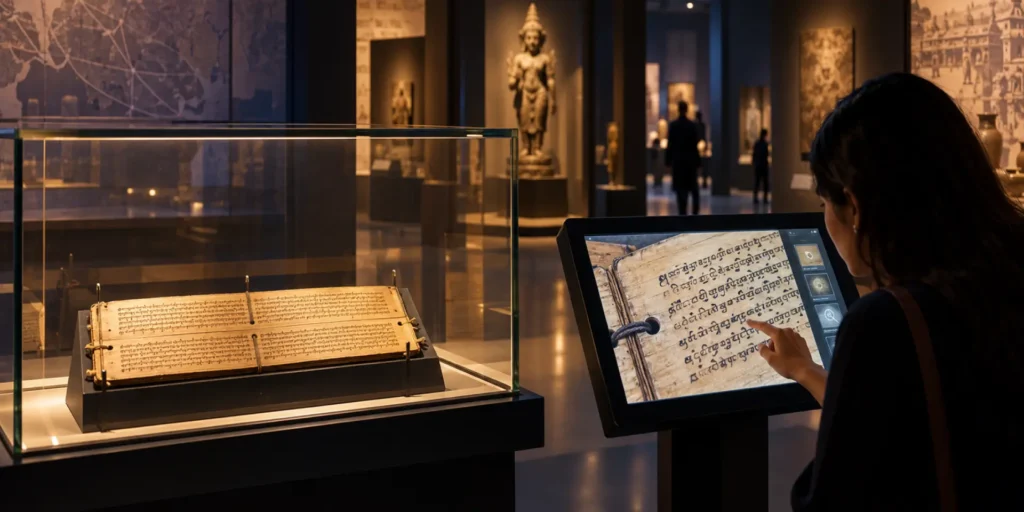
Museum design is the planning of everything a visitor sees, hears, touches, and does inside a gallery. It covers spatial layout, lighting, object placement, label writing, and the digital layer that now runs through modern museum exhibition design. Architecture gives a museum its shell. Museum design gives it a voice.
The discipline has three connected layers:
- Gallery design shapes movement, sightlines, pacing, and object display inside each room.
- Museum exhibition design turns a curatorial idea into a physical story told across zones.
- Museum experience design plans the full visit, from arrival to the moment a visitor tells a friend about it.
The projects that succeed treat these three layers as one system. The ones that struggle treat them as separate contracts.
Why Visitors Forget Most Galleries Within a Week
Museum fatigue is one of the oldest findings in visitor research. It was first described in 1916, and recent research on museum fatigue confirms that attention, engagement, and satisfaction decline steadily as a visit progresses. Visitors become selective. They skip labels, walk faster, and stop reading well before the final room.
Passive viewing speeds this up. A case, an object, and a two hundred word label demand effort and give nothing back. Across our projects, the pattern repeats: attention survives where visitors act, and it collapses where they only observe. Memory follows attention. This is the exact problem museum design exists to solve.
Five Principles of Gallery Design That Hold Attention
We apply these five principles on every gallery design brief. They come from our own project data, and they hold across art, history, and science collections.
Give Each Zone One Story
A gallery that tries to say ten things says nothing. Write one sentence per zone that a twelve year old could repeat. Every object, label, and screen in that zone must serve that sentence.
Let Visitors Do Something
Participation creates memory. At MAP, we rebuilt a traditional lamp lighting ritual as a shared digital ceremony that guests join from their own phones. More than 15,000 lamps have been lit so far, and an opening night moment earned a permanent place on the museum floor.
Pace the Visit
Attention needs recovery points. Alternate dense zones with open ones. Place seating with clear sightlines to key objects. A rested visitor reads more and stays longer.
Keep the Object at the Centre
Technology earns its place when it explains the artefact. Screens that compete with the collection weaken it. Our rule on every project: the digital layer interprets, and the object performs.
Design for Every Visitor
Good museum design works for children, elders, wheelchair users, and first time visitors at the same time. The Smithsonian Guidelines for Accessible Exhibition Design set clear standards for label contrast, viewing heights, circulation, and seating. We treat them as a minimum standard on every gallery we plan.
Inside the Museum Exhibition Design Process: Six Phases From Brief to Opening Day
Museum exhibition design follows a sequence. The table below shows the six phases we use, the question each phase answers, and the decision a museum director must take before the next phase begins.
| Phase | Core Question | Key Output | Director’s Decision |
| Discovery and brief | Who is the visitor and what should they remember? | Vision note, audience profile, budget range | Approve the one line story |
| Concept design | How does the story live in space? | Zone plan, mood boards, early visuals | Lock the narrative and zones |
| Design development | What exactly gets built? | Drawings, content plan, technology specification | Freeze scope and budget |
| Fabrication and build | Who builds it, and to what standard? | Prototypes, production, quality checks | Sign off the prototypes |
| Installation and testing | Does everything work in the real space? | Installed gallery, calibrated media, trial walkthroughs | Approve the soft opening |
| Evaluation and refresh | What does visitor data say? | Dwell time reports, feedback, update plan | Fund the first refresh |
Two phases decide most museum design outcomes. Discovery, because a weak brief cannot produce a strong gallery. Evaluation, because a gallery is never finished on opening day. Our own process begins with visitor journey planning and zone by zone story design, and we open the technology conversation only after the story is fixed.
Timelines run shorter than most boards expect. A focused gallery refresh takes four to six months. A full permanent exhibition usually takes twelve to twenty four months.
Where Technology Fits in Museum Experience Design
Museum experience design treats technology as an interpretation tool. In modern museum design, the useful question is never which screen to buy. The useful question is which part of the story a visitor cannot grasp from the object alone.
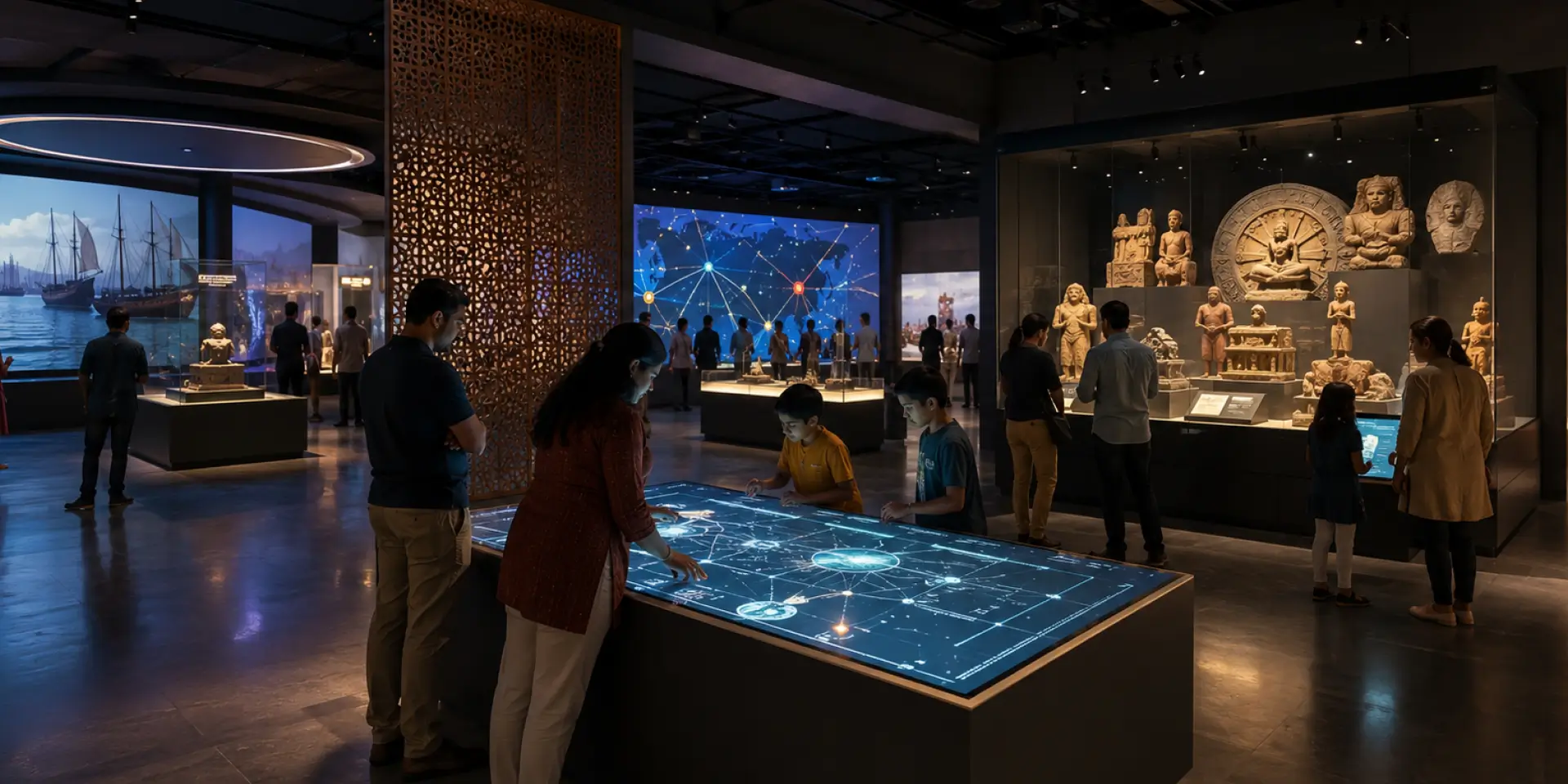
We tested this at CSMVS, where the Networks of the Past exhibition brought together more than 250 artefacts from 14 museums across six countries. We delivered four interactive installations for the exhibition: a Rosetta Stone digital twin, an LED trade route table, a dual screen display tracing Harappan materials, and a digital feedback station. Visitors spent measurably more time at these touchpoints, and younger audiences explored ancient history at their own pace.
Strong museum experience design also removes friction. No app downloads. No instructions longer than one line. No dead screens on a Tuesday morning. If your team is weighing a wider digital strategy, our guide on what a digital museum is explains how the digital layer and the physical collection support each other.
How to Measure Whether Your Gallery Design Works
Opinion settles arguments slowly. Data settles them fast. We instrument every gallery design we deliver and track four numbers:
- Dwell time per zone, which shows where attention holds and where it drops.
- Interaction rate, the share of visitors who touch, tap, or join an installation.
- Completion rate, the share of visitors who reach the final zone.
- Structured feedback, captured digitally instead of on paper forms.
At CSMVS, a multilingual feedback station replaced paper forms and gave curators real time visitor data for the first time. Numbers like these turn museum experience design into a management decision rather than a matter of taste.
Planning a New Gallery? Start With the Checklist We Use
We have condensed this guide into a gallery design checklist that covers brief writing, zone planning, technology selection, and measurement. We share it with museum directors and heritage trust heads who are scoping a museum design project.
The advice in it comes from delivery, and our record backs it: more than 100 projects over ten years, a 92 percent client satisfaction rate, interactive galleries at CSMVS, and a participatory installation at MAP that visitors made permanent. If a new gallery or a refresh sits on your roadmap, send us a short note about your collection, and we will send the checklist with an honest read on what your space needs.
The Bottom Line on Museum Design
Museum design succeeds when a visitor leaves with a story they can retell. That outcome can be engineered: one story per zone, participation over passive viewing, deliberate pacing, objects at the centre, access for everyone, and measurement after opening. Museums across the region are opening new galleries at a pace the sector has rarely seen. The galleries people will still talk about in ten years are being designed for memory from day one. That is the standard modern museum design has to meet.
Frequently Asked Questions
What is the difference between museum exhibition design and museum experience design?
Museum exhibition design plans the physical narrative inside a gallery: zones, objects, labels, and media. Museum experience design plans the entire visit, including arrival, wayfinding, participation, and follow up. Exhibition design sits inside experience design.
How long does a museum design project take?
A focused museum design refresh typically takes four to six months. A full permanent exhibition takes twelve to twenty four months, depending on collection size, approvals, and fabrication.
What does gallery design cost?
Cost depends on floor area, fabrication quality, and the depth of the digital layer. A phased plan spreads the investment and lets visitor data guide each next step.
Do interactive exhibits distract visitors from the artefacts?
They distract when they compete with the object. Installations built to interpret an artefact increase the time visitors spend with it, which is what we measured at CSMVS across a collection of more than 250 artefacts.