DMS, a Mining Simulator That Puts Students in Charge of an Entire Mine
Where education meets mining. A browser-based simulation that turns the full mine lifecycle, from surface survey to the sale of ore, into decisions a student has to make and then pay for.
Project Overview
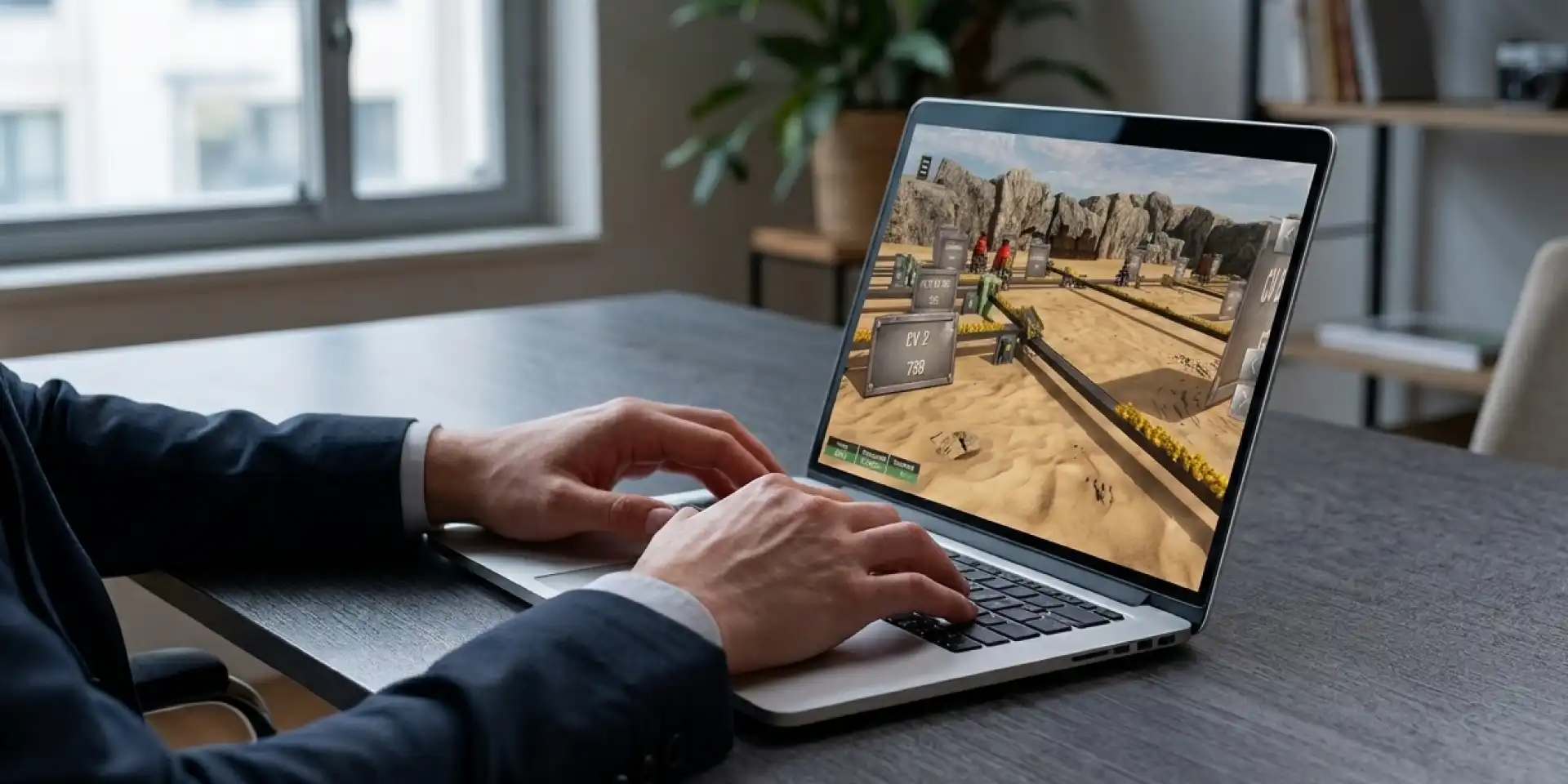
Mining education has a structural problem: the thing students most need to understand is not a single task but the way an entire operation hangs together, and no classroom can show them that. ViitorX built DMS, the Digital Mining Simulator, to put a whole mine in a student’s hands. It runs in a browser behind a login, presents the deposit as a cross-section you dig into, and asks the learner to survey the ground, estimate what is in it, buy the equipment to get it out, process it and sell it. Every machine carries a real capacity, a capital cost and an operating cost, so a decision that looks clever in isolation can still ruin the balance sheet. The strapline on the login screen is the whole idea in four words: where education meets mining.
Objective
The brief was to teach mining as a connected system rather than a syllabus of separate topics. DMS had to:
- Turn traditional mining education into an immersive learning experience built on real-world operations rather than diagrams.
- Make the economics inseparable from the engineering, so students feel the cost of a choice as well as its output.
- Hold to industry accuracy, developed with mining experts so that scenarios reflect genuine practice.
- Adapt to different curriculums and industry training needs across institutions.
- Give instructors data on student decisions and progress, not just completion.
Challenges
A mine is a chain of dependent decisions, which is exactly what makes it hard to teach and hard to model:
- The subject is a system, so a simulation that models one task well and the rest badly teaches the wrong lesson.
- Equipment economics have to be credible to a mining engineer while staying legible to a first-year student.
- Exploration involves genuine uncertainty. Students need to act on incomplete grade data, as they would in practice.
- It had to run on ordinary institutional computers, since a headset for every student is not a realistic ask for most colleges.
Solutions
We built DMS as a single connected loop, with the economics visible at every step:
- Surface exploration and resource estimation: The learner starts above ground in a survey mode, works the terrain and runs an Estimate Resources pass. Grades come back as high, medium and low readings rather than certainties, so the first real decision is made on imperfect information.
- A mine you dig in cross-section: The deposit is presented as a cut-away face. As the student excavates, different ore bodies are exposed at different depths, which makes the relationship between overburden, depth and yield something they see rather than something they are told.
- An equipment shop built on capex, opex and capacity: Seven categories, each with three tiers: exploration drilling, blast hole drilling, loaders, trucks, crushers, processing plants and stockpiles. Every item lists its capacity in tons alongside its capital and operating cost, so upgrading is a trade-off rather than a reward.
- Real machines, named: The fleet is drawn from the mining technology students will actually meet on site, including Epiroc Pit Viper, Boomer and Simba drill rigs, CAT 966 loaders and CAT 777 trucks, Volvo haulers, John Deere and Tata Hitachi loaders, and Sandvik LH202 and TH545i units. Processing runs through a heap leaching plant, a flotation plant and an integrated smelter.
- A full value chain, ending in a sale: Ore is loaded, hauled, stockpiled, crushed, processed and sold at a live price. Because revenue only arrives at the end of that chain, students learn why a bottleneck anywhere in it is a financial problem, not just an operational one.
- Progressive unlocking and accounts: Better equipment is gated behind earlier purchases, which paces the learning curve. Each student works behind their own login, which is what makes progress analytics possible for the institution.
Why a Management Simulator Beats a Procedure Trainer
Most mining simulation is built to rehearse a single procedure, and it is good at that. The gap it leaves is judgement. A graduate who can operate a rig but cannot say whether the mine should have bought it is only half-trained, and that second half is what employers interview for. DMS closes it by making every engineering decision cost something: capital that could have gone elsewhere, operating expense that eats the margin, capacity that becomes the bottleneck three steps later. Because it runs on a normal computer, an institution can put a full cohort through it in a scheduled lab rather than queuing students for one headset, and because every session sits behind a login, the department can see who is reasoning well and who is guessing.
Results & Impact
- Delivered DMS, a browser-based mining simulator covering the full lifecycle from surface exploration to the sale of processed ore.
- Modelled seven equipment categories across three tiers each, every item carrying capacity in tons plus capital and operating cost.
- Built the fleet and plant list around real industry equipment, from Epiroc drill rigs and CAT haulage to heap leaching, flotation and smelting.
- Made exploration a decision under uncertainty, with high, medium and low grade readings and an explicit resource estimation step.
- Tied engineering choices to a running cash position, so students experience mining economics rather than reading about them.
- Developed with mining experts for industry accuracy, and adaptable to different curriculums and technical training needs.
- Runs on ordinary institutional hardware with per-student logins, giving departments progress analytics without buying headsets.
Conclusion
A mine is a business that happens to involve rock. DMS is built on that premise, and it is why the simulator asks students to invest, extract and sell rather than simply to operate. ViitorX designed it so that a mining department can teach the whole system in a computer lab, with the trade-offs visible and the consequences immediate. It is simulation training aimed at the judgement employers actually hire for, and it makes that judgement something a student can practise long before anyone hands them a budget.