What Is VR Training?
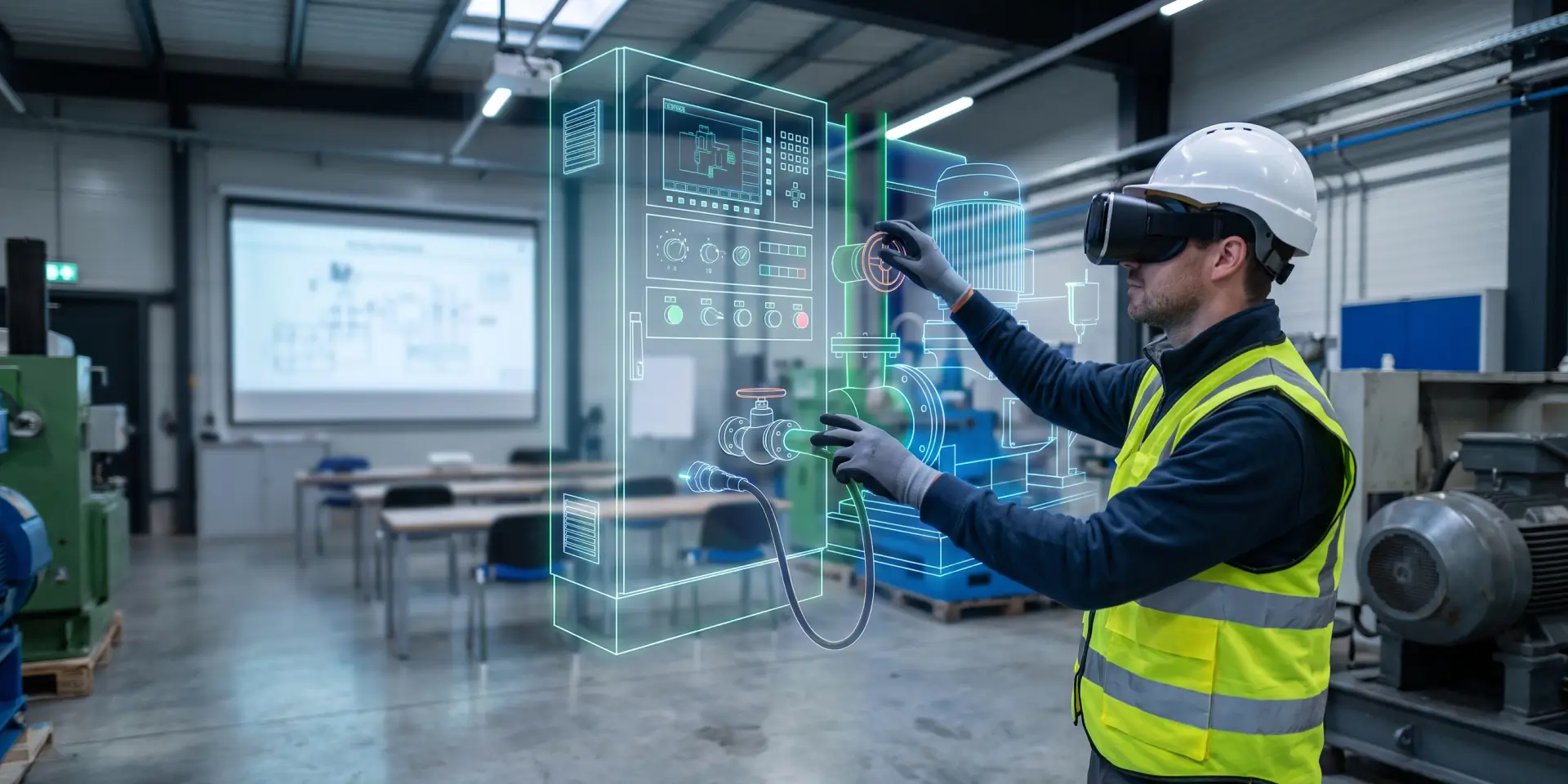
Virtual reality training is a method of building skills inside a computer-generated environment that a person enters through a headset. The environment reacts to the learner’s movements and choices, so the practice feels close to the real task.
Three features separate VR training from a video or a slide deck:
- The learner acts. They reach, turn, connect, and operate, instead of watching.
- The scene reacts. A wrong step produces a visible, immediate consequence.
- The task repeats on demand, with no cost for each attempt.
VR sits at the deep end of a wider set of immersive experiences, which run from simple on-screen 3D up to full headset immersion. The deeper the immersion, the more the brain treats the practice as real, and the better the skill holds. This is the basis of effective immersive learning.
Why VR Training Beats a Classroom Session
People forget most of what they hear in a lecture. They remember what they do. Immersive training works because it converts instruction into action, and action builds lasting memory.
The evidence is clear. A widely cited PwC study found that people trained with virtual reality training finished up to four times faster than in a classroom and were 275% more confident applying the skill afterward. Retention runs far higher than with passive methods because the learner practises the movement, not only the theory.
For industrial work, the confidence result matters most. A worker who has rehearsed an emergency shutdown many times in a headset reacts faster and makes fewer errors when a real fault appears. This is why recall stays strong months later. That transfer of skill to the job is the core promise of immersive learning.
Where Industrial VR Pays Off on the Plant Floor
Industrial VR is strongest where the cost of an error is high and hands-on practice is hard to stage. The common uses of immersive training in heavy industry are practical and easy to justify.
- Safety and compliance. VR safety training covers lockout/tagout, confined-space entry, fire response, and work at height. Learners run the correct sequence and see what happens if they skip a step.
- Machine operation and maintenance. Operators learn controls, startup, and shutdown on a virtual copy of a machine before they touch the real one.
- Emergency drills. Teams rehearse evacuations, spill response, and rescue without staging a live event.
- Onboarding and induction. New hires walk a virtual site and learn its layout, hazards, and procedures from day one.
A peer-reviewed review of VR safety training across high-risk engineering industries reported higher knowledge scores for VR groups than for groups taught by traditional methods.
We see the same pattern across our own projects. Physical, repeatable, high-stakes tasks gain the most from industrial VR, and the workforce reaches competence sooner.
The Money Question: Does VR Training Pay Off?
Senior teams ask a fair question. Does the return justify the cost? For the right use case, it does, and the calculation is simple. Two returns matter, one direct and one that appears in fewer incidents.
The same PwC research found that a VR programme reaches cost parity with classroom training at around 375 learners, then drops to roughly half the cost at larger scale. The direct savings come from cutting travel, equipment wear, downtime, and repeated sessions.
The second return is harder to see on a spreadsheet and higher in value:
- Fewer incidents, which lowers injury cost and lost time.
- Faster competence, so new staff reach productive work sooner.
- Consistent standards, since every learner runs the same scenario at every site.
A single prevented incident often covers the cost of a full VR training simulation programme. This is why many safety and operations heads treat industrial VR as risk reduction rather than a simple training expense.
What a Strong VR Training Simulation Includes
A VR training simulation works only when it is built around the real task and measured properly. Strong immersive training comes down to three parts, which we apply in every build.
Content that matches the real site
The simulation uses the actual layout, equipment, and procedures. Real footage and accurate 3D models keep it credible for experienced workers who know the job.
Learning design that scores competence
Scenarios start simple and grow harder. The system records each action and produces a competency score, so trainers can see who is ready and who needs more practice.
Integration and reporting
The programme connects to the company LMS, tracks completion, and produces compliance reports. Managers get data instead of guesswork. This is the standard we apply in our simulation-based learning work.
A large workforce also needs language options, so each VR training simulation can ship in more than one language and let every worker train in the language they know best.
When VR Training Is Worth It, and When It Is Not
VR training is a tool for specific problems. It is not the right choice for every task, and being honest about that helps teams spend well.
Choose VR training when:
- The task is physical and improves with hands-on repetition.
- The real task is dangerous, costly, or rare.
- You need many people trained to the same standard.
Stay with simpler methods when:
- The content is pure knowledge, such as a policy update, where e-learning costs less.
- You have very few learners and a low-risk task.
- The procedure changes so often that a simulation would date quickly.
Matching the method to the task is what turns immersive training into a sound investment.
Proof From the Plant Floor
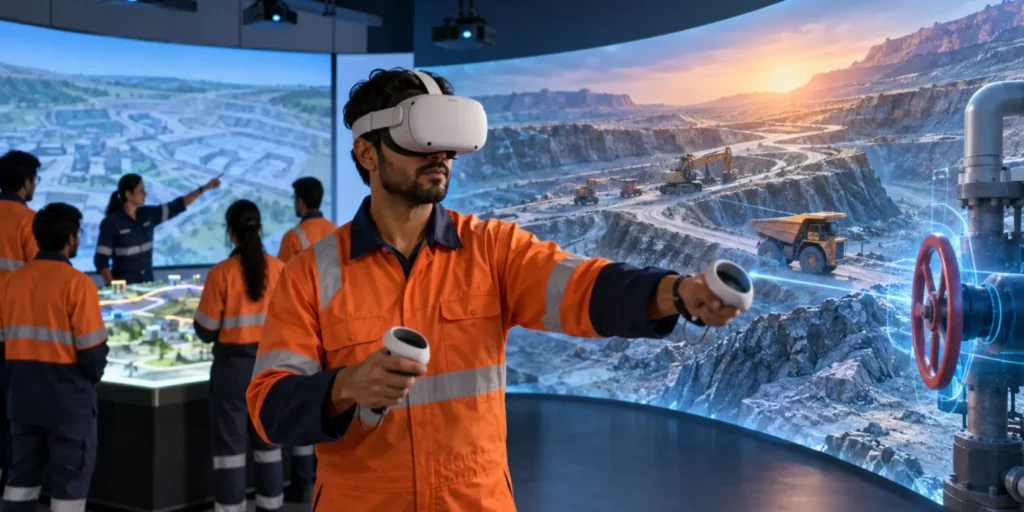
We build immersive training for high-risk industrial work, and our numbers come from live deployments. For the Adani Centre of Excellence at IIT-ISM Dhanbad, we built a virtual reality training environment for the Adani Centre of Excellence where students practised drilling, blasting, and excavation without any access to a live mine.
The programme ran on Meta Quest 3, used real mine footage, and shipped in both Hindi and English. It delivered 100% safe operations training with zero live-site exposure, inside a single facility that also housed two further immersive systems.
That work sits within a record of more than 100 projects delivered over ten-plus years, at a 96% success rate. The same method carries across our wider body of work in immersive and industrial VR.
Teams planning a programme can share a project brief and get a direct, practical view of what will and will not work for their site.
The Bottom Line for Industrial Teams
VR training gives industrial teams a safe, scalable way to build dangerous, costly, or rare skills. The technology is proven, the return is measurable, and the method now fits inside a normal training budget.
Start with one high-value use case, such as a critical safety procedure. Measure the result against your current method. Then scale what works. Teams that start now run safer, faster, and more consistent operations while others still rely on manuals and classroom slides.
FAQs
What is VR training in simple terms?
VR training is learning by doing a task inside a realistic digital environment worn through a headset. The learner practises real actions, sees the results, and repeats until the skill becomes automatic.
How is VR training used in industry?
Industrial teams use VR training for safety drills, machine operation, maintenance, emergency response, and onboarding. It suits any task that is dangerous, costly, or hard to practise on real equipment.
Does virtual reality training actually work?
Yes. Research, including a PwC study, shows that learners train faster, retain more, and feel far more confident after virtual reality training than after classroom or e-learning sessions.
What does a VR training simulation cost?
A VR training simulation reaches cost parity with classroom training at a few hundred learners and falls well below it at scale. The savings grow as more staff use the same programme.
Is VR safety training better than traditional safety training?
For hands-on procedures, yes. VR safety training lets workers practise high-risk steps repeatedly with no real danger, which improves both recall and response under pressure.